Americas Market Update 4 Feb
Bunker fuel prices have moved upwards, and adverse weather conditions may cause delays at Freeport in the Bahamas.
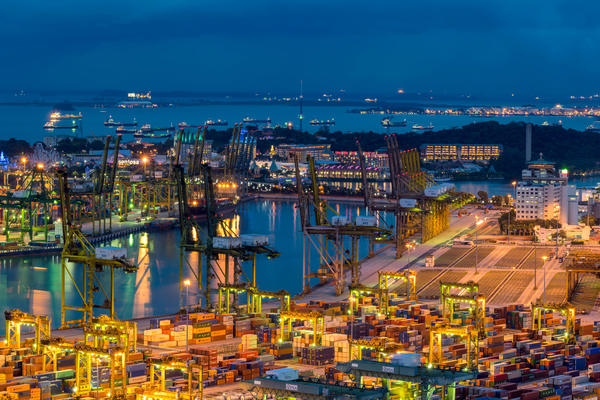
 IMAGE: Heavy industrial rigs at a shipyard near Houston, Texas. Getty Images.
Changes on the day to 07.00 CST (13.00 GMT) today:
- VLSFO prices up in Zona Comun ($14/mt), Balboa ($12/mt), Houston and New York ($8/mt)
- LSMGO prices up in Balboa ($13/mt), Los Angeles ($10/mt) and Zona Comun ($1/mt), and unchanged in Houston
- HSFO prices up in Balboa ($14/mt), Los Angeles ($6/mt), Houston ($4/mt) and New York ($3/mt)
Barring Houston's LSMGO price, fuel grades across all other ports have recorded increases in the past day.
Houston's LSMGO is currently trading at discounts of $177/mt to Beaumont, $93/mt to the Galveston Offshore Lightering Area (GOLA) and $73/mt to Port Arthur, making Houston a preferable location to bunker the grade.
Advised lead times at Houston for all three conventional fuel grades remains at 6–10 days this week. Additional delays may be expected, if visibility conditions at the port deteriorate, due to the ongoing fog season, a source said.
At Bahamas’ Freeport, possible delays to anchorage deliveries are expected between 5–8 February due to high wind gusts, a source said. Operations are currently ongoing.
In Balboa, the port’s Hi5 spread has widened to $70/mt today, from $52/mt on 4 January.
HSFO availability is tight at the port and requires lead times of 6–9 days this week. VLSFO availability is meanwhile better and requires between 5–7 days.
Brent
The front-month ICE Brent contract has gained by $0.90/bbl on the day, to trade at $67.50/bbl at 07.00 CST (13.00 GMT) today.
Upward pressure:
Brent futures have moved higher after the US shot down an Iranian drone and armed Iranian boats approached a US-flagged vessel in the Strait of Hormuz, reviving concerns over a possible escalation in tensions between Washington and Tehran.
“The market is back to pricing in the risk of a US-Iran military confrontation after two maritime encounters on Tuesday,” said Vandana Hari, founder of VANDA Insights.
“Crude oil gained… amid renewed geopolitical tensions,” Daniel Hynes, senior commodity strategist at ANZ Bank, echoed.
Additional support came from industry data pointing to a sharp decline in US crude inventories. US crude oil stocks fell by 11.1 million barrels in the week ending 30 January, according to American Petroleum Institute (API) estimates cited by Trading Economics.
Falling crude inventories are generally seen as a signal of stronger demand and can underpin Brent prices.
“The oil market got another boost from a bullish inventory report from the American Petroleum Institute,” two analysts from ING Bank said.
Furthermore, a trade agreement between the US and India has lifted expectations of stronger global energy demand.
“Prices were also supported by reports that as part of the US India trade deal, the US would roll back tariffs in return for an agreement that India would stop buying Russian oil,” ANZ Bank’s Daniel Hynes noted.
Downward pressure:
Meanwhile, the US government is preparing to issue, as early as this week, a general license that would allow companies to produce oil and gas in Venezuela, in a bid to encourage higher output from the OPEC member, Reuters reported citing sources.
The license, to be issued by the Treasury Department’s Office of Foreign Assets Control, would permit companies to explore for and produce crude oil and natural gas, the report added. This prospect has weighed on Brent futures.
Additionally, crude oil production in the US has reportedly recovered following recent storm-related disruptions. By Monday, only about 100,000 b/d of US crude output remained shut, after extreme weather last month had cut supplies, with outages peaking at around 2 million b/d on 24 January, according to Reuters.
The easing of these disruptions has further contributed to downward pressure on oil prices.
By Gautamee Hazarika and Tuhin Roy
Please get in touch with comments or additional info to news@engine.online