Australia’s emissions plan charts course for shipping’s fuel switch
Australia has laid out a plan to build demand and supply for low- and zero-emission bunker fuels and expand bunkering infrastructure as it looks to align its shipping sector with the IMO's 2050 net-zero ambition.
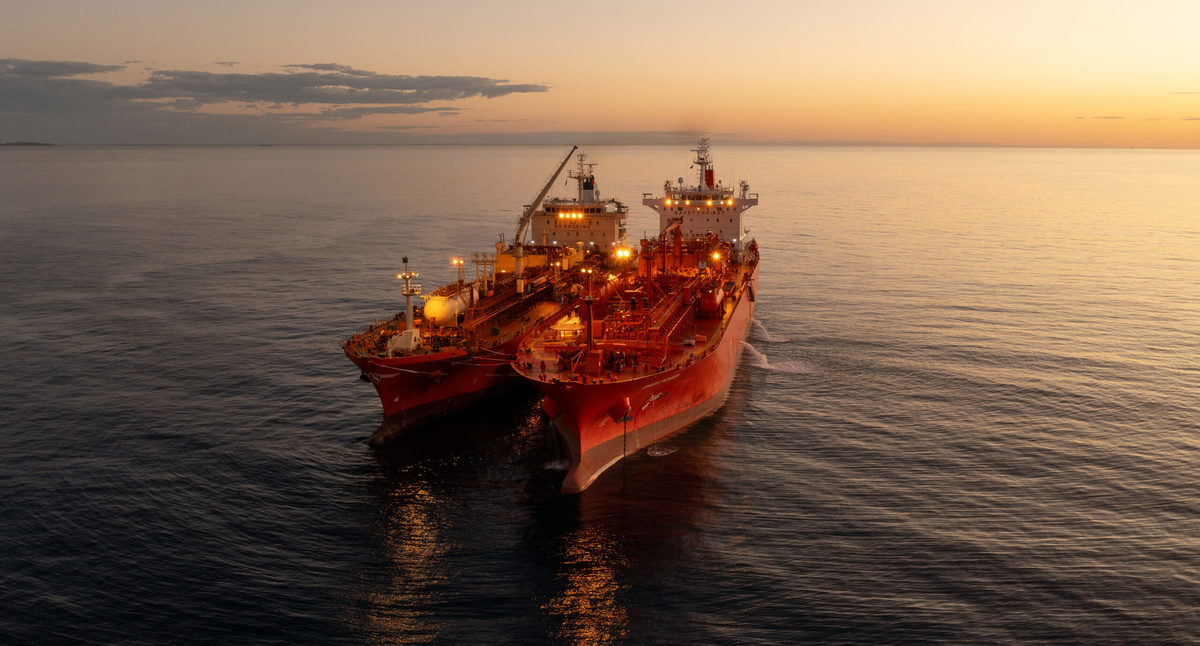 IMAGE: STS ammonia transfer between Navigator Global and the Green Pioneer at the outer anchorage of Port Dampier in Australia. Yara Clean Ammonia
The Australian government has released its Maritime Emissions Reduction National Action Plan (MERNAP), setting out five areas for action covering cleaner fuels, ports, research, regulation and green shipping corridors.
A major focus is getting low- and zero-emission fuels from production into ships.
The plan proposes encouraging their use in shipping while supporting domestic fuel production through existing programmes, including the AUD 1.5 billion ($1.08 billion) Future Made in Australia Innovation Fund.
The voluntary Guarantee of Origin scheme could support this by providing a way to track and certify how fuels are produced and their emissions intensity.
MERNAP also proposes reviewing existing funding programmes to identify where they could support the maritime sector. This work would feed into Australia's green fuel bunkering strategy, which has already received AUD 4 million ($2.9 million) in government funding.
The plan also calls for investment in low-carbon fuel storage and bunkering facilities, shore power and greater energy capacity at Australian ports.
Another focus is squeezing emissions out of existing shipping operations while cleaner fuels become more widely available.
The government has allocated AUD 51.7 million ($37.2 million) to develop a Maritime Single Window, which would create a single digital system for ships to submit information required when calling at Australian ports. MERNAP also proposes assessing potential emissions savings from more efficient vessel arrivals, including reducing the time ships spend waiting outside ports.
These relatively low-cost changes could deliver emissions reductions while cleaner marine fuels and the infrastructure to supply them are still scaling up, MERNAP argued.
The plan suggests smaller regional operators, including fishing and tourism companies, to combine their low- and zero-emission fuel and technology requirements. Pooling demand from multiple buyers can give fuel suppliers and infrastructure developers a stronger reason to invest, particularly in remote regions.
MERNAP also aims to ease regulatory and financial burdens for early adopters and first movers. It recommends working with the Australian Maritime Safety Authority (AMSA) to identify whether existing rules create unnecessary hurdles for new vessel technologies and where those barriers could be reduced.
The plan recommends working with the Clean Energy Finance Corporation, Australian Renewable Energy Agency and other bodies to support the development of green bunker fuels and energy-saving technologies.
Several existing funding programmes could support the transition. Australia has committed AUD 1.1 billion ($792 million) to its Cleaner Fuels Program and AUD 250 million ($180 million) through the Future Made in Australia Innovation Fund. Its Hydrogen Headstart programme can provide up to AUD 2.25 billion ($1.62 billion) to large-scale renewable hydrogen projects.
Another AUD 20 million ($14.4 million) has been committed to joint Australia-Singapore initiatives for low-emission maritime and port technologies.
MERNAP also proposes continued Australian involvement in the IMO negotiations over global shipping regulation and net-zero framework.
The IMO will discuss proposals around the Net-Zero Framework during the intersessional Working Group on Reduction of Greenhouse Gas Emissions from Ships (ISWG-GHG) meetings scheduled for September and November, before delegates consider the framework at MEPC 85 from 30 November to 3 December.
If member states agree on a final text, the amendments could then be formally adopted at the second extraordinary session of the MEPC (MEPC ES.2). This session was adjourned in October 2025 and is expected to reconvene on 4 December.
By Konica Bhatt
Please get in touch with comments or additional info to news@engine.online