B100 bunkering picks up in Rotterdam in 2026 – ENGINE data
The number of B100 samples ENGINE recorded in Rotterdam more than doubled in the first eight months of 2026 from a year earlier, lifting its share of the port's biofuel samples to almost a quarter.
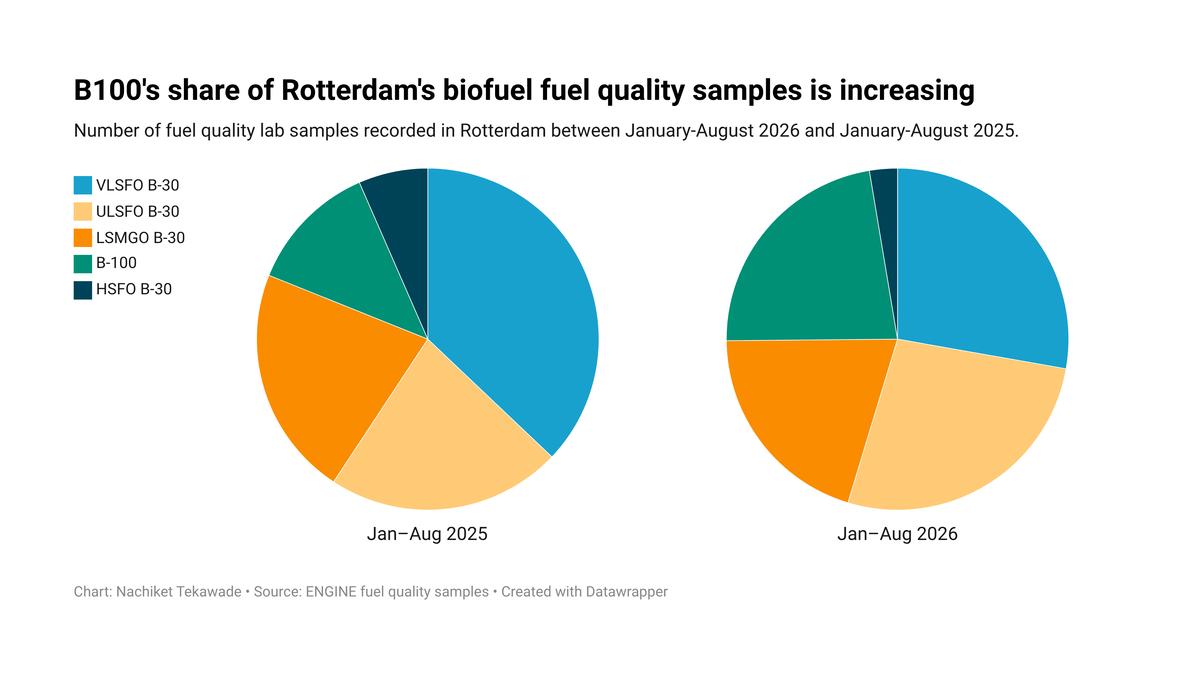
ENGINE recorded 77 B100 fuel quality samples in Rotterdam between January and August, up 126% from 34 in the same period last year.
In total, ENGINE had data for 342 biofuel samples in Rotterdam between January and August 2026, up from 275 in the same period of 2025.
ENGINE's sample data covers only part of Rotterdam's biofuel bunker market. In the first half of 2026, suppliers in the Dutch port sold around 345,000 mt of what the Port of Rotterdam Authority classes as bio-blended fuel oils and distillates.
ENGINE's samples for the same period cover around 135,000 mt, or 39%, of those sales. Some samples do not have a quantity recorded, so actual coverage is somewhat higher.
The port authority does not report B100 sales as a separate category, so no official B100 figures exist for the port. The number of B100 samples in ENGINE's data can therefore act as an indicator of how demand for the fuel is trending in Rotterdam.
B100's share of Rotterdam's biofuel samples rose to 23% in the first eight months of 2026, from 12% in the same period of 2025.
Most other biofuel grades lost share. B30-VLSFO accounted for 28% of samples, down from 37%. B30-LSMGO's share slipped from 22% to 20%, and B30-HSFO's fell from 7% to 3%.
B30-ULSFO was the only other grade to gain share, rising from 22% to 27%.
Rotterdam is currently the largest bunker hub in the world by marine biofuel volumes. The port's demand is supported by the Netherlands' implementation of the EU's RED III directive, which incentivises bunkering of biofuels, making them considerably cheaper in Rotterdam than in other European ports.
Under Dutch rules, bunker suppliers in the country's ports can generate maritime emission reduction units, known as ZRE A tickets, by selling low-emission marine fuels such as biofuels made from advanced feedstocks listed in the directive, including palm oil mill effluent.
These ZRE A tickets can then be sold to suppliers of conventional fuels such as VLSFO or LSMGO, who need them to meet their own obligations.
The EU Emissions Trading System (EU ETS) and FuelEU Maritime add a further pull, as both reward shipowners for burning biofuel with lower carbon costs and smaller compliance penalties.
ENGINE's samples show 15 bunker suppliers selling biofuels in Rotterdam in the first eight months of 2026, up from 10 in the same period last year. The number selling B100 rose from three to seven.
Dutch bunker supplier Verde Marine Energy made its first B100 delivery in the ARA region in June.
By Nachiket Tekawade
Please get in touch with comments or additional info to news@engine.online


