Carbon Ridge gets DNV nod for OCCS system
Classification society DNV has conducted a performance verification of US-based Carbon Ridge’s onboard carbon capture and storage (OCCS) system.
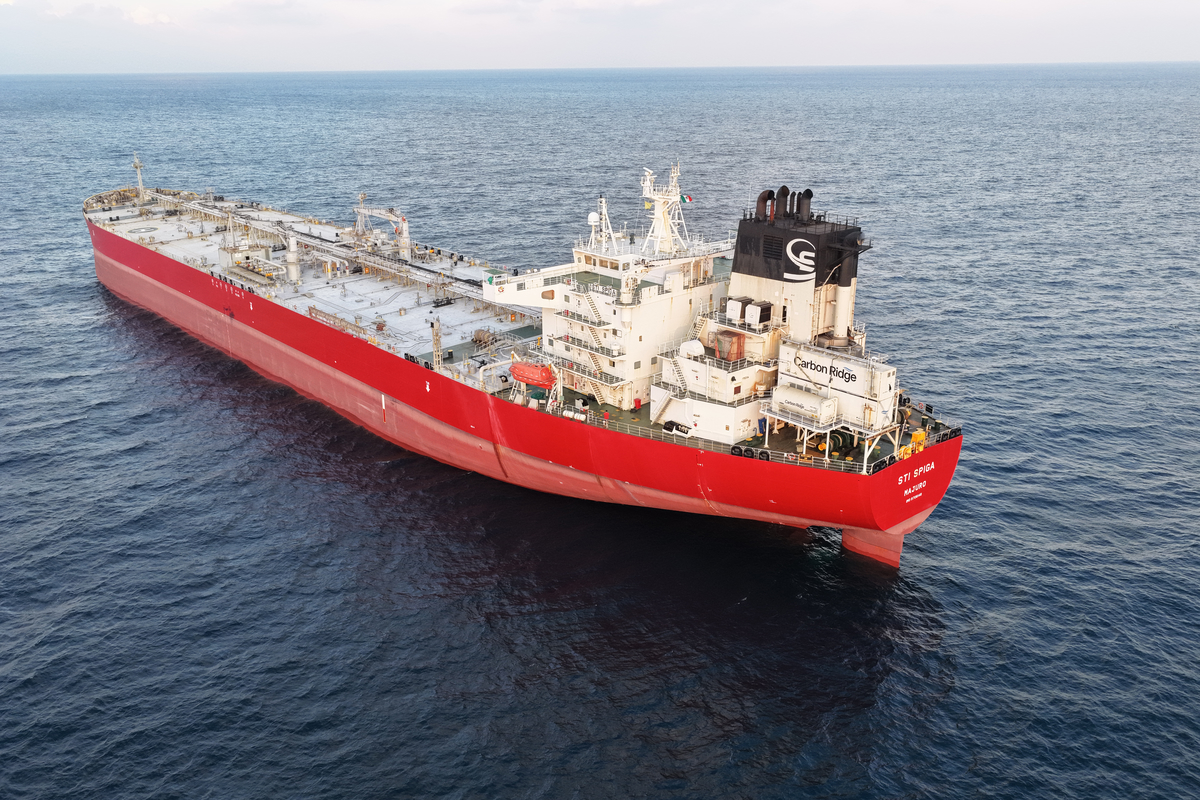 IMAGE: Carbon Ridge's OCCS installed onboard Scorpio Tankers STI Spiga. Carbon Ridge
Carbon Ridge develops modular OCCS systems.
The technical evaluation confirmed that the company’s centrifugal onboard carbon capture system can reach carbon dioxide (CO2) capture rates of 98%, it said.
A centrifugal OCCS system is a compact technology designed to capture CO2 emissions directly from a ship's exhaust. It differentiates itself from traditional OCCS systems, primarily through its size, efficiency, and use of rotating packed beds.
The system was set up to capture and treat a part of the emissions stream generated by a 109,999-dwt Long Range product tanker, STI Spiga, owned by Scorpio Tankers.
The captured CO2 is compressed, liquefied, and stored safely for the duration of the voyage, Carbon Ridge said earlier.
The final evaluation by DNV was completed over a five-month pilot period, which commenced at Besiktas Shipyard in Turkey.
DNV was able to “corroborate peak CO2 capture rates of over 98%, with 55% of the observations falling within a range of 86–98%,” Carbon Ridge said.
Maritime industry advancing with CCS
The shipping industry is promoting carbon capture and storage (CCS) technology to reduce the sector's carbon footprint and effectively meet global emissions reduction goals.
CCS plays a crucial role in the process of decarbonizing hard-to-abate sectors like shipping and several shipping companies are exploring ways to integrate the technology onboard vessels.
By Aparupa Mazumder
Please get in touch with comments or additional info to news@engine.online