East of Suez Fuel Availability Outlook 3 Mar
Availability is good in Zhoushan
South Korean ports may face weather disruptions
Middle East ports continue operations despite escalating regional crisis
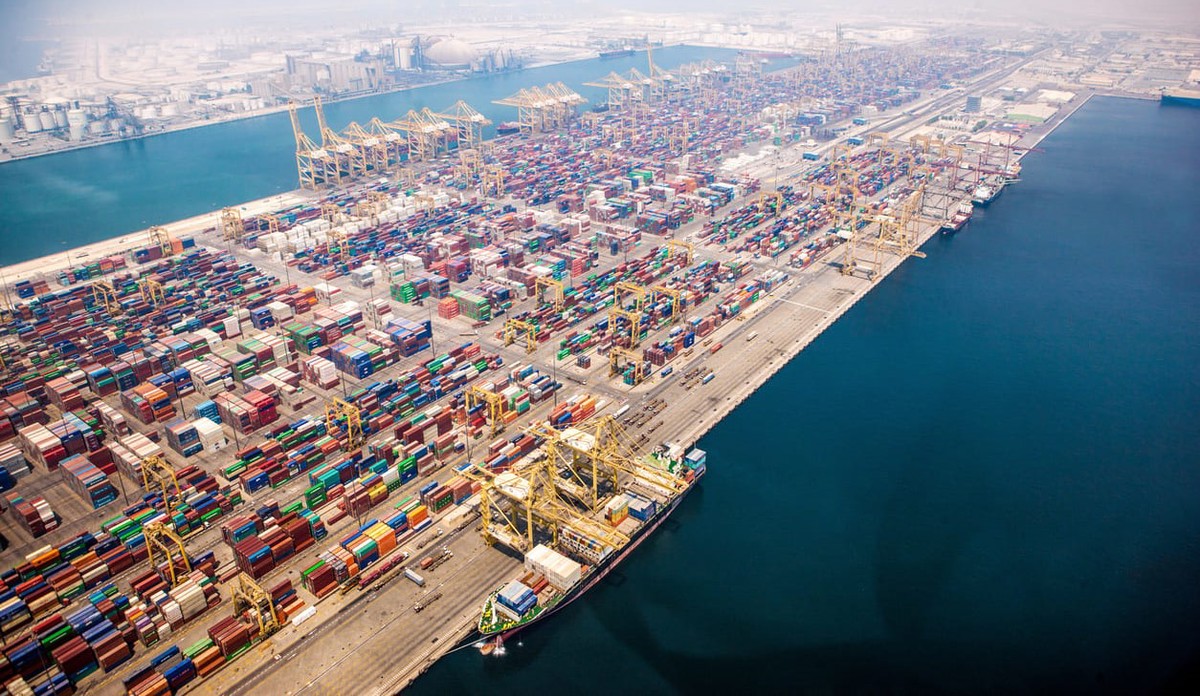 IMAGE: Aerial view of Jebel Ali Port, Dubai. Getty Images
Singapore and Malaysia
In Singapore, VLSFO requires lead times of about 7–11 days, slightly extended compared with last week's 6–10 days. LSMGO suppliers are typically advising 4–11 days, slightly wider than the 4–9 days seen previously. HSFO lead times are indicated at 8–11 days, versus 6–12 days a week earlier.
Over the weekend, US and Israeli forces conducted a joint strike on Iran that killed the Islamic Republic’s Supreme Leader, Ayatollah Ali Khamenei. Iran retaliated with direct attacks on Gulf states, including the UAE and Saudi Arabia, and caused disruptions to traffic through the Strait of Hormuz.
While supply conditions in Singapore remain unaffected, the geopolitical escalation has driven a sharp rally in Brent crude, lifting bunker prices in its wake.
“Across the grades, premiums are up,” a Singapore-based trader said.
Singapore’s VLSFO price jumped by nearly $80/mt over the weekend, to reach $589/mt.
Elsewhere in the region, Port Klang reports generally sufficient availability of VLSFO and LSMGO—particularly for smaller prompt stems—though HSFO supply remains constrained and more difficult to secure.
East Asia
Bunker availability across all grades in Zhoushan remains solid, a source said. Lead times for VLSFO and LSMGO are steady at 3–5 days, unchanged from last week. HSFO supply has improved, with lead times tightening to 3–5 days from 5–7 days previously.
As in Singapore, the Middle East crisis has not yet disrupted physical supply in Zhoushan. However, one source cautioned that prices “will be higher” at the port. Zhoushan’s VLSFO price jumped by $78/mt over the weekend, to $592/mt.
Across northern China, supply conditions are uneven. Dalian and Qingdao report sufficient volumes of VLSFO and LSMGO, though HSFO remains constrained in Qingdao. Tianjin is seeing tight availability across all grades. In Shanghai, VLSFO and HSFO supplies are limited, while LSMGO availability is comparatively stable.
In the south, Fuzhou is experiencing tight supply of both VLSFO and LSMGO. Xiamen has adequate VLSFO stocks, but LSMGO remains restricted. Delivery schedules in Yangpu and Guangzhou are also constrained for both grades.
In Hong Kong, bunker lead times remain around seven days for all grades, broadly unchanged in recent weeks.
In Taiwan, a trader reported “no significant impact” on supply. However, the Brent surge triggered by the Middle East escalation has “influenced” pricing considerably over the weekend. Kaohsiung’s VLSFO price rose by $48/mt, to $575/mt.
Lead times for VLSFO and LSMGO in Keelung and Hualien are about two days, while Kaohsiung and Taichung continue to recommend slightly longer lead times of around three days.
In South Korea, most suppliers are advising lead times of 5–7 days across all bunker grades, compared with a broader 3–8-day range last week.
Seasonal winter conditions continue to raise the risk of operational disruptions. Weather-related delays could affect Busan and Ulsan between 3–8 March, Yeosu from 6–8 March, and Daesan over 6–8 March.
Suppliers in the country are “carefully monitoring the situation. Premiums jumped a lot, but their producing schedule will not be affected because they have enough reserves at the moment. However, for sure it will cause problem if the war goes on,” one supplier said.
In Japan, VLSFO supply remains comfortable at major hubs such as Tokyo, Chiba, Yokohama and Kawasaki. Availability is comparatively tighter in Nagoya, Yokkaichi, Mizushima and Tokuyama, where recommended lead times remain at 7–10 days. LSMGO supply is generally consistent nationwide, while B24-VLSFO is available on request in Tokyo, Chiba and Yokohama.
HSFO inventories are largely steady across several ports. Oita reports adequate availability of all three grades, and Kashima has sufficient volumes of both VLSFO and HSFO.
Bunkering demand in Japan is expected to ease on 20 March due to the Vernal Equinox Day holiday.
In Indonesia, VLSFO supply continues to be stable at Jakarta, Surabaya, Balikpapan and Cigading, with suppliers typically quoting lead times of 2–3 days. LSMGO availability is also steady in Jakarta, Benoa, Surabaya and Batam. HSFO stocks are said to be well supplied in Jakarta, Surabaya and Balikpapan, according to a trader.
Oceania
Bunker availability across Australia remains generally steady. VLSFO and LSMGO are widely accessible nationwide, with typical lead times of about seven days.
In Western Australia, suppliers in Kwinana and Fremantle are asking for roughly one week’s notice. Deliveries are primarily carried out by barge through a single provider, while LSMGO can also be moved by truck. Strong afternoon winds continue to cause intermittent scheduling disruptions.
In New South Wales, VLSFO deliveries at Port Kembla can be arranged by truck or pipeline. Sydney maintains healthy stocks of VLSFO and LSMGO, though HSFO remains tight, with suppliers usually requiring around seven days’ notice.
Queensland's ports, Brisbane and Gladstone, are supplying VLSFO and LSMGO with lead times close to seven days. HSFO is available on request in Brisbane. Two barges operated by separate suppliers are active there, delivering VLSFO and LSMGO, while HSFO is provided on enquiry.
In Victoria, Melbourne and Geelong report strong inventories of VLSFO and LSMGO. HSFO availability is tight for prompt stems, although Melbourne currently holds adequate volumes. Both ports depend on a single barge, and lead times are near seven days. LSMGO can also be delivered by truck to smaller ports, such as Portland and Port Welshpool, within 2–3 days.
Weather risks are building. Multiple tropical cyclones could develop in Australian waters this week, heightening the likelihood of severe conditions in Western Australia, the Northern Territory and Queensland, according to a source.
So far, the Middle East crisis has not disrupted supply in the region, but “yet is the key word… we'll see in the next few days,” a trader said.
Overall, Australia’s bunker market appears balanced. With comfortable stock levels, many deliveries can be arranged within three to four days. Even at pipeline-equipped ports like Darwin and Dampier, trucks remain an essential part of the supply chain.
In New Zealand, market conditions are stable. VLSFO is readily available in Tauranga and Auckland, with pipeline connections at certain Tauranga berths. Marsden Point can supply both VLSFO and LSMGO via pipeline to cargo vessels, though truck-based deliveries across South Island ports remain constrained.
South Asia
Adverse weather is forecast to affect operations at India’s Sikka on 5–6 March, with the potential to disrupt bunkering activities at the port during that period.
In Sri Lanka, supply fundamentals remain steady. A supplier, active in Colombo and Hambantota, is quoting lead times of around five days for all fuel grades, largely in line with the previous week.
Middle East
The Fujairah Government Media Office said authorities in the Emirate responded to a fire that broke out this morning at the Fujairah Petroleum Industrial Estate (FOIZ). The blaze was triggered by falling debris after air defenses successfully intercepted a drone. No injuries were reported, the fire was brought under control, and operations have since resumed.
In Fujairah and Khor Fakkan, many bunker suppliers have halted deliveries due to uncertainty around loadings, as some terminals remain closed. Prices in Fujairah have climbed sharply, with only a limited number of suppliers still quoting.
At Jebel Ali, certain container terminals resumed operations this morning. However, bunkering inside the port has been suspended for safety reasons, while deliveries at Dubai Anchorage continue as normal. Availability is extremely tight as suppliers work through a backlog of vessels that were unable to stem fuel at Jebel Ali, a source said.
Adverse weather is forecast in Fujairah on 6 March, which could further disrupt bunkering at the port.
In Iraq’s Basrah, VLSFO and LSMGO remain readily available, though HSFO supply continues to be constrained. The Iraqi ports of Umm Qasr and Khor Al Zubair are fully operational. Basrah Oil Terminal (BOT) is also operating without disruption to crude loadings or marine traffic, according to GAC Hot Port News.
Port operations across Kuwait — including Mina Al Ahmadi, Mina Abdulla and Mina Al Zour — are proceeding normally. Inchcape Shipping reported that vessels originally bound for Shuaiba Port must divert to Shuwaikh Port to discharge cargo.
In Bahrain, all port movements, including pilotage services, have been temporarily suspended, shipping agency added.
Jeddah reports solid availability of both VLSFO and LSMGO. In Yanbu, however, adverse weather is expected to interrupt bunkering between 4–5 March.
Elsewhere, operations remain steady. Egyptian ports and the Suez Canal are fully functional. Jordan’s Aqaba Port continues normal activity. Ports in Pakistan remain open. Lebanon’s Beirut and Tripoli ports are operating as usual. There have been no official cancellations of vessel calls in Cyprus, and Israeli ports are functioning normally, Inchcape Shipping said.
In Qatar, ports are operating as usual, although significant GPS signal degradation has been reported at Mesaieed Port. At Ras Laffan, LSMGO supply is tight, while VLSFO is available only by barge and exclusively at anchorage.
Djibouti is facing tight VLSFO supply, and LSMGO stocks are nearly depleted.
In Oman, operations are partially restricted. Activities are suspended at the Port of Duqm, Asyad Drydock – Duqm, and the Port of Salalah’s General Cargo Terminal (GCT) until further notice. Meanwhile, Port Sultan Qaboos in Muscat, Mina Al Fahal, the Port of Sohar, Port of Salalah’s container terminal, Qalhat LNG Terminal in Sur, and the OMIFCO Terminal in Sur are operating normally, according to Inchcape Shipping.
“Ship movements through the Strait of Hormuz and adjacent waters have dropped sharply, with reports suggesting up to a 70% decline in vessel transits, reflecting adjustments by shipping companies in response to heightened risks. The situation has also affected ports in the region, including Oman, with operational and logistical considerations requiring careful management. Major marine insurers have reviewed or limited coverage in surrounding waters, impacting shipping costs and operational planning,” a regional trader said.
By Tuhin Roy
Please get in touch with comments or additional info to news@engine.online