East of Suez Market Update 19 Nov
Zhoushan prices have fallen for all three grades, while availability stays tight with lead times of around nine days.
Changes on the day to 17.00 SGT (09.00 GMT) today:
- VLSFO prices up in Singapore ($15/mt) and Fujairah ($8/mt), and down in Zhoushan ($16/mt)
- LSMGO prices up in Fujairah ($22/mt), and down in Zhoushan ($69/mt) and Singapore ($20/mt)
- HSFO prices up in Fujairah ($14/mt), and down in Zhoushan ($57/mt) and Singapore ($33/mt)
Zhoushan’s VLSFO price has fallen by $16/mt, the steepest move among the three major Asian bunker ports. The price now stands at a $20/mt premium over Fujairah and a $2/mt discount to Singapore. Yesterday, it carried a $29/mt premium over Singapore.
Consequently, Zhoushan’s Hi5 spread has widened from $127/mt to $168/mt, staying below Fujairah’s $242/mt and Singapore’s $196/mt.
Zhoushan’s monthly average VLSFO price jumped to $925/mt in March from $506/mt in February and eased to $714/mt in June. It then rose every month to $947/mt in October, the highest monthly average since July 2022, and has averaged $865/mt so far in November. The monthly average HSFO price reached $883/mt in October, the highest since November 2021.
Suppliers in Zhoushan are working through accumulated backlogs after bad weather disrupted bunker deliveries. Availability remains tight for all grades, and lead times have stretched to around nine days.
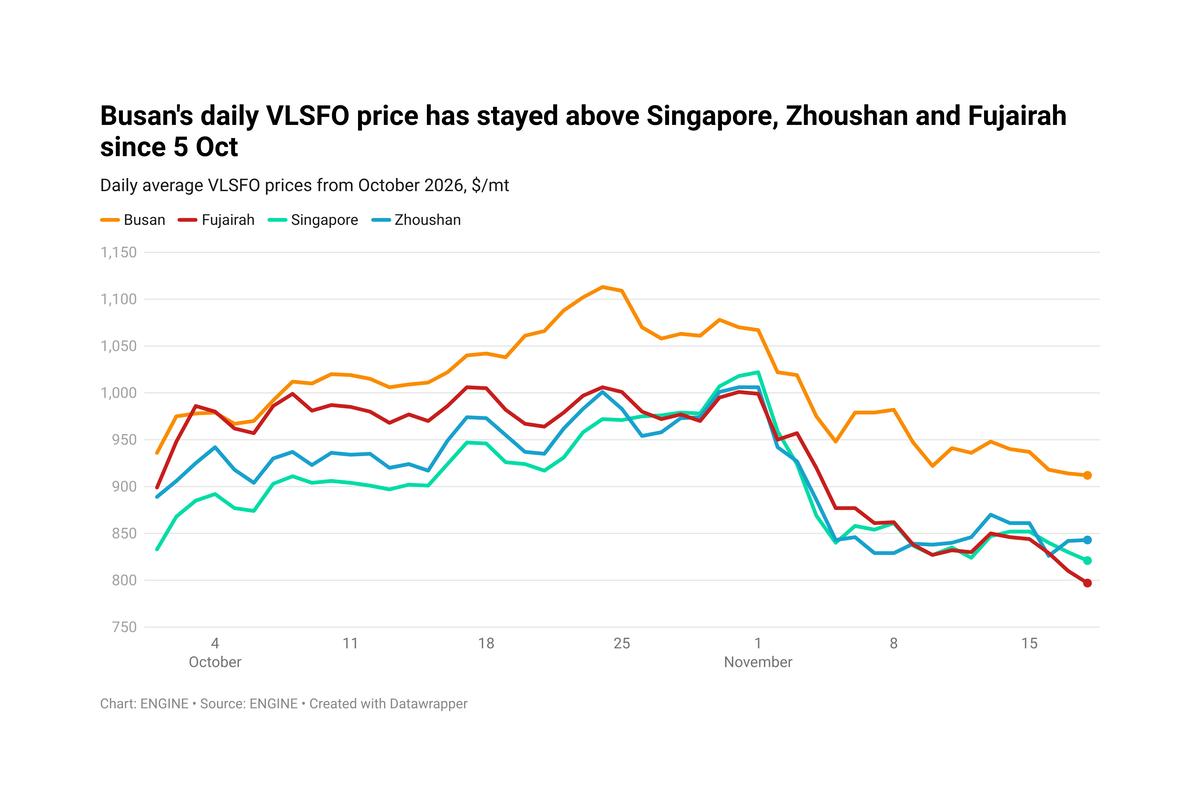
Bunker demand has weakened across South Korea as prices remain higher than those at neighbouring bunker hubs, a local trader said. Busan’s VLSFO price stands at a $79/mt premium over Singapore and an $81/mt premium over Zhoushan.
Lead times for all major fuel grades are around 3-7 days at southern ports, including Busan, Ulsan, Masan, Onsan, Yeosu and Kwangyang. VLSFO, LSMGO and HSFO have similar lead times at western ports, including Incheon, Daesan, Dangjin, Pyeongtaek and Taean.
Brent
The front-month ICE Brent contract has gained by $0.69/bbl on the day, to trade at $92.46/bbl at 17.00 SGT (09.00 GMT) today.
Upward pressure:
Brent crude’s price has gained support from intensifying attacks in the Persian Gulf and renewed strikes on Russian refineries.
Kuwait said it intercepted drone attacks yesterday, after Iranian attacks on US military sites in Bahrain earlier this week, Al Jazeera reported.
Iran’s navy said three oil tankers sailing east of the Strait of Hormuz were disabled by mines, Reuters reported, citing Iranian media.
Separately, Ukrainian drones hit two refineries in Russia’s southern Krasnodar region yesterday, ANZ Bank’s senior commodity strategist Daniel Hynes said.
Ukrainian drone attacks have cut Russian refineries’ combined crude processing capacity by 45% since late October, Reuters reported, citing industry sources.
Downward pressure:
Brent’s price has come under some downward pressure from a larger-than-expected rise in US crude stocks and expectations of higher US interest rates.
Commercial US crude oil inventories rose by 3.4 million bbls to 417.8 million bbls in the week ending 13 November, according to the US Energy Information Administration (EIA).
A rise in US crude stocks usually signals lower demand and can put downward pressure on Brent’s price.
Meanwhile, minutes from the US Federal Reserve’s (Fed) October meeting, released yesterday, strengthened expectations that the US central bank may raise interest rates in December, Reuters reported.
Higher interest rates in the US can dampen demand growth and make dollar-denominated commodities like oil more expensive for holders of other currencies.
By Tuhin Roy and Aparupa Mazumder
Please get in touch with comments or additional info to news@engine.online