East of Suez Market Update 20 Oct
East of Suez bunker prices have moved in mixed directions, and Typhoon Champi has halted bunker operations at two of Zhoushan’s outer anchorages.
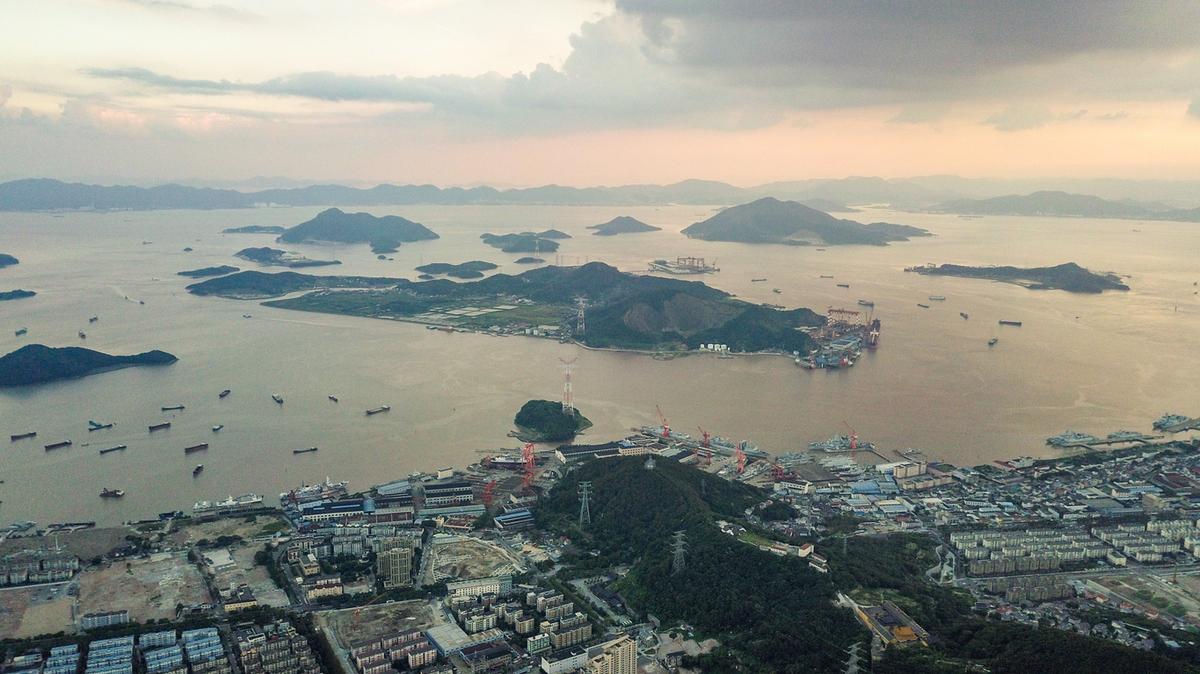 IMAGE: Aerial view of Zhoushan City, Zhejiang Province. Getty Images
Changes on the day to 17.00 SGT (09.00 GMT) today:
- VLSFO prices up in Singapore ($7/mt), and down in Fujairah ($12/mt) and Zhoushan ($10/mt), and
- LSMGO prices up in Zhoushan ($28/mt) and Fujairah ($5/mt), and down in Singapore ($13/mt)
- HSFO prices up in Fujairah ($14/mt) and Singapore ($1/mt), and down in Zhoushan ($6/mt)
Zhoushan’s LSMGO benchmark has gained $28/mt, marking the steepest increase among the three major East of Suez bunker ports. The price currently stands at a $122/mt premium to Singapore and a $360/mt discount to Fujairah.
Compared to some other East Asian ports, Zhoushan’s LSMGO price stands at premiums of $18/mt to Tokyo and $21/mt to Busan. These have flipped from yesterday’s discounts of $41/mt and $31/mt, respectively.
Its premium to Hong Kong has widened to $142/mt today from $94/mt yesterday.
Rough weather from Typhoon Champi has halted bunker operations at Zhoushan’s outer Tiaozhoumen and Xiazhimen anchorages today, according to a source. Bunker operations continue at the inner Xiushandong and Mazhi anchorages.
Supply of all major grades remains tight, with suppliers recommending lead times of around 11 days.
Brent
The front-month ICE Brent contract has gained $2.90/bbl on the day, to trade at $111.41/bbl, at 17.00 SGT (09.00 GMT) today.
Upward pressure:
Iran has no choice but to exercise sovereignty over the Strait of Hormuz to protect its security, First Vice President Mohammad Reza Aref said yesterday, according to Iranian state news agency IRNA. He added that the US had caused the current situation and must pay for it.
Yemen’s Houthis said yesterday that they had launched missile and drone attacks on Saudi energy, airport and military targets, including an Aramco site in Yanbu and the Shaybah oilfield. Saudi authorities have not confirmed the attacks. Yanbu is Saudi Arabia’s main Red Sea export hub and lets crude bypass Hormuz.
Attacks on ships have kept a risk premium in Brent, with ship-tracking firm Kpler reporting at least 18 vessels attacked in the region over the past two weeks.
The escalation in strikes across the Middle East highlights the upside risks to oil prices, economic research firm Capital Economics said in a note last week.
Downward pressure:
Gulf crude flows have held up despite the attacks. US Energy Secretary Chris Wright told Fox News that flows had recovered to about 80% of their pre-war level, although refined product shipments remained constrained.
Iraq's crude exports have averaged more than 3.4 million b/d so far this month, its oil minister said. That is close to pre-war levels.
The US is also authorising the sale of sanctioned “dark fleet” tankers so they can carry crude legally, Wright said. The aim is to add tanker capacity and bring freight rates down, analysts at Dutch bank ING said.
If flows continue uninhibited, “the risk premium would likely erode slowly”, the analysts added, noting that there are no signs of this yet.
By Konica Bhatt and Erik Hoffmann
Please get in touch with comments or additional info to news@engine.online