East of Suez Market Update 23 Jan
Most bunker prices in East of Suez ports have moved up, and VLSFO availability is tight across major Japanese ports.
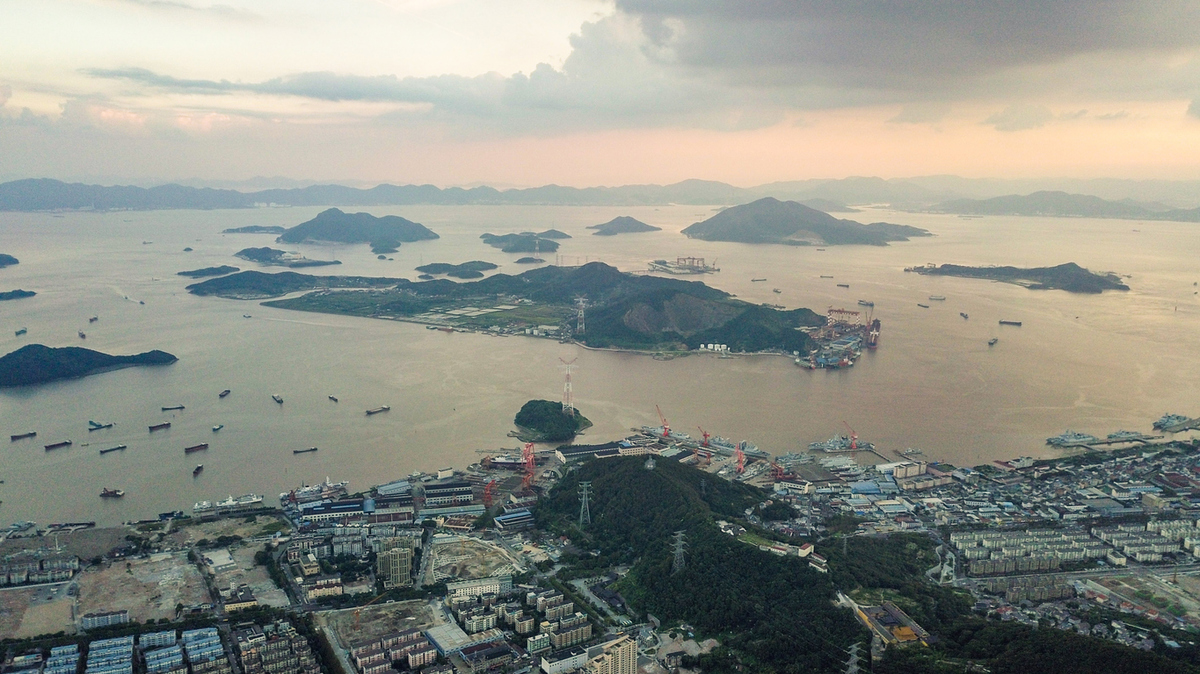 IMAGE: Aerial view of Zhoushan City, Zhejiang Province. Getty Images
Changes on the day to 17.00 SGT (09.00 GMT) today:
- VLSFO prices up in Fujairah ($2/mt), Singapore ($1/mt), and down in Zhoushan ($9/mt)
- LSMGO prices up in Singapore ($4/mt), Fujairah and Zhoushan ($1/mt)
- HSFO prices up in Singapore, Fujairah ($4/mt), and down in Zhoushan ($4/mt)
- B30-VLSFO prices up in Fujairah ($13/mt) and Singapore ($7/mt)
VLSFO prices in Singapore and Fujairah have increased some in the past day, while the grade’s price has declined in Zhoushan. Despite the fall, Zhoushan continues to command a premium of $10/mt over Singapore and $21/mt over Fujairah.
Zhoushan’s HSFO price has also dropped in the past day, but a steeper fall in its VLSFO benchmark has narrowed the port’s Hi5 spread by $5/mt, to $59/mt.
VLSFO availability remains tight in Zhoushan, with several suppliers running low on stocks. Lead times of 7–10 days are recommended for VLSFO deliveries, up from 5-7 days last week, while lead times for LSMGO and HSFO remain unchanged at 5–7 days.
Securing prompt VLSFO supplies can be difficult across major Japanese ports, including Tokyo, Chiba and Yokohama. Tight supply conditions also persist at Osaka, Kobe, Mizushima, Nagoya, Yokkaichi and Oita, and are expected to continue until early February. Conversely, LSMGO supply remains generally stable across the country. B24-VLSFO is being supplied only on request in Tokyo, Chiba and Yokohama, while HSFO availability is tight at these ports.
Brent
The front-month ICE Brent contract has inched lower by $0.28/bbl, to trade at $64.65/bbl at 17.00 SGT (09.00 GMT) today.
Upward pressure:
Brent has remained relatively steady in the past week, as concerns around supply disruption and the International Energy Agency’s (IEA) revised oil demand growth outlook have supported the benchmark.
The IEA has revised its oil demand growth forecast for 2026 up from 860,000 b/d to 930,000 b/d, adding some support to Brent’s price.
Supply disruption concerns have resurfaced after Kazakhstan halted output at its Tengiz and Korolev oilfields after power disruptions. Kazakhstan produced 35% less crude per day in the first 12 days of January than on average in December, according to Reuters.
Downward pressure:
The US, Russia and Ukraine will hold a trilateral meeting in the UAE, Ukraine’s President, Volodymyr Zelenskyy confirmed in a social media post.
“Any breakthrough to end Russia’s war in Ukraine could see an end to US sanctions on Russia that have curtailed oil flows,” Daniel Hynes, senior commodity strategist at ANZ said.
US President Donald Trump has rescinded tariff threats against nations that oppose his plans to acquire the island after claiming that his ambitions for Greenland were headed toward a negotiated solution.
“Based upon a very productive meeting that I have had with the Secretary General of NATO, Mark Rutte, we have formed the framework of a future deal with respect to Greenland and, in fact, the entire Arctic Region,” Trump said in a social media post.
US commercial crude stocks have increased by 3.60 million bbls in the week ending 16 January to 426 million bbls, according to the Energy Information Administration. This is slightly higher than the American Petroleum Institute’s estimate of a 3.04 million-bbl build.
By Shilpa Sharma and Konica Bhatt
Please get in touch with comments or additional info to news@engine.online