East of Suez Market Update 28 Apr
Prices in East of Suez ports have moved in mixed directions, and bunker availability is tight across grades in Zhoushan.
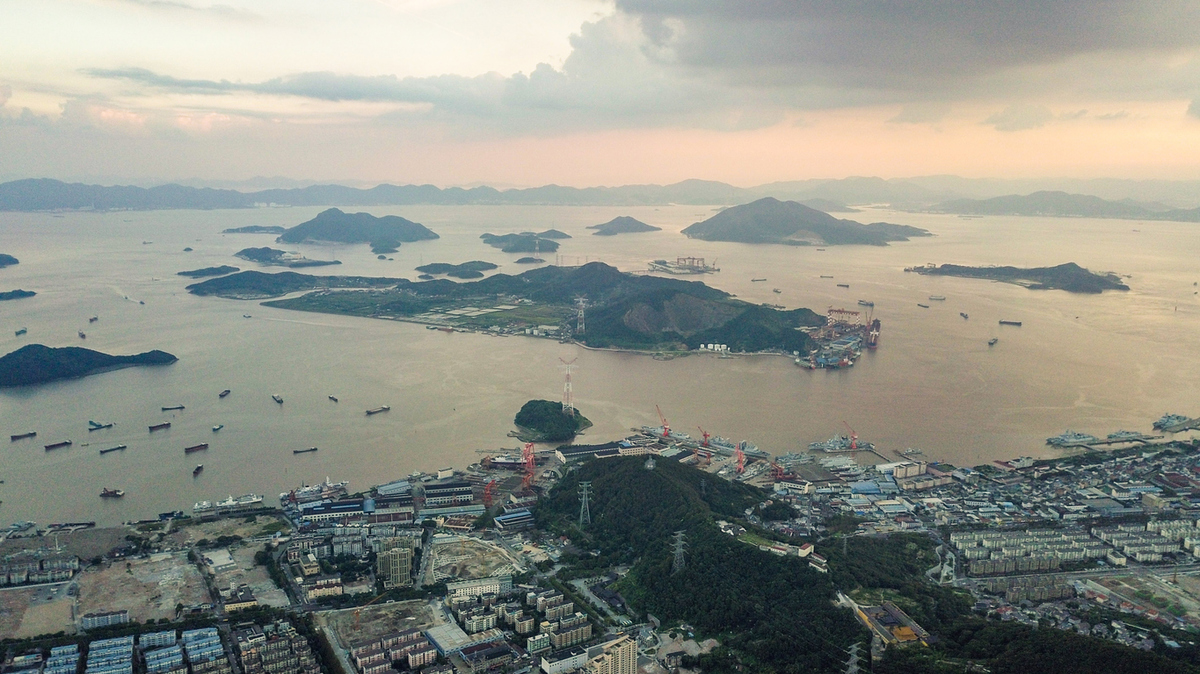 IMAGE: Aerial view of Zhoushan City, Zhejiang Province. Getty Images
Changes on the day to 17.00 SGT (09.00 GMT) today:
- VLSFO prices up in Fujairah ($54/mt), Singapore ($6/mt), and down in Zhoushan ($12/mt)
- LSMGO prices up in Fujairah ($20/mt), and down in Zhoushan ($103/mt) and Singapore ($28/mt)
- HSFO prices up in Fujairah ($24/mt), Singapore ($3/mt), and down in Zhoushan ($10/mt)
- B30-VLSFO prices up in Singapore ($21/mt)
Zhoushan’s VLSFO price has fallen by $12/mt over the past day, while corresponding benchmarks in Fujairah and Singapore have moved higher. As a result, Zhoushan's VLSFO is now at steep discounts of $103/mt to Fujairah and $26/mt to Singapore.
Supply in Zhoushan has tightened across all grades, with several suppliers reporting low inventory levels. Lead times for VLSFO have extended to 8–10 days, while LSMGO and HSFO now require 6–9 days. This compares with shorter lead times of 3–7 days across all grades last week, according to market sources.
Bunker demand in China is expected to ease during the Chinese Labour Day holiday period from 1–5 May. Most suppliers are not expected to take new orders during this window, and 29 April is effectively the final date to book stems for delivery within the holiday period at most ports.
In Taiwan, bunker supply remains stable, with lead times of around two days for both VLSFO and LSMGO deliveries at Keelung and Hualien, and about three days at Taichung and Kaohsiung.
Brent
The front-month ICE Brent contract has gained by $3.34/bbl on the day, to trade at $111.04/bbl at 17.00 SGT (09.00 GMT) today.
Upward pressure:
Brent crude’s price has continued to trade north of $110/bbl as US-Iran negotiations remain stalled and transit through the Strait of Hormuz stays constrained.
In an interview with Fox News yesterday, US secretary of state Marco Rubio said that Washington will not accept Iran’s alleged control over the Strait of Hormuz.
“If what they [Iran] mean by opening the straits is, “Yes, the straits are open as long as you coordinate with Iran, get our permission or we’ll blow you up, and you pay us,” that’s not opening the straits,” Rubio said.
The remarks came after negotiations between Washington and Tehran were cancelled over the weekend.
Prior to the Middle East war – which is now in its eighth week – the Strait of Hormuz carried roughly 20% of the world’s seaborne crude oil flows.
“After considering the diversion of some oil via pipelines and the trickle of tankers still making it through the Strait of Hormuz, around 14m b/d [14 million b/d] of oil supply is currently disrupted,” remarked ING Bank’s head of commodities strategy Warren Patterson.
Downward pressure:
Brent’s price has felt some downward pressure from the latest positions data, as money managers and hedge funds decreased their net-long bets on ICE Brent futures over the last reporting week.
Speculators sold a little over 4,000 lots as of last Tuesday, decreasing net-long positions in Brent futures to about 369,000 lots, according to futures and options data from ICE Futures Europe.
When speculators reduce net-long positions, prices tend to decline. Conversely, when they boost these positions, oil prices typically rise, leading to a cycle where their actions can influence oil prices and the market.
By Tuhin Roy and Aparupa Mazumder
Please get in touch with comments or additional info to news@engine.online