Europe & Africa Market Update 26 June
Bunker prices across major European and African ports have mostly gained, while prompt fuel availability is tight in South Africa’s Durban.
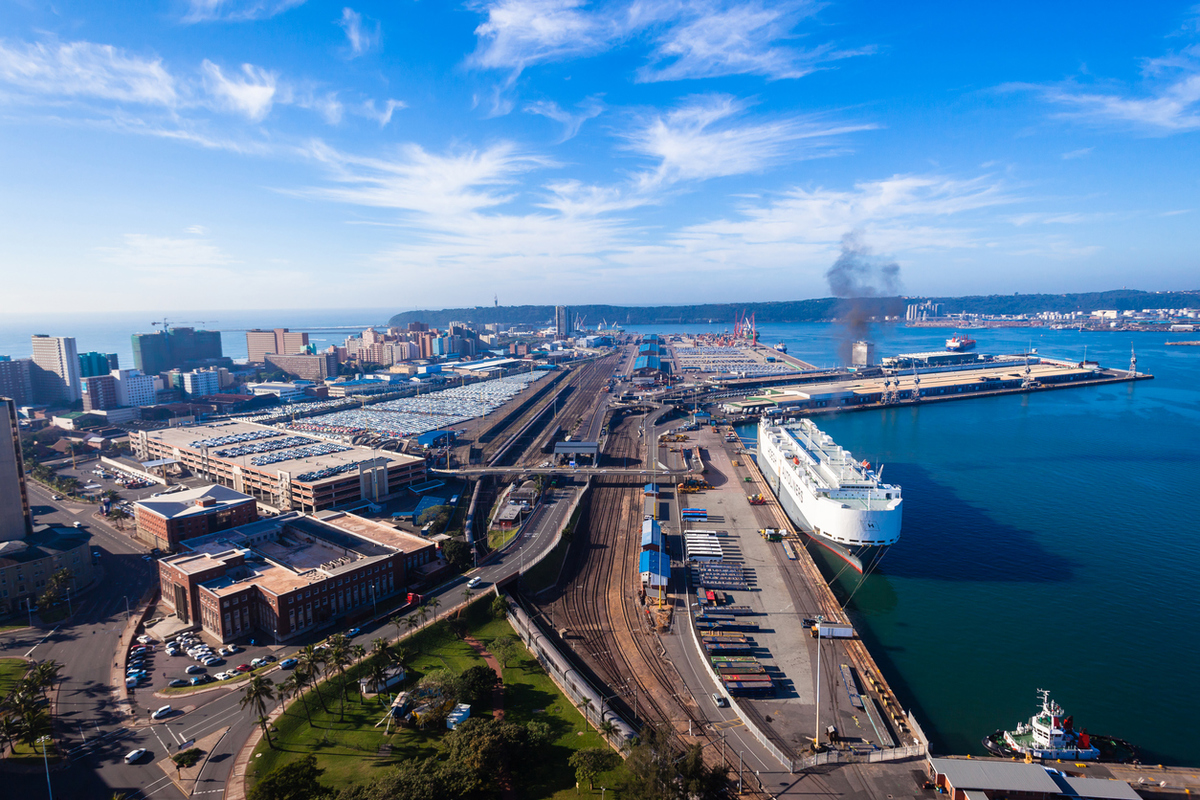 IMAGE: Aerial view of Durban port landscape. Getty Images
Changes on the day to 09.00 GMT today:
- VLSFO prices up in Durban ($26/mt) and Gibraltar ($2/mt), and unchanged in Rotterdam
- LSMGO prices up in Durban ($182/mt), Gibraltar ($3/mt) and Rotterdam ($1/mt)
- HSFO prices up in Rotterdam ($5/mt) and Gibraltar ($1/mt)
- B30-VLSFO prices up in Rotterdam ($7/mt), and down in Gibraltar ($1/mt)
Durban’s LSMGO price has significantly jumped over the past day. A higher-priced 150-500 mt stem, fixed at $2,018/mt, has pushed the price higher.
Its price premium over both, South Africa’s Cape Town and Mauritius’ Port Louis, has widened by $138/mt in a single day.
Fuel availability in Durban is tight for prompt delivery dates, a trader said. Buyers are advised to book around 5-7 days ahead to get delivery of any fuel grade.
North-easterly wind gusts of more than 25 knots and swells higher than 2.5 metres are forecast in Durban during the weekend, which could result in some disruptions to incoming traffic.
Brent
The front-month ICE Brent contract has gained by $0.19/bbl on the day, to trade at $72.56/bbl at 09.00 GMT.
Upward pressure:
Brent crude has drawn some upward thrust as regional skirmish continued between Israel and Lebanon, with the Israel Defense Forces (IDF) targeting the Zawtar al-Sharqiya region in southern Lebanon, it said on social media platform X.
The news emerges as a significant threat to the durability of the US-Iran interim agreement, as Tehran has conditioned its commitment to the peace deal, only after a complete cessation of military operations in Lebanon.
Meanwhile, a cargo vessel transiting the Strait of Hormuz was struck by an unknown projectile off the coast of Oman yesterday, the United Kingdom Maritime Trade Operations (UKMTO) reported.
“Oil bounced back yesterday after a vessel was struck in the Persian Gulf,” two analysts from ING Bank noted.
The attack occurred shortly after Iran’s Islamic Revolutionary Guard Corps (IRGC) Navy warned commercial vessels against using unauthorised routes through the region.
The attack “highlighted the fragile state of the ceasefire, while also demonstrating the risks facing vessels in the Persian Gulf,” ING Bank’s analysts added.
Downward pressure:
Brent’s price has felt some downward pressure as the oil market focused on the resumption of oil flows through the Strait of Hormuz.
Oil is flowing through the Persian Gulf at the “fastest pace” since the beginning of the Middle East conflict on 28 February, according to ANZ Bank’s senior commodity strategist Daniel Hynes.
Cargo tracking platform Kpler reports dry bulk carrier transits through the strait have increased from one or two ships a week, to more than 10 a day in the week to 24 June, since the interim US-Iran peace deal was signed in France.
“[Oil] market momentum still appears to be largely downward,” ING Bank’s analysts said.
By Nachiket Tekawade and Aparupa Mazumder
Please get in touch with comments or additional info to news@engine.online