Europe & Africa Market Update 4 Feb
Fuel prices across European and African ports have increased, while weather disruptions have led to longer lead times in Gibraltar.
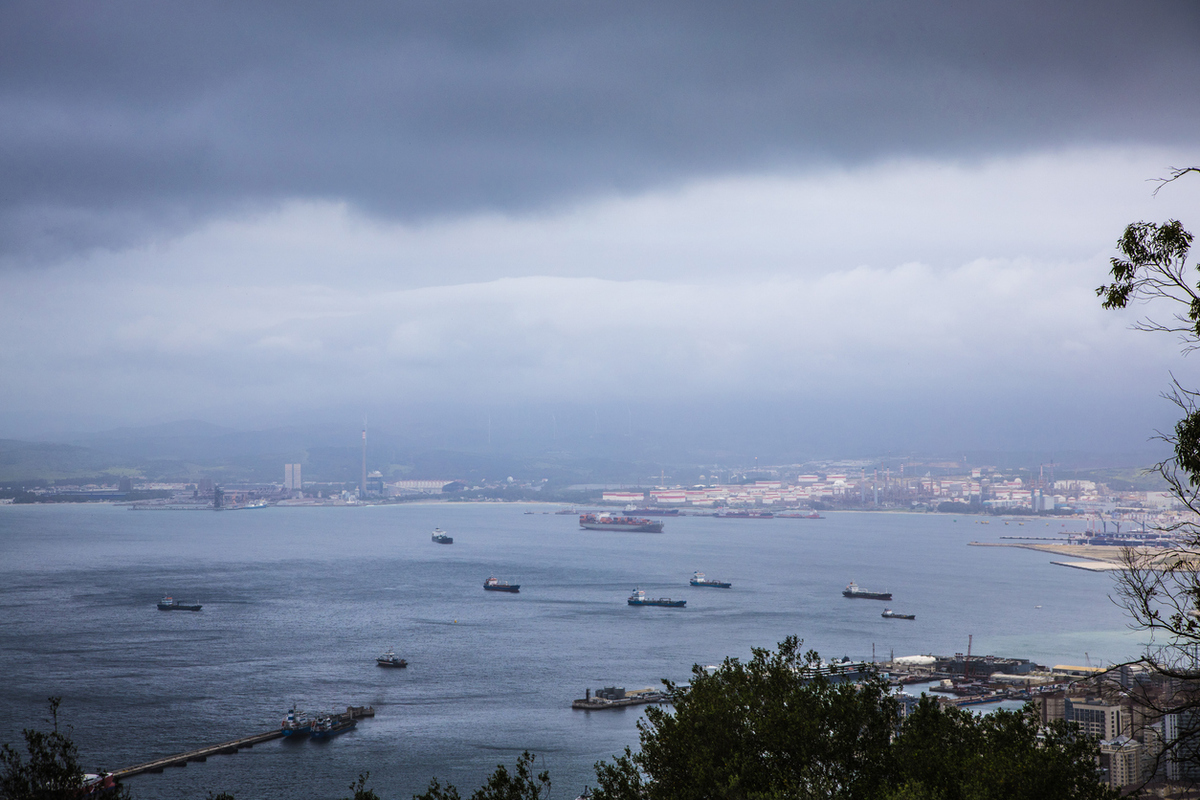 IMAGE: Aerial view of Gibraltar Harbour with dark storm clouds in the background. Getty Images
Changes on the day to 09.00 GMT today:
- VLSFO prices up in Durban ($24/mt), Rotterdam ($11/mt) and Gibraltar ($9/mt)
- LSMGO prices up in Rotterdam ($20/mt) and Gibraltar ($12/mt)
- HSFO prices up in Rotterdam ($12/mt), Gibraltar ($11/mt) and Durban ($8/mt)
- B30-VLSFO prices up in Rotterdam ($13/mt) and Gibraltar ($10/mt)
Bunker price benchmarks have gained in all three major ports, tracking the Brent’s price rise.
Durban’s VLSFO price has increased almost threefold compared to its HSFO price, widening the port’s Hi5 spread by $16/mt to $55/mt in a single day.
Hi5 spreads at Rotterdam and Gibraltar are at $44-46/mt.
Continuing rough weather has kept inbound traffic suspended in Gibraltar, while all port operations are suspended in Algeciras and Ceuta as well, according to port agent MH Bland.
Weather is expected to remain rough in the strait until at least 11 February with winds higher than 40 knots and waves around 2 metres high forecast during this period.
There are around 17 vessels currently waiting for bunkers in Gibraltar, compared to nine vessels waiting yesterday, port agent MH Bland said.
Due to this disruption, buyers are recommended long lead times to get deliveries of any fuel grade in the Gibraltar strait, a trader said.
Some suppliers in Algeciras can deliver earliest by 17 February. In Ceuta, ex-pipe deliveries can be done with a five-day notice, while barge deliveries can be carried out earliest by around 14 February, the trader added.
Brent
The front-month ICE Brent contract has risen by $1.57/bbl on the day, to trade at $67.18/bbl at 09.00 GMT.
Upward pressure:
Brent futures have moved higher after the US shot down an Iranian drone and armed Iranian boats approached a US-flagged vessel in the Strait of Hormuz, reviving concerns over a possible escalation in tensions between Washington and Tehran.
“The market is back to pricing in the risk of a US-Iran military confrontation after two maritime encounters on Tuesday,” said Vandana Hari, founder of VANDA Insights.
“Crude oil gained… amid renewed geopolitical tensions,” Daniel Hynes, senior commodity strategist at ANZ Bank, echoed.
Additional support came from industry data pointing to a sharp decline in US crude inventories. US crude oil stocks fell by 11.1 million barrels in the week ending 30 January, according to American Petroleum Institute (API) estimates cited by Trading Economics.
Falling crude inventories are generally seen as a signal of stronger demand and can underpin Brent prices.
“The oil market got another boost from a bullish inventory report from the American Petroleum Institute,” two analysts from ING Bank said.
Furthermore, a trade agreement between the US and India has lifted expectations of stronger global energy demand.
“Prices were also supported by reports that as part of the US India trade deal, the US would roll back tariffs in return for an agreement that India would stop buying Russian oil,” ANZ Bank’s Daniel Hynes noted.
Downward pressure:
Meanwhile, the US government is preparing to issue, as early as this week, a general license that would allow companies to produce oil and gas in Venezuela, in a bid to encourage higher output from the OPEC member, Reuters reported citing sources.
The license, to be issued by the Treasury Department’s Office of Foreign Assets Control, would permit companies to explore for and produce crude oil and natural gas, the report added. This prospect has weighed on Brent futures.
Additionally, crude oil production in the US has reportedly recovered following recent storm-related disruptions. By Monday, only about 100,000 b/d of US crude output remained shut, after extreme weather last month had cut supplies, with outages peaking at around 2 million b/d on 24 January, according to Reuters.
The easing of these disruptions has further contributed to downward pressure on oil prices.
By Nachiket Tekawade and Aparupa Mazumder
Please get in touch with comments or additional info to news@engine.online