Extend ETS reach to 600 nautical miles to curb carbon tax evasion – T&E
The European Commission should include non-EU ports up to 600 nautical miles from any EU port within the scope of the EU Emissions Trading System (ETS) to reduce the risk of “evasive” port calls, Transport & Environment (T&E) said.
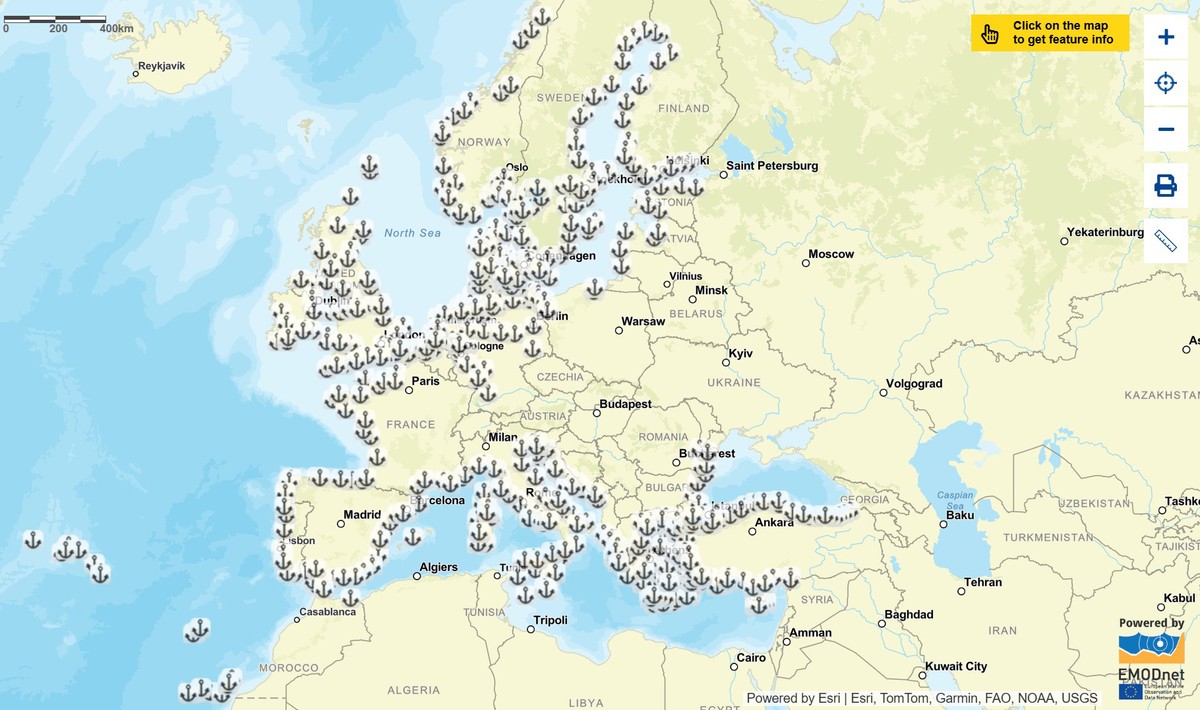 IMAGE: Major ports in and around the EU. European Commission
The EU ETS reached its final phase of “phasing in” this year, which means a vessel sailing between two EU ports now has to pay for 100% of its emissions, up from the 70% coverage in 2025.
A vessel sailing between EU and non-EU ports has to cover 50% of its emissions, up from 35%.
But a recent T&E report has reiterated a regulatory loophole where a vessel can use transshipment ports to avoid paying for CO2 emissions from long-haul voyages between non-EU and EU ports by routing cargo through a nearby non-EU port.
For instance, a vessel travelling from Singapore to Rotterdam could use a port just outside the EU as its “port of call” to transfer cargo before proceeding to Rotterdam. The shorter distance from that port to the EU could significantly reduce the total emissions counted under the EU ETS, compared to a direct voyage between Singapore and Rotterdam.
To close this loophole, the European Commission identified East Port Said in Egypt and Tanger Med in Morocco as transhipment ports under the EU ETS in 2023.
A vessel calling at these ports must include 50% of the emissions from the voyage to that port, rather than reporting only the short leg from the transshipment port to the EU port, the Commission said.
According to the Commission’s criteria, for a port to be identified as a neighbouring container transhipment port it should be located within 300 nautical miles of an EU port and its share of container transshipment must exceed 65% of its total container traffic in the past year.
T&E has now pointed out that other ports outside the EU could also pose a risk of evasive port calls. While it has not provided a full list, it estimates that 225 ports within 600 nautical miles of the EU could be used to “shorten the ETS-relevant leg of a voyage and reduce ETS liability.”
In 2023, the Port Authority of Valencia identified Tekirdag Asyaport in Turkey as a potential transshipment port for evading EU ETS costs, as it meets the Commission’s criteria. It also flagged Turkish ports such as Ambarli, Aliaga and Mersin, Israeli ports Ashdod and Haifa and Lebanon’s Port of Beirut as potential candidates.
The authority also urged the EU to monitor traffic growth at emerging ports including Damietta II in Egypt, Nador West Med in Morocco and Cherchell in Algeria and to include them under the ETS framework if they meet the criteria.
By Konica Bhatt
Please get in touch with comments or additional info to news@engine.online