Future Fuel Talks: Predictable pricing can make blue ammonia more attractive to shipowners - NH3 Clean Energy
Long-term price certainty could give blue ammonia an advantage in a market where shipowners must weigh the cost of switching fuels against the emissions reductions they can achieve, Charles Whitfield told ENGINE.
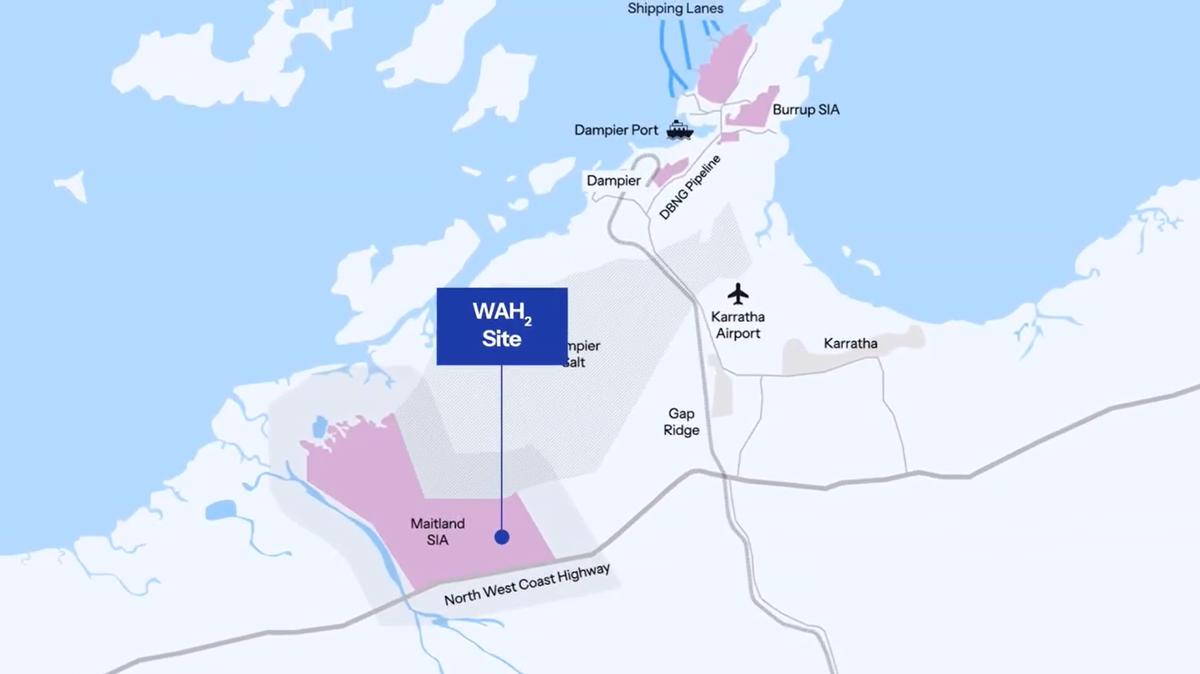 MAP: Site of blue ammonia production facility in Pilbara, Australia. Youtube of NH3
Charles Whitfield is the chairman of Australian clean ammonia developer NH3 Clean Energy. The company is developing a blue ammonia facility in Western Australia's Pilbara region, with an initial production capacity of 650,000 mt/year targeted from 2030.
Whitfield estimates the company could sell ammonia at $600/mt free on board (FOB) at Dampier without relying on Australian government subsidies.
"There's no subsidy. There's nothing assumed in that price," he said.
Central to this pricing proposition is Western Australia's domestic gas reservation policy. The policy requires LNG exporters to make gas equivalent to 15% of their exports available to the domestic market.
Access to locally sourced natural gas through long-term bilateral contracts could allow NH3 Clean Energy to offer ammonia prices indexed to Australia's consumer price index, rather than exposing them directly to oil-linked gas prices in the Middle East or Henry Hub-linked prices in the US, Whitfield explained.
“In terms of a price proposition, it's actually pretty attractive to a lot of customers who want to be able to secure long-term price security.”
The $600/mt estimate excludes the cost of delivering ammonia to vessels.
Whitfield expects the additional cost of bunker vessel deliveries within Dampier and nearby Port Hedland to be minimal due to the ammonia being already at the port. Deliveries to more distant markets such as Singapore and Japan could incur higher transport costs.
To Pilbara and beyond
NH3 Clean Energy and Pilbara Ports Authority plan to establish ammonia bunker operations by 2030. That date depends mainly on when production starts, not on building new port infrastructure, Whitfield said.
“One of the great things about Dampier is that it already handles ammonia. There's actually been a grey ammonia plant in the Burrup, which is the peninsula where Dampier Port is, for about 25 years,” he said.
“There is a bulk liquid wharf with ammonia rundown lines, which is underutilised at the moment. It's only operating at about 30% of its capacity, so actually we're very fortunate that the infrastructure is already there.”
The proposed production facility would sit about 20 kilometres south of Dampier. A pipeline would connect it to additional ammonia storage near the port, with existing infrastructure used to transfer the fuel to the wharf for loading onto bunker vessels.
The region has already hosted an early ammonia bunker operation. CMB.TECH recently bunkered its bulk carrier Mineral Europa with green ammonia at Port Hedland using the bunker vessel Shenghang Yongle. The bulk carrier is currently chartered by Australian mining firm Fortescue.
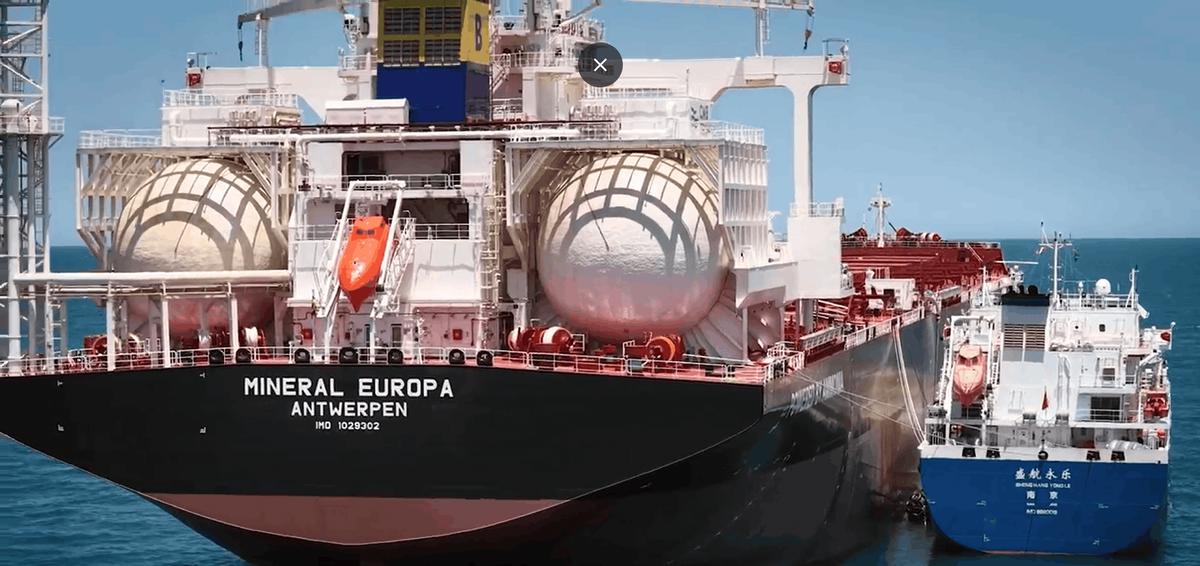
IMAGE: Ship-to-ship ammonia bunkering of the ammonia-capable bulk carrier Mineral Europa in Hedland. Linkedin of Fortescue
Bunker vessels can supply ships at both Dampier and Port Hedland, removing the need for separate ammonia storage facilities in Port Hedland. Early trials can also help develop the operating procedures, licensing arrangements and regulatory frameworks needed for routine ammonia deliveries in Pilbara, Whitfield said.
NH3 Clean Energy is collaborating with Oceania Marine Energy on the design of an ammonia bunker vessel, which Oceania has said it plans to order.
On the demand side, the company has secured non-binding offtake arrangements with Japan's Mitsui OSK Lines and Itochu which are back-to-back demand aggregation agreements.
Beyond the Pilbara, NH3 Clean Energy sees potential to supply major Asia-Pacific ports as the conflict in the Middle East creates uncertainty over ammonia prices and availability. Around 85% of Asia's ammonia imports come from the Middle East, Whitfield said.
Whitfield believes Western Australia's location could offer a logistical advantage by allowing shipments to reach overseas markets without passing through major maritime chokepoints. He estimated that transporting ammonia from the Pilbara to Japan would cost half as much as from the Middle East and one-third as much as from the US.
More than shipping
Ships are only one part of NH3 Clean Energy's intended customer base.
The company expects to allocate around 20% of its initial production capacity to marine fuel. That would amount to approximately 130,000 mt/year, although the final allocation will depend on demand.
The balance could be sold to power generation customers in Japan and Singapore or to established ammonia markets, including fertilisers, chemicals and other sectors.
“There's sort of three different markets that we address which helps us to diversify our customer base,” he said.
“The speed of uptake of ammonia demand for shipping is still a little bit unknown. Obviously, the IMO outcome and a whole load of other variables will determine how much supply is required at certain stages. The way we mitigate that risk is essentially by addressing multiple markets.”
Whitfield expects IMO member states to reach an agreement on the Net-Zero Framework in December, but believes it could be less stringent than the version approved in April 2025.
“But I think that there will be a piece of paper or an agreement that does actually get ratified.”
Carbon intensity over colour
Blue ammonia is excluded from Australia's hydrogen production tax incentive because of its fossil-based production pathway. Technology-specific eligibility requirements could also limit access to other government funding programmes.
Whitfield suggested that a more technology-neutral approach, with incentives linked to lifecycle emissions reductions rather than production methods, could help scale uptake of the fuel. Low-emission fuels should be assessed on their actual greenhouse gas (GHG) performance rather than whether they are labelled blue or green, he said.
NH3 Clean Energy expects to capture 99.5% of process emissions at its proposed facility, and Whitfield put its production emissions at 0.37 kgCO2/kg ammonia. The estimate does not establish the fuel's full well-to-wake emissions intensity, which would also need to account for relevant upstream and onboard emissions.
“You can talk about perfection, and it never happens, or you can actually get somewhere that is 97% of perfection and do that today. So it’s like, what do you want to do? Talk about it for 10 years or actually make it happen today?” he said.
The distinction between production methods and emissions performance also has commercial implications. Whitfield said customers are increasingly concerned with emissions intensity because of regulations, GHG pricing and Scope 3 reporting requirements. Many are willing to pay a premium for emissions reductions rather than judging a fuel solely by whether it is labelled blue or green.
Currently, the cost of renewable electricity and the efficiency of electrolysers remain significant obstacles to green hydrogen production. But NH3 Clean Energy could eventually replace blue hydrogen with green hydrogen in its ammonia production process if renewable electricity and electrolysis become commercially competitive, he added.
“We would produce green tomorrow if there was a market for it,” he said.
Expansion is also under consideration, both within the Pilbara and in other regions.
“We are certainly looking to expand in the Pilbara because one of the things about blue ammonia is there aren't actually that many places in the world where you can do it. You need plentiful gas supply, CCS [carbon capture and storage] sequestration capacity and access to market.”
“And so, if you look around the world at where most of the blue ammonia plants have been built, it's the Middle East, the US Gulf Coast and then the North West Shelf of Australia. There are a couple of other places, but I'm not going to give it away at this point in terms of where our sort of next ports of call are,” he said.
“But yeah, one is obviously you've got to have market demand, but for blue especially, there are certain pieces of the jigsaw that you need to have in place.”
By Konica Bhatt
Please get in touch with comments or additional info to news@engine.online