German RED III draft spares shipping, but may strain biofuel supply
Germany’s draft RED III legislation excludes marine fuels from national transport fuel mandates, leaving them to be regulated under the EU’s FuelEU Maritime and Emissions Trading System regulations.
Last week, the German cabinet approved draft rules to implement the EU’s third Renewable Energy Directive (RED III), ending double counting for advanced biofuels, moving to exclude palm oil mill effluent (POME)-based fuels from compliance and introducing mandatory quotas for e-fuels.
Maritime transport is being excluded from the mandates to avoid burdening fuel suppliers with multiple obligations and also to avoid a competitive disadvantage to national operators.
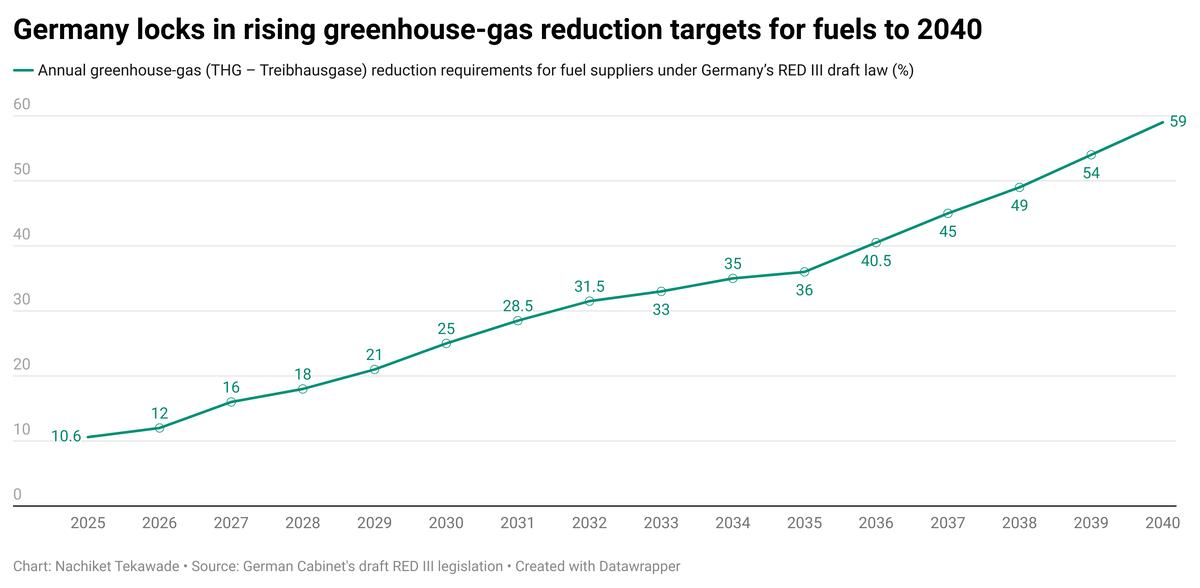
According to the draft, fuel suppliers would be required to reduce the greenhouse gas (GHG) intensity of the fuels they sell. The baseline GHG intensity in RED III is 94 grams of carbon dioxide-equivalent per megajoule of energy (94 gCO2e/MJ), and Germany is set to mandate a 12% reduction next year, rising to a 59% by 2040.
Fuel suppliers would not only meet the overall GHG reduction intensity targets, but also comply with minimum sub-quotas for specific fuel types.
The draft law retains a dedicated sub-quota for advanced biofuels made from waste and residue feedstocks, with required shares rising from below 1% in the mid-2020s to around 9% by 2040.
Under the earlier RED II system, some advanced biofuels could be counted twice once minimum targets were met, meaning suppliers could meet emission rules using smaller amounts of actual biofuel. This was done to boost their economic attractiveness and stimulate initial uptake.
The draft law will end double counting from 2026, meaning suppliers will need to use more actual biofuel. As a result, demand could almost double because volumes that once counted twice will now count only once, a Prima Markets analyst noted.
Removal of double counting would lead to higher demand in road transport, so this could impact the available biofuel supply for shipping, the analyst said.
The draft law said that the introduction of mandatory on-site inspections, or witness audits, for fuel production outside Germany has been pushed to 2027.
In addition, the proposal to exclude biofuels made from palm oil, palm oil residues and POME from counting toward Germany’s GHG intensity reduction quota under the new RED III framework, will also be effective from 2027.
The delay has disappointed Germany’s biofuels industry, which had pushed for the POME exclusion to apply from 2026 in order to more quickly reduce competition from overseas supplies that are widely seen as fraudulent, Prima Markets said.
Even though the POME exclusion does not apply to maritime bunkering, it is expected to reduce supply in the German market, the analyst said.
The legislation will also introduce binding minimum quotas for renewable fuels of non-biological origin (RFNBOs), such as green hydrogen-based e-fuels.
The RFNBO quota will start at 0.10% of suppliers’ fuel mixes in 2026 and rise steadily to 8% by 2040. These fuels will be mandated despite concerns over insufficient supply and high prices relative to conventional fuels.
These changes have yet to pass through legislative hearings in order to be enacted into German law. That process is expected to conclude early next year.
Market sources broadly believe that the law will be implemented retroactively in 2026, with 1 January 2026 as the effective date.
By Nachiket Tekawade
Please get in touch with comments or additional info to news@engine.online