IEA revises global oil demand forecast
The Paris-based International Energy Agency (IEA) expects global oil demand to decline by 2.7 million b/d in 2026 to 102.3 million b/d – about 100,000 b/d higher than its previous estimates.
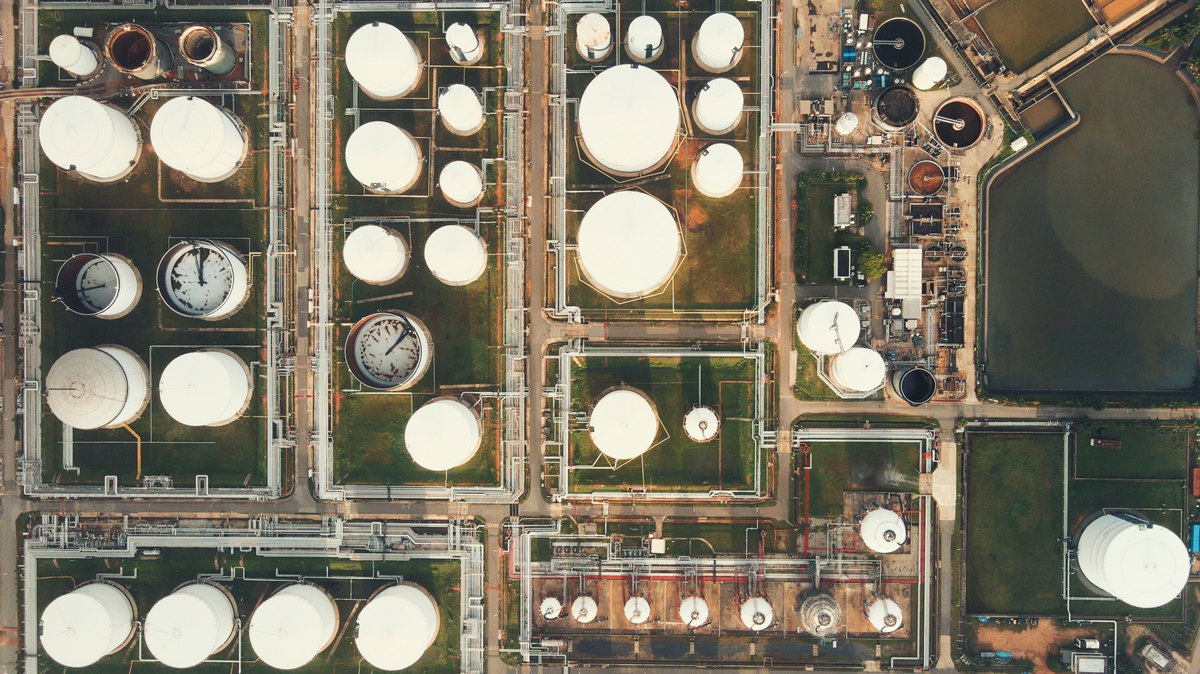
 IMAGE: Oil storage tanks. Getty Images
Global oil demand has continued to drop due to the ongoing blockade of the Strait of Hormuz, and elevated oil prices continue to choke consumption, the IEA said.
Oil demand growth will continue its slump due to “disruptions to exports of refined products and LPG from the Gulf, remaining at roughly half of pre-war levels,” the energy agency said.
Global oil demand is projected to recover modestly next year, contingent on an end to hostilities in the Middle East. The IEA sees oil demand to expand by 2 million b/d in 2027 – the same as its previous estimates.
Global supply and demand balances suggest that the global oil market will return to a surplus in the fourth quarter of this year, and to a substantial build in 2027, the IEA said.
“As always, downside risks to the forecast persist, as attacks on shipping undermine maritime security, which is pivotal to a sustained recovery,” the energy agency added.
Supply estimates
Global oil supply increased by 2.3 million b/d, to 105.4 million b/d in October, largely driven by growing output from the Persian Gulf producers, despite ongoing attacks on energy infrastructure and commercial tankers, the IEA noted in its monthly Oil Market Report (OMR).
“The oil market is showing tentative signs of rebalancing, with global oil supplies surpassing demand for the first time since the outbreak of the war in Iran,” the IEA said.
Despite continued attacks on oil tankers, Persian Gulf oil exports, excluding Oman, reached 18.4 million b/d last month, 26% below pre-war levels.
“The recent increase was led by crude, with flows rising to 15 mb/d [15 million b/d], equivalent to 82% of pre-war levels in October,” the IEA noted.
Notably, the Americas Quintet – the US, Canada, Brazil, Argentina and Guyana – are on track to boost output by 1.6 million b/d in 2026.
After a decline of 4.8 million b/d this year, global oil supply is expected to rebound by 6.6 million b/d, reaching an average of 108.1 million b/d in 2027, according to the Paris-based energy agency.
This includes a “a 5.3 mb/d [5.3 million b/d] increase in Gulf production and a further 1.1 mb/d [1.1 million b/d] gain from the Quintet,” the IEA noted.
Projection by the US Energy Information Administration (EIA)
The US Energy Information Administration (EIA) expects the Brent crude spot price to average near $100/bbl for the remainder of this year, before declining to around $77/bbl in the fourth quarter of 2027.
The EIA forecasts Brent crude’s price to stay elevated this year, amid falling global oil inventories and repeated attacks on oil tankers attempting to transit the Strait of Hormuz.
Global liquid fuels production is expected to reach 101.69 million b/d in 2026 – about 600,000 b/d higher than the EIA’s previous estimate.
In 2027, total liquid fuels production is projected to touch 108.40 million b/d – 1.15 million b/d lower than the EIA’s September estimates.
OPEC's liquid fuels production is expected to average around 24.50 million b/d this year – about 570,000 b/d higher than its previous projection.
The US energy agency forecasts global oil demand to reach 102.38 million b/d in 2026 – about 50,000 b/d lower than its previous forecast.
Oil demand growth is expected to rebound in 2027 to around 104.35 million b/d.
By Aparupa Mazumder
Please get in touch with comments or additional info to news@engine.online