IMO majority holds firm on GHG pricing and fund – UCL
30 countries open to softer near-term GFI targets
Two-tiered GFI structure draws broad support
38 countries back retaining a central financial mechanism
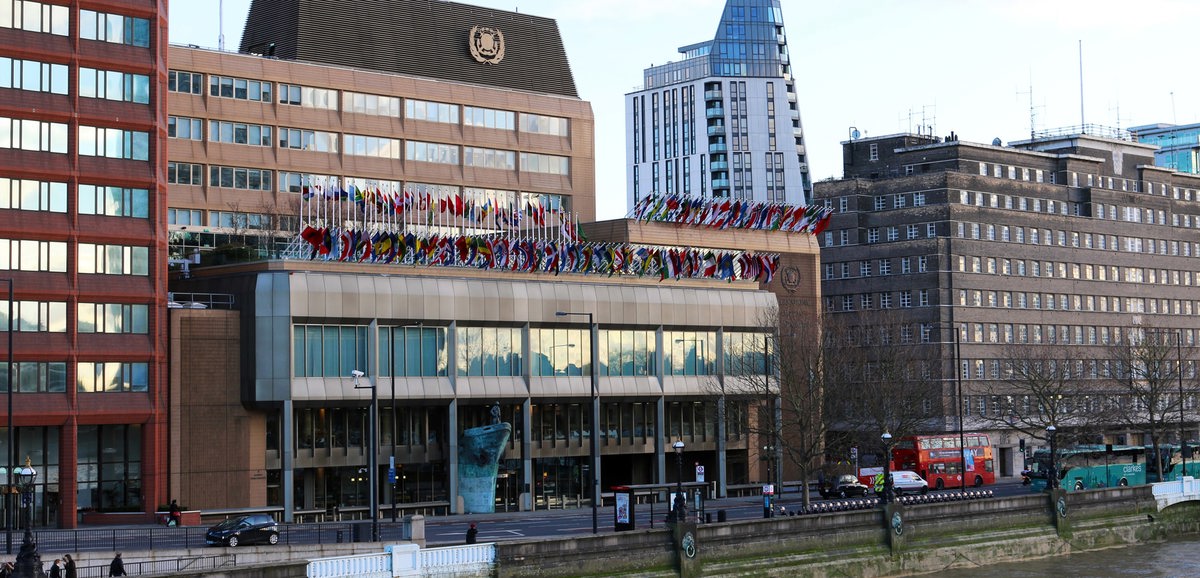 IMAGE: IMO headquarters in London. X of @IMOHQ
The 22nd Intersessional Working Group on Reduction of Greenhouse Gas Emissions from Ships (ISWG-GHG 22) met on 1-4 September to consider proposals addressing concerns over the draft MARPOL Annex VI amendments approved at MEPC 83 in April 2025.
24 member states attending the closed-door meetings favoured retaining the GHG fuel intensity (GFI) reduction targets as approved in April 2025, according to a report by University College London's (UCL) Shipping and Oceans Research Group.
The current version of the Net-Zero Framework (NZF), approved at MEPC 83 in April 2025, introduces a two-tiered greenhouse gas (GHG) fuel standard that would require ships to progressively reduce their well-to-wake GFI from 2028 onwards.
The draft sets the base reduction factor at 65% by 2040.
30 member states were open to easing GFI reduction requirements between 2029-35, the report said.
This included 23 member states that favoured compensating for the softer start with steeper reductions later in the 2030s. But a lack of clarity over the exact targets left the trajectory open to further negotiation, the authors noted.
10 countries backed an approach linking GFI targets more closely to fuel affordability, availability and scalability, as proposed by Liberia and supported by the US.
Discussions also revisited whether the 2040 target approved in April 2025 should remain in the framework. 35 member states backed retaining it, while 16 preferred to remove it and determine the target later.
The two-tier structure of base and direct targets, supported in separate proposals from Brazil, Tuvalu and Japan, drew backing from 30 member states, compared with 17 that favoured Liberia’s proposed single-tier system based only on the base target.
The financial mechanism produced a more pronounced majority.
UCL counted 38 member states supporting a fund, facility or similar structure, while 17 others favoured a technical-only system without a central financial mechanism.
The existing NZF would require non-compliant ships to buy remedial units (RUs), with the revenues flowing into an IMO Net-Zero Fund to support uptake of low- and zero-emission fuels and accelerate a just and equitable transition.
Japan proposed allowing shipowners to instead make equivalent payments directly to eligible projects.
UCL said this proposal was "robustly rejected", highlighting that only 12 countries supported direct contributions, while another 12 explicitly opposed the Japanese concept and 32 backed RU payments.
On the other hand, the Chinese proposal to balance RU and reward payments that could be netted to form a single transaction received broad support, it said. However, several delegations raised concerns over how the system would work in practice, with the details still to be developed through guidelines.
32 countries favoured retaining a specific incentive for the use of low- and zero-emission fuels, while 14 argued that a separate reward was not needed or opposed it.
29 delegations were open to further consideration of a multiplier that could award additional surplus units to promote the use of low- and zero-emission fuels, while nine opposed it. Its interaction with the existing ZNZ reward mechanism remains unresolved.
There was "clear potential for a return to a strong policy solution" this year, but uncertainty remained over support for the industry's transition and lower-income countries, lead report author Tristan Smith said.
While member states did not reach a consensus, ISWG-GHG chair Sveinung Oftedal said delegations had shown a "genuine willingness" to make further progress. The group invited delegations to work between sessions towards proposals that could attract greater convergence.
Discussions will continue at ISWG-GHG 23 on 23-27 November, ahead of MEPC 85 on 30 November to 3 December. ISWG-GHG 23 will also include discussions on the IMO’s lifecycle GHG assessment (LCA) framework, which were deferred because of time constraints.
Any revised text emerging from MEPC 85 could then be put forward for adoption at the second extraordinary session, scheduled to resume on 4 December, subject to discussions at MEPC 85.
By Konica Bhatt
Please get in touch with comments or additional info to news@engine.online