India could become regional alternative-fuel bunker hub by 2047 in best case - DNV
DNV’s model assumes that Indian ports could capture up to 80% of container transhipment currently handled by Sri Lanka, provided delivered fuel costs fall first.
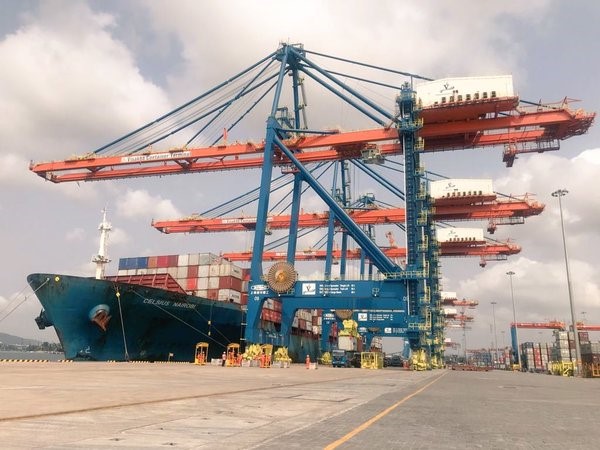 IMAGE: Container ship berthed at the port of Visakhapatnam. @vptIndia via Twitter
India does not need to match Singapore to become a regional hub for low- and zero-carbon bunkers, classification society DNV said in a study for the IMO and India’s Directorate General of Shipping. It can build one from strong cargo flows, port locations on the East-West trade lanes and renewable energy supply. The study recommends a three-phase strategy to achieve this: pilot projects at selected container ports by 2030, regional clusters by 2035 and multi-fuel hubs by 2047.
The volumes stay modest next to established hubs. DNV modelled three scenarios, which are its own assumptions rather than Indian government targets. In the best case, India wins 80% of Sri Lanka’s container transhipment, and demand for alternative fuels reaches 293 petajoules by 2047, equal to 7.30 million mt of HFO.
The slowest case gives 113 petajoules, or 2.80 million mt, and the middle case assumes India wins half of Sri Lanka’s transhipment. Singapore sold 54.92 million mt of bunkers in 2024, against 2.25 million mt across Indian ports.
Cost decides whether ships bunker in India. In DNV’s case study, India would have to deliver bio-methanol about 5.5% cheaper than a rival hub to tempt a large container ship off its route, at around $30/GJ (gigajoule) against around $32/GJ. The study also suggests that alternative marine fuels should be exempted from the 5% GST that India applies to bunker fuel for foreign-going ships.
Production costs look more promising. India’s state-owned Solar Energy Corporation of India (SECI) ran 13 auctions for green ammonia in July and August 2025, for 10-year supply to fertiliser plants. The ministry of new and renewable energy said the first bid was far below the price found in the H2Global auction in 2024, though still above conventional grey ammonia. Producers also receive incentives for their first three years. DNV said ammonia at around that price level would already sit within its competitive range for 2035 and 2047.
The study recommends concentrating early investment where container ships already call. It proposes a methanol pilot at Mundra, supplied from the green hydrogen hub at Deendayal Port in Kandla, about 75 km away. Jawaharlal Nehru Port and the Chennai-Tuticorin corridor would follow.
By 2035, it recommends setting up a west coast cluster, linking Kandla, Mundra and Jawaharlal Nehru Port, and an east coast cluster, linking Chennai, Tuticorin, Paradip and Visakhapatnam. Expansion would depend on proven demand, reliable supply and available bunker vessels, which industry representatives interviewed for the study flagged as scarce. Ammonia would come later, with interim safety guidelines for 2-3 pilot ports between 2030 and 2035.
Some of this is already moving. A planned 150 mt/day e-methanol plant at Kandla has a first phase of 50 mt/day targeted for January 2027, and the ministry of ports, shipping and waterways said all output is earmarked for ships on the Asia-Europe route. VO Chidambaranar port in Tuticorin ran methanol bunker drills earlier this month. The study also points to green shipping corridors with Rotterdam and Singapore as a way to line up fuel supply with ship demand.
By Tuhin Roy
Please get in touch with comments or additional info to news@engine.online