Insurance squeeze clouds Hormuz shipping despite Trump’s $20 billion backstop
Surging war-risk premiums and uncertainty around a proposed $20 billion US reinsurance backstop could discourage shipowners from returning to the Strait of Hormuz.
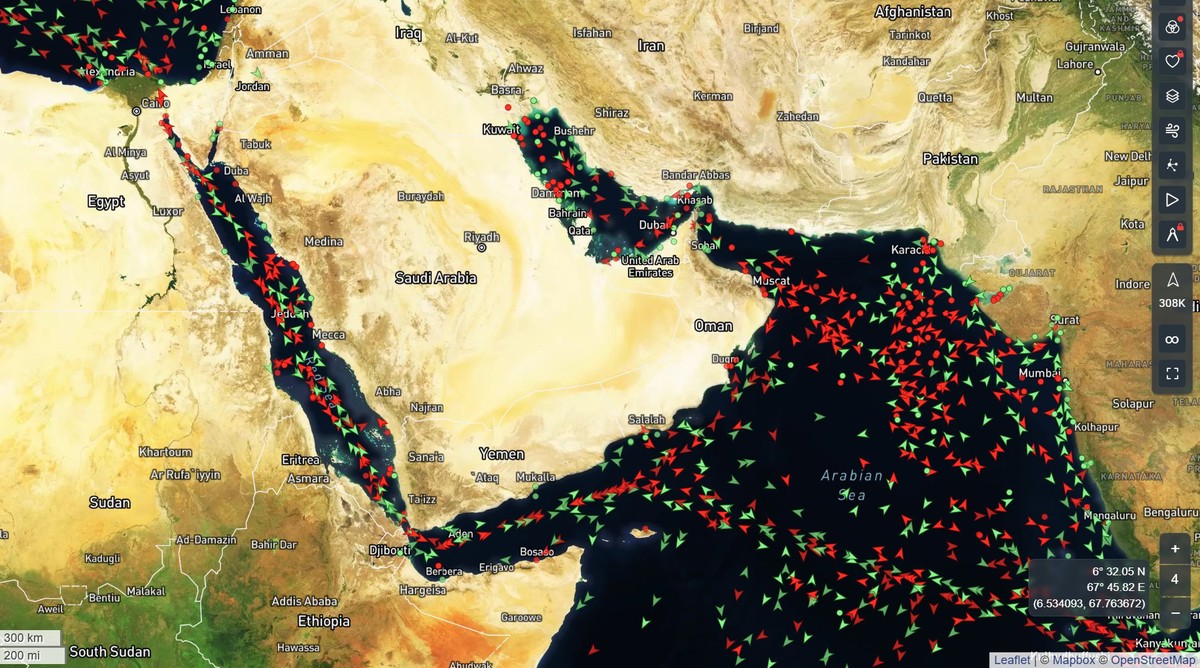 IMAGE: Live cargo (green) and tanker (red) vessel traffic around the Red Sea and Strait of Hormuz. MarineTraffic
Sharp repricing and withdrawal of war-risk insurance cover could discourage commercial ships from transiting from one of the world’s most critical energy corridors.
Several global marine insurers have withdrawn war-risk coverage for vessels entering Iranian waters and the wider Persian Gulf since 5 March, citing heightened security concerns.
Without war-risk cover, ships operating in areas of active conflict face sharply higher risk premiums, additional security requirements and potential exposure to losses typically excluded from standard marine insurance policies.
This has pushed premiums to around 1–1.5% of a vessel’s total insured hull value, analysts note.
“Insurance premiums at six-year highs make transit economically unviable for most operators,” Amena Bakr, head of Middle East insights at Kpler said. “Insurance withdrawal is doing the work that physical blockade has not. The outcome for cargo flow is largely the same.”
Vortexa’s freight analyst, Wanying Zhang, added that lack of insurance availability is creating a market stand-off.
“A collapsing insurance market has created a ‘financial blockade’ just as effective as a naval one,” Zhang said.
The Joint War Committee of the Lloyd’s Market Association and International Underwriting Association has expanded its additional premium zones to include Bahrain, Djibouti, Kuwait, Oman and Qatar. The revised area now covers waters stretching from the southern Red Sea below 18°N across the Arabian Sea to waters off Pakistan and southwards to the Somalia coastline.
Some insurers, such as NorthStandard, are offering additional premiums at higher rates. But these rates are typically charged as a percentage of the ship’s insured value and cover only about seven days of transit.
Clarity lacking around US lifeline
The US International Development Finance Corporation (DFC) has launched a $20 billion reinsurance plan aimed at restoring commercial shipping through the Strait of Hormuz.
The government-backed agency said the scheme will insure losses up to about $20 billion “on a rolling basis” and will apply “only to vessels that meet the criteria,” but has not clarified on the eligibility of the criteria.
DFC added that the programme will initially focus on Hull & Machinery and cargo insurance.
The agency added it has identified “preferred American insurance partners” and is coordinating with the US Treasury and US Central Command (CENTCOM) on the implementation.
“Working alongside CENTCOM, DFC coverage will offer a level of security no other policy can provide,” said Ben Black, chief executive of the DFC.
“We are confident that our reinsurance plan will get oil, gasoline, LNG, jet fuel, and fertilizer through the Strait of Hormuz and flowing again to the world,” Black added, noting that the reinsurance will “safeguard the continued flow of trade” through Hormuz.
But Vortexa’s Zhang noted that provisions of DFC’s $20 billion reinsurance “is still a question mark for the market”, adding that shipowners are likely to wait for clearer details on how the scheme will operate before risking voyages through the Strait of Hormuz.
By Konica Bhatt
Please get in touch with comments or additional info to news@engine.online