Major bunker ports poised to lead green fuel transition - LR study
Major ports with established bunkering infrastructure and strong industrial links are likely to lead the early adoption of low- and zero-emission marine fuels, according to a Lloyd’s Register (LR) report.
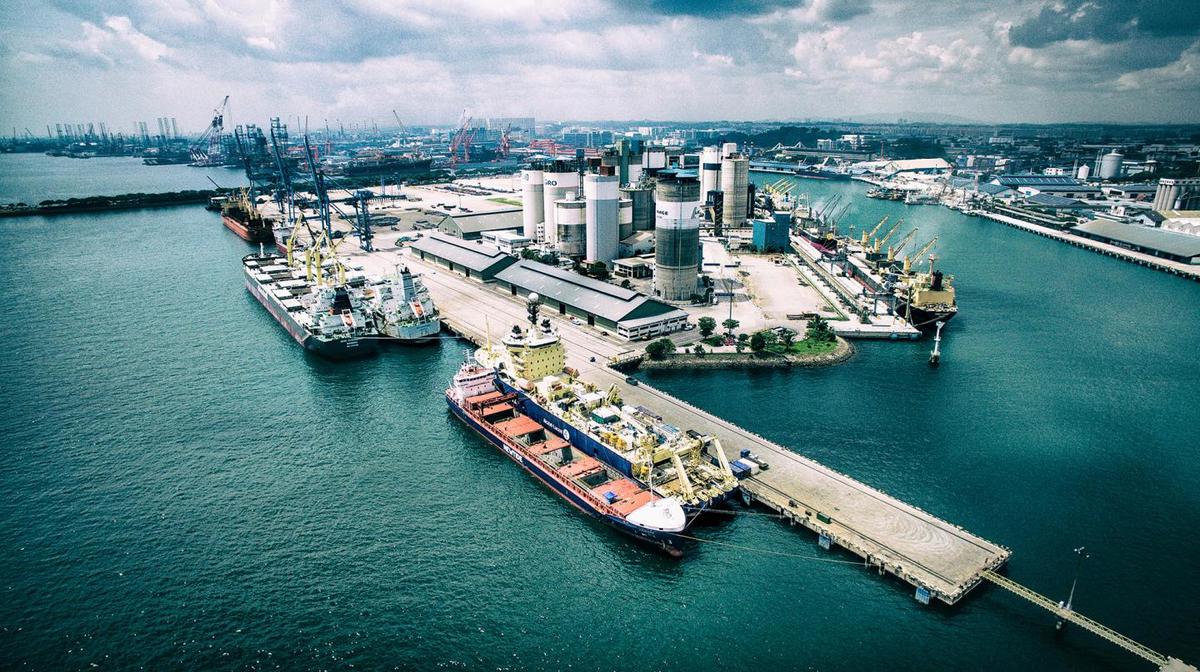
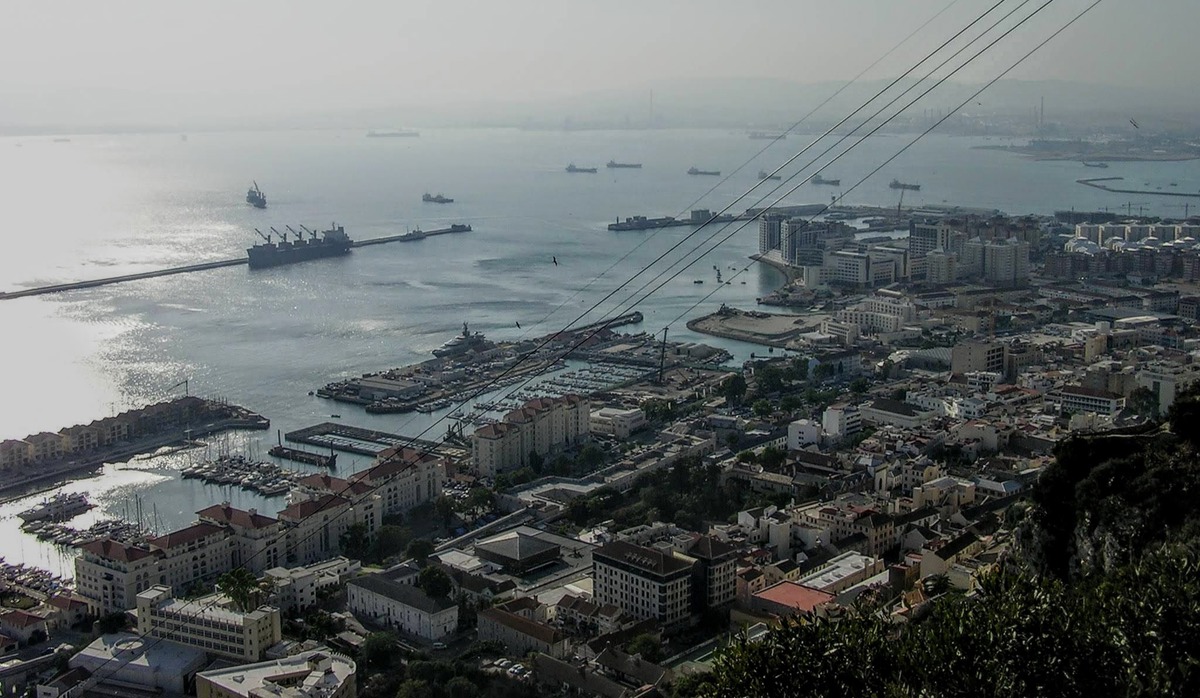 IMAGE: Aerial view of Port of Gibraltar. Getty Images
“Early adoption of sustainable maritime fuels is most likely to happen in ports that already operate as high-throughput, tightly regulated bunkering systems, because they can add new fuels while maintaining delivery assurance and safety,” the LR report notes.
Singapore and the ARA hub are best positioned to scale bunkering of low- and zero-emission fuels such as green methanol and green ammonia.
Singapore benefits from its large bunker market, established regulatory framework and ongoing work on ammonia and methanol bunkering standards. The ARA cluster offers extensive terminal infrastructure, established supplier networks and integrated logistics systems.
North Sea-Baltic and Scandinavian ports including Copenhagen, Aalborg, Esbjerg, Gothenburg, Sundsvall and Gdańsk could also emerge as early adopters, supported by EU climate policies, offshore wind development and regional support for green methanol, ammonia and hydrogen projects.
Southern European ports such as Valencia, Barcelona, Castellón, Genoa, Huelva and Sines are well positioned due to their links with refining, chemical and logistics industries that could support fuel production, storage and distribution.
Tanger Med in Morocco could gain an early advantage because its designation as a “neighbouring container transhipment port” under EU ETS rules may increase pressure to offer fuels that help shipowners manage carbon costs.
Major Chinese major ports could also move quickly.
LR points to Shanghai, Dalian and Xiamen as likely plausible early adopters because of strong regional demand and the country's ability to rapidly expand infrastructure. Ningbo-Zhoushan and Yantian could gain from high vessel traffic.
Other locations identified as potential early adopters include Hamburg, Los Angeles and Vancouver, alongside Middle Eastern ports such as Ain Sokhna, Port of Duqm, Port of Salalah, NEOM Port (Oxagon) and Yanbu.
Panama and Gibraltar are flagged because of their strategic position along major shipping routes.
Beyond bunkering demand, the report identified at least 127 e-fuel projects worldwide that could eventually supply the maritime sector, but cautioned that most of these projects are still at the pre-final investment decision stage.
The largest concentration of projects is located across the Middle East and North Africa, particularly along the Arabian Sea, Red Sea and Suez Canal trade routes, where developers are integrating fuel production with port and industrial infrastructure.
Australian e-fuel projects linked to ports including Gladstone, Dampier and Port Hedland can benefit from abundant renewable energy resources and policies aimed at supporting large-scale fuel production.
Across Asia, e-fuel projects are concentrated along the coastlines of India, North China, Malaysia, Vietnam and Indonesia. In Africa, several green ammonia projects are advancing near ports in Mauritania, Namibia and South Africa.
European e-fuel projects are largely centred around established industrial ports such as Rotterdam, Vlissingen, Hamburg and Brunsbüttel, “indicating Europe’s role is likely to be both an importer and a bunkering hub rather than purely an export region,” the study finds.
In South America, developers are advancing e-fuel projects near Pecém and Aratu in Brazil. Argentina's Patagonia region is also attracting interest, with projects linked to Punta Colorada and Río Grande positioned close to Atlantic shipping routes.
The report also identified 51 potential fuel distribution ports connected to biomethanol, bioethanol and biomethane projects. These include facilities near Montreal, Halifax, Santos, Tianjin and Caofeidian, as well as several locations across the Nordic region.
The report notes that biofuels could support early adoption because they can often use existing bunkering infrastructure while helping build demand for future methanol- and methane-based fuel supply chains.
By Konica Bhatt
Please get in touch with comments or additional info to news@engine.online