Recap 2025: Biofuel bunkering expanded across Europe
European biofuel bunkering expanded across multiple fronts in 2025, with more suppliers entering the market, wider geographic availability across ports, and growing logistical and commercial support underpinning deliveries.
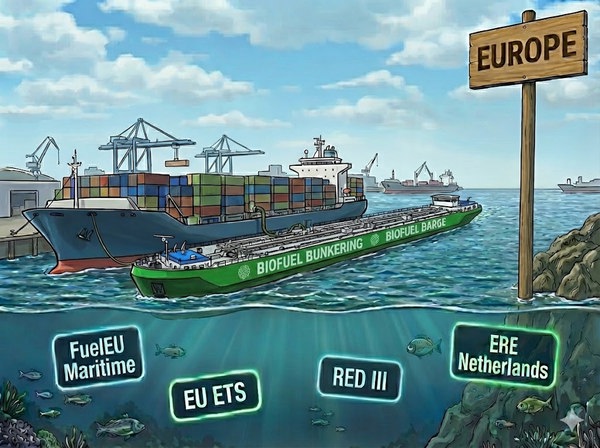 IMAGE: ENGINE with Gemini
Suppliers increase coverage
More suppliers launched supply in new and already established biofuel bunker locations across Northwest Europe, the Mediterranean and Scandinavia this year.
Northstar Bunkering expanded beyond the ARA with a new bunker tanker that can blend B24 biofuel onboard. The locations include several ports across Germany, France and the UK.
ExxonMobil Marine started supplying fatty acid methyl ester (FAME)-based bio-HSFO and bio-LSMGO blends by barge to vessels calling at ports in the UK.
In the Mediterranean, Enilive, a subsidiary of Italian energy firm Eni, began offering HVO-based marine biofuels to ships by barge in the ports of Genoa and Ravenna.
Greece’s Coral Marine, a subsidiary of Motor Oil, launched biofuel supply in two of the country’s ports - by barge in Piraeus, and by truck in Lavrio.
The company supplies B24-LSMGO blends, with the LSMGO produced at one of Motor Oil’s refineries, and used cooking oil methyl ester (UCOME)-based biofuel produced at the group’s plant called VERD.
Scandinavia also saw additional biofuel bunkering capacity. Biofuel Express started offering physical deliveries of HVO and B100 by truck in all ports in southern Norway, southern Sweden, Denmark and northern Germany, with barge deliveries planned in the future.
ScanOcean started offering HVO-based biofuel blends in Finnish ports.
Commercial uptake and infrastructure expands
The year also saw increasing commitments from shipping companies to take on biofuel.
A new biofuel green corridor between the ARA and Brazil is expected to increased biofuel uptake. Chemical tanker firm Odfjell has entered into an offtake agreement for B24 blends to be bunkered in Brazil's Rio Grande.
Moeve signed a deal to supply 40,000 mt of pure biofuel to Spanish ferry operator Armas Transmediterranea in Las Palmas and Tenerife through 2025.
Norwegian Cruise Line is increasingly looking to power its European cruises with biofuel. It has signed a deal with Repsol to bunker biofuel in Barcelona from the 2026 summer season. The cruise company has signed a separate biofuel supply deal with ARA supplier Burando Energies.
Suppliers have also boosted biofuel infrastructure, especially in the ARA. Burando said it will repurpose its Amsterdam terminal to store around 30,000 cbm of biofuel across eight tanks.
Peninsula has added blending and storage capacity at the Chane Terminal in Rotterdam.
Some areas of Europe remain behind on biofuel bunkering, largely due to insufficient bunkering infrastructure. For example, no biofuel bunkering is planned in Malta in the foreseeable future, despite it being a popular bunker stop for vessels transiting the Mediterranean.
Data backs visible growth
These developments have gone hand-in-hand with increased biofuel bunker sales in the ARA hub, the biggest bunkering hub in Europe. Rotterdam’s bio-bunker sales rose to 201,000 mt in the third quarter of 2025, official port data shows. That was a 18% increase from the second quarter, and a 45% jump from the same quarter last year.
The port of Antwerp-Bruges reported bunker sales of 56,000 mt in the third quarter, which was the highest level since the port authority started releasing numbers in the third quarter of 2024.
Regulatory drivers
The increase in bunker sales and corresponding growth in biofuel availability and infrastructure has been backed by tighter regulations.
This was FuelEU Maritime's first year in effect. To avoid steep penalties, shipping companies with vessels in the EU have either had to bunker biofuel and other low-emission fuels, buy compliance surpluses from other shipping companies or borrow compliance with interest from next year. Many have chosen the biofuels route.
The combined effects of FuelEU Maritime and the EU ETS have for the first year ever made it cost-effective to opt for biofuels and liquefied biomethane (LBM) based on regulations. Ships bunkering these fuels in Rotterdam and transferring or selling on their FuelEU Maritime overcompliance to other vessels in a pool have consistently been able to outperform ships running on pure fuel oil or gasoil on EU-EU voyages this year.
This regulatory leg up for biofuels and LBM could be reinforced next year, with a fully phased in EU ETS, higher emission allowance costs for fossil fuels. Various EU nations' transpositions of the EU's third Renewable Energy Directive (RED III) is poised to create new incentives to bunker biofuels, and disfavour some biofuel feedstocks over others.
Dutch HBE tickets will be replaced by a new ERE system from tomorrow, which could weaken the competitiveness of advanced Dutch biofuels for bunkering. Certain suppliers have already announced surcharges for fuels delivered in 2026, but the real price impact will only become evident once we see more trading into the new year.
By Nachiket Tekawade
Please get in touch with comments or additional info to news@engine.online