Recap 2025: The Year in Alternative Fuels
IMO adoption deferred by one year
FuelEU pooling rewires bunker economics
Multi-fuel pathways expand
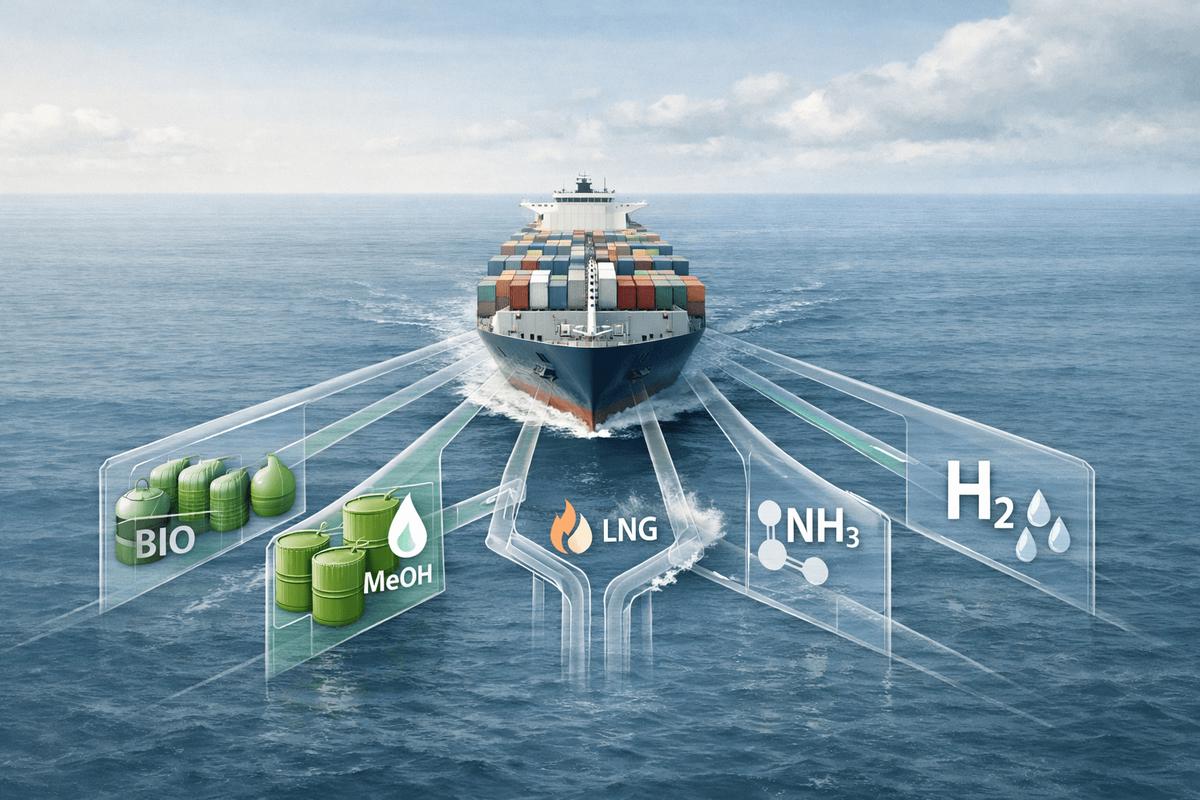 IMAGE: ENGINE with ChatGPT
Another year of delay at the IMO
Adoption of the long-awaited IMO Net-Zero Framework (NZF) was deferred by a year at the second extraordinary session of the Marine Environment Protection Committee (MEPC ES-2) in London.
The delay extended the absence of a global climate regime for shipping and exposed the fragility of multilateral consensus.
Not all states wanted a delay. 49 states voted against a deferral. This group included Brazil, Singapore and the EU bloc, which were joined by climate-vulnerable island states such as Tuvalu, Vanuatu and the Marshall Islands, and the African nations of Namibia, South Africa and Seychelles.
But they were outnumbered by the 57 member states that voted to postpone adoption.
The delaying bloc was led by the US and Saudi Arabia and backed by major flag states such as the Bahamas, Liberia, as well as other OPEC+ members including the UAE, Kuwait and Qatar.
Some earlier supporters of the Net-Zero Framework, like India, Panama, Kenya also voted to postpone. Abstentions from Japan, South Korea and Greece further eroded momentum.
The result? Yet another year without a global framework and the regulatory clarity it was meant to deliver.
Not all observers viewed the delay as failure. The Mærsk Mc-Kinney Møller Center for Zero Carbon Shipping stressed that the IMO’s 2050 net-zero target remains intact, arguing that the case for a single global framework is stronger than ever, even if near-term clarity is lacking.
Singapore’s Global Centre for Maritime Decarbonisation echoed that view, suggesting the pause could accelerate regional action.
The Net-Zero Framework will be revisited at the IMO in a year. Non-profit Transport & Environment has warned that with the delay, the framework might not be implemented until the end of the decade. It has urged the IMO to use the extra time to close gaps, tighten biofuel safeguards and finalise lifecycle accounting rules.
Regional momentum takes shape
While a global greenhouse gas (GHG) regulation for shipping has stalled, the first-ever regional GHG framework underscored how regulatory design can shape bunker fuel economics and market behaviour.
The total cost of bunkering and consuming biofuels and liquefied biomethane (LBM) became much lower in the EU because shipowners could make use of FuelEU Maritime's pooling mechanism and avoid paying for them to comply with the EU Emissions Trading System (EU ETS).
Those economics have been underpinned by the option for vessels running on low-emission fuels to generate FuelEU compliance surpluses that can be transferred or sold to undercompliant vessels in pools.
The result has been a noticeable rise in biofuel and LBM bunkering activity and growing participation in pooling arrangements. Shipowners placed vessels running on these fuels into pools, either operated in-house by suppliers such as Gasum and FincoEnergies or managed via external platforms like Ahti, which is used by the supplier Neste and ScanOcean.
Latvia rolled out loans and capital support for biomethane production and infrastructure.
The UK confirmed plans to extend its Emissions Trading Scheme (UK ETS) to international shipping.
Shanghai’s Maritime Safety Administration in China began developing an international sustainable fuel certification system. Hong Kong launched some incentives for LNG and green methanol bunkering.
Overall, 2025 saw pockets of progress in a handful of countries amid a broader global backtrack towards fossil fuels.
A multi-fuel future, indeed
Every alternative fuel had its moment in the sunshine in 2025, underlining once again that no single option owns shipping’s green fuel transition.
Biofuels enjoyed a regulatory breakthrough early in the year. In February, the IMO’s Sub-Committee on Pollution Prevention and Response finalised interim guidance allowing bunker tankers to carry up to 30% biofuel blends (B30), up from 25%.
B30 deliveries were carried out in Singapore, Fujairah and Hong Kong using regular bunker tankers. India issued guidelines allowing B30 bunkering across all of its ports.
LNG retained its dominance in newbuild orderbooks for yet another year, with 624 vessels on order for delivery by 2033. This was buoyed by LBM’s rising role in EU compliance strategies. At the same time, a growing number of e-methane production projects were announced, offering early signals of future low- and zero-emission methane supply.
Methanol followed close behind, with 97 methanol-capable vessels already in operation and 353 on order for delivery towards 2030.
European Energy produced the world’s first drop of e-methanol for bunkering at its Kassø plant in Denmark with A.P. Moller–Maersk as a key offtaker. It delivered a total of 2,500 mt in the first nine months of 2025.
Methanol engines also flirted with greater flexibility, as Maersk trialled a 10% ethanol and 90% e-methanol blend on a methanol dual-fuel ship, with plans to ultimately test 100% ethanol. Engine makers Everllence and Wärtsilä are testing ethanol on methanol dual-fuel engines and WinGD aims to launch ethanol-capable engines to the market by 2027.
Ammonia moved decisively from concept to near-term reality.
WinGD and Everllence launched ammonia engines tested with 5% pilot fuel. Itochu ordered the world’s first ammonia bunkering vessel and announced plans for ship-to-ship operations in Singapore by 2027.
Cargo owners also stepped in to support investments in multiple alternative fuels.
Hapag-Lloyd and North Sea Container Line will deploy e-methanol- and green ammonia-powered vessels under agreements with the Zero Emission Buyers Alliance, whose cargo owner members will pay premiums for the equivalent of 120,000 mt of GHG emission reductions through a book-and-claim model.
Even hydrogen had its moment, with Japanese firms completing the world’s first land-based tests of marine hydrogen engines, and Japan Engine preparing to trial a two-stroke hydrogen internal combustion engine next spring.
Here are key stories from the past week:
Hapag-Lloyd orders eight methanol dual-fuel vessels
German RED III draft spares shipping, but may strain biofuel supply
Singapore biofuel bunkering slows as methanol makes a comeback
Gulf Coast eyed for first commercial methanol bunkering in US
By Konica Bhatt
Please get in touch with comments or additional info to news@engine.online