The Week in Alt Fuels: Can December deliver a breakthrough?
The IMO’s GHG working group negotiations showed broad support for core elements of the Net-Zero Framework, but greater backing for softer near-term GFI targets.
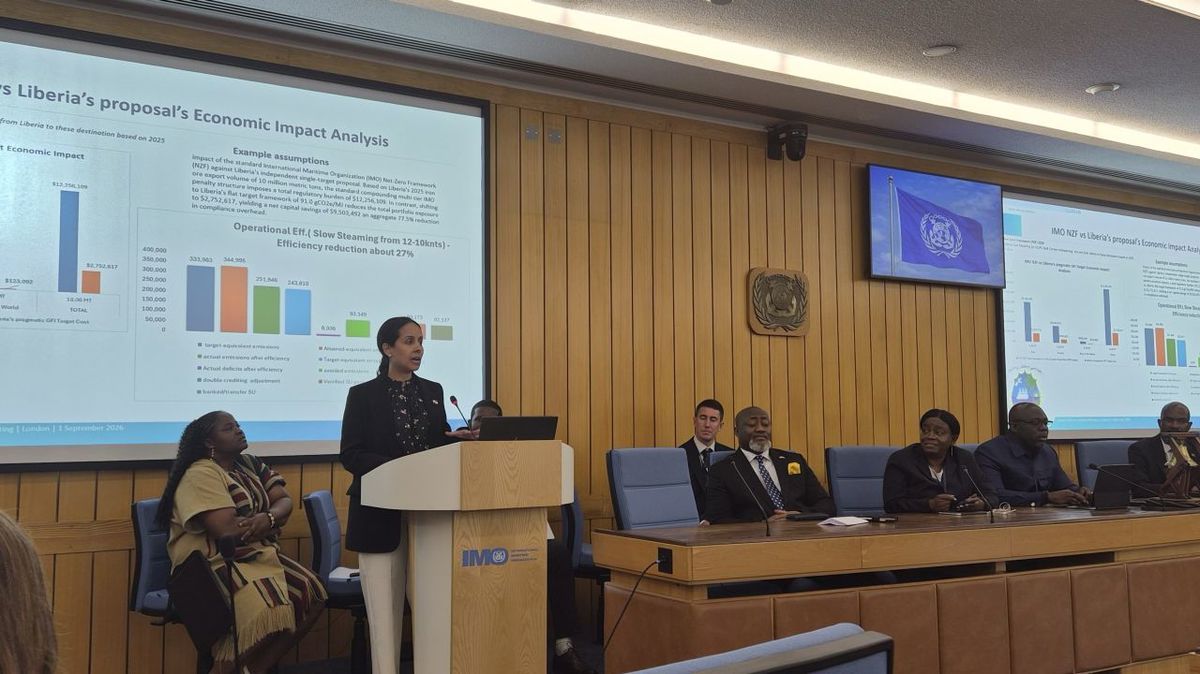 IMAGE: Panama's IMO representative Ginette Testa presenting the Liberia-Panama proposal to African representatives at the ISWG-GHG 22. Linkedin of the Permanent Mission of Panama to IMO
Member states now have less than three months to close the gaps and secure adoption this year.
John Taukave and John Fatuimoana Kautoke shared an anecdote from last week's 22nd IMO Intersessional Working Group on Reduction of GHG Emissions from Ships (ISWG-GHG 22) in London. Both are researchers at the Micronesian Center for Sustainable Transport (MCST).
One Caribbean delegate attending the meeting told Taukave that being back in the negotiating room felt like déjà vu. Kautoke added that it certainly felt like they were repeating last year all over again, after hearing the “same interventions… more organisations, but same interventions” that surrounded MEPC 83, at the ISWG-GHG 22.
And that sense of déjà vu is hard to miss - though the numbers tell a different story.
A draft version of the Net-Zero Framework (NZF) was approved for circulation at the IMO's 83rd Marine Environment Protection Committee (MEPC 83) meeting in April 2025, after a week of negotiations failed to produce consensus on a flat-rate levy.
63 of the 79 member states present and voting were in favour and 16 were against. 24 member states abstained from voting. The US walked out and did not participate in the procedure. But the vote still marked a rare multilateral compromise.
The amendments were then circulated for formal adoption in October 2025, only for the extraordinary MEPC session to be adjourned for a year as divisions once again persisted.
11 months later, the divide has shifted rather than hardened, and analysis by University College London's Shipping and Oceans Research Group shows it has shifted towards a softer start.
It found 30 member states at ISWG-GHG 22 were open to easing GHG fuel intensity (GFI) reduction requirements during 2029-35. Another 24 favoured retaining the trajectory approved in April 2025.
30 supported a two-tier GFI structure of base and direct targets and 17 favoured Liberia’s proposed single-tier system.
38 member states leaned towards a fund, facility or similar financial structure, against 17 that wanted a technical-only system without a central financial mechanism.
32 supported retaining a specific incentive for low- and zero-emission fuels and 14 said a separate reward was unnecessary or opposed it.
There was “clear potential for a return to a strong policy solution” this year, but uncertainty remained over support for the industry's transition and lower-income countries, lead report author Tristan Smith said.
And the devil will be in the detail. Countries still have to settle the GFI trajectory, compliance system, financial mechanism and incentives for zero- and near-zero-emission fuels, including whether to introduce a multiplier offering additional rewards for their use.
Several implementation guidelines also remain unfinished. Discussions on lifecycle assessment (LCA) guidelines, which determine how fuel emissions are calculated on a well-to-wake basis, were pushed to November because ISWG-GHG 22 ran out of time.
Countries’ own accounts of the ISWG-GHG 22 meeting show where they want that softer start to lead.
Panama advocated for a "practical, balanced and inclusive" transition, according to its Permanent Mission to the IMO. It wants the framework to reflect “availability, scalability and affordability of alternative fuels” while still delivering verifiable emissions reductions.
Saudi Arabia pushed for “realism” and “technological neutrality” through six working papers assessing how the proposed measures might affect global trade, its Permanent Representative to the IMO, Kamal Al Junaidi, said.
India called for an initial preparatory period to gauge fuel readiness and practical feasibility of low- and zero-emission bunker fuels, followed by a phase in which the industry could build up operational experience before the main measures take effect, India’s Directorate General of Shipping said.
Argentina acknowledged progress on some technical elements, according to Carlos Recio, technical adviser at Argentina's Permanent Representation to the IMO. He said significant differences remained over the design and governance of a financial mechanism and how it could support Small Island Developing States (SIDS) and Least Developed Countries (LDCs).
MCST's Kautoke said Caribbean and Pacific Island nations would resist further compromises if oil-exporting member states were unwilling to budge on the financial mechanism and the trajectory.
But there is still a route to adoption this year.
ISWG-GHG 23 meets on 23-27 November, followed by MEPC 85 on 30 November-3 December. If member states find enough common ground, or decide to put to a vote one of the amendment proposals already circulated under the six-month rule, the adjourned extraordinary session could resume on 4 December for formal adoption.
But “procedurally, a vote to delay always takes precedence so if one is called for then that vote has to happen first,” a source told ENGINE. If the MARPOL Annex VI amendments are not adopted this year, the next opportunity could come at MEPC 86 in October 2027.
For now, member states have nearly three months to bridge some fundamental differences and dot the i’s and cross the t’s. So is another multilateral win possible this December? On the numbers, yes, but the question is what is left of the framework by then.
In other alt fuels news this week, the global LNG bunker vessel fleet needs to expand to 165-208 vessels by 2030, up from roughly 70 vessels currently in operation, according to a new white paper from DNV. With more than 30 additional vessels contracted for delivery between 2026 and 2029, the report warns that bunkering capacity is struggling to keep pace with the rapid expansion of the LNG-capable fleet.
Brazilian mining firm Vale has entered a long-term shipping contract with South Korean shipping company HMM for transportation of iron ore on methanol-capable newbuilds. HMM ordered eight 210,000-dwt methanol- and ethanol-capable bulk carriers in June, with deliveries scheduled to begin in 2030.
Chinese producer CIMC Enric supplied a large bio-methanol stem to a Nippon Yusen Kabushiki Kaisha (NYK) Group bulk carrier at the Lantau Anchorage in the Port of Guangzhou. Sinobunker's bunker vessel Daqing 268 delivered around 1,000 mt of pure bio-methanol via ship-to-ship (STS) bunkering to the methanol dual-fuel bulk carrier Green Future, operated by NYK subsidiary NYK Bulk & Projects Carriers.
By Konica Bhatt
Please get in touch with comments or additional info to news@engine.online