The Week in Alt Fuels: Grey clouds for green methanol
Few confirmed green methanol production plants and demand from sectors beyond shipping could stiffen competition for volumes towards the end of the decade.
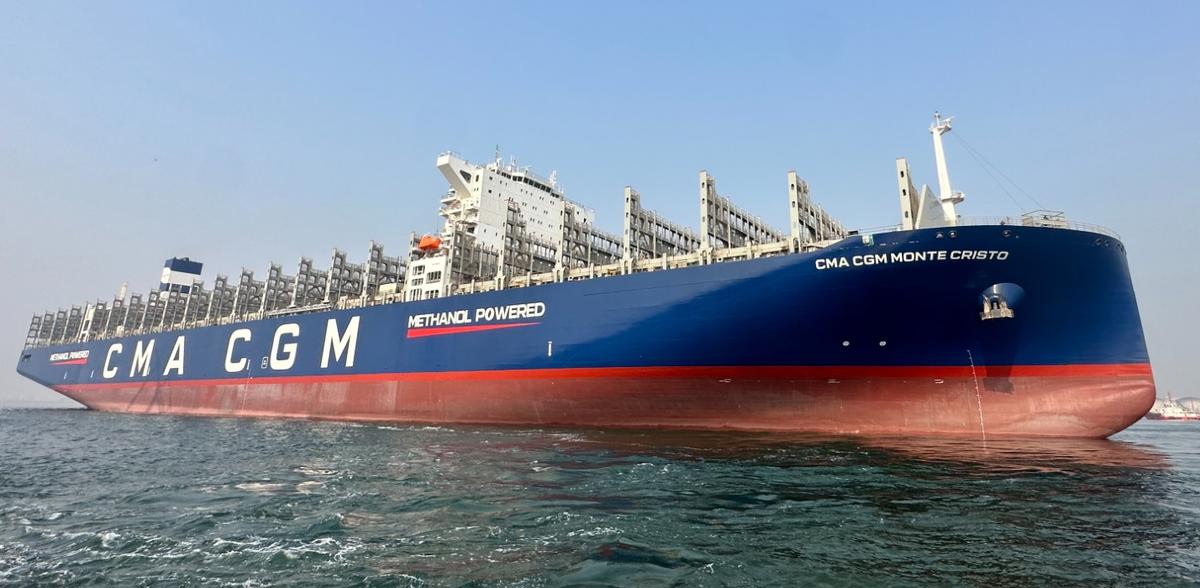 IMAGE: CMA CGM has taken delivery of two methanol-capable vessels this month. The CMA CGM Monte Cristo is one in six methanol dual-fuel 15,000-TEU vessels. CMA CGM
Correction: Renewable methanol production capacity would only fall short of bunker demand if projected vessel consumption reaches its theoretical maximum of 14-15 million mt/year. In reality, consumption is likely to be much lower and a projected production capacity of 6-13 million mt/year could then be sufficient to meet this demand. We have added a low-consumption scenario from DNV to illustrate this point, along with a comment from GENA Solutions chief executive Vitalii Protasov.
Methanol’s role as a bunker fuel is expanding as more vessels enter service and bunkering infrastructure gradually develops across ports.
But a recent comment by Reolum’s chief executive Yann Dumont has raised an important question. Some shipping companies want to secure e-methanol supply “ahead of the competition spike foreseen by 2030–2032,” he told ENGINE.
An e-methanol project typically needs around two years for development and another 2-3 years for construction. With relatively few such projects underway today, shipowners could find themselves scrambling for supply later this decade, especially if sustainable aviation fuel demand rises alongside shipping, Dumont stressed.
“This points to a structural dynamic in the market: vessel orders are moving faster than fuel projects reach bankability,” the Methanol Institute told ENGINE in a reply to Dumont’s comment.
Renewable methanol demand projections vary widely.
DNV lists 112 methanol-capable vessels already in operation and another 337 on order for delivery towards 2030.
A separate DNV report from December estimated that, theoretically, the maximum methanol consumption from methanol-capable vessels could be 14-15 million mt/year by 2030. But in reality, demand is likely to be much lower, especially without the pull of a global regulation like the IMO’s postponed Net-Zero Framework.
DNV laid out another scenario where methanol-capable vessels use only enough low-GHG methanol to meet the FuelEU Maritime GHG intensity target. In that scenario, consumption is closer to 1-1.5 million mt/year by 2030. Consumption will likely be topped up some by EU ETS-driven demand, and by voluntary demand from cargo owners and passengers willing to pay for low-emission voyages.
Paper capacity vs reality
But the availability of green molecules seems to be lagging far behind.
For instance, HAMR Energy has announced a 300,000 mt/year biomethanol project in Australia by 2030. Repsol is building a 240,000 mt/year biomethanol plant in Spain by 2029. Perpetual Next has announced three plants in the US, one in Estonia and another in the Netherlands, but has not confirmed the timelines.
Most of these facilities are currently at various stages of development and financing.
European Energy’s Kassø plant delivered around 2,500 mt in the first nine months of 2025, with A.P. Moller-Maersk as a key offtaker. But on a global scale, this is a very small number.
The Methanol Institute (MI) tracks 252 bio- and e-methanol projects globally, with a combined capacity of 45.1 million mt/year by 2030. But it estimates that only 6-13 million mt/year of this capacity will actually materialise by then, as many projects still face financing and development hurdles.
“The estimated capacity range of 6-13 Mt [million mt/year] by 2030 is based on our global renewable methanol demand scenarios, among other factors. While the methanol-capable fleet could technically consume up to 15 Mt [million mt/year], shipping companies do not plan to consume that volume by 2030," commented Vitalii Protasov, chief executive of GENA Solutions, which has developed and manages a methanol project database with MI.
"Operational capacity could be higher if demand increases - that is, if there is greater willingness to pay for methanol - not merely due to technical capability,” Protasov said.
Competition from other sectors
Renewable methanol volumes are likely to be spread across multiple industries, such as aviation, chemicals and power.
“Not only shipowners but furniture manufacturers that use methanol as raw material for glue are also considering a future shortage scenario with high prices,” Carlos Lopez, a methanol industry analyst, told ENGINE.
Producers such as Methanex, Repsol, European Energy and Shanghai Electric are already allocating supply beyond shipping. If demand for green molecules from competing sectors rises, it could tighten availability for bunkering.
China’s export hurdle
Some biomethanol production for bunkering has started to emerge in China. Towngas produces around 6,000 mt/year at its Inner Mongolia facility. Shanghai Electric has started producing 50,000 mt/year at its Taonan plant in Jilin, with plans to reach 250,000 mt/year by 2027. Goldwind’s 500,000 mt/year biomethanol project is also expected to start this year, according to Maersk.
But China’s decision to abolish VAT rebates on certain exports from April this year has raised concerns over projects targeting international bunker markets.
“Renewable methanol projects linked to maritime transport are more exposed because shipping currently represents the most advanced source of demand for renewable methanol and it’s the only major end-use sector where demand is being driven by regulation,” a spokesperson at MI told ENGINE.
Many renewable methanol projects in China have been developed specifically to serve international bunker demand under long-term offtake agreements.
Any rise in export costs will have a "direct and immediate impact on project economics and delivered fuel prices," the spokesperson added.
Distance adds cost
Geography could also play a role in future costs.
Several bio- and e-methanol projects are being developed far from major bunker ports such as Singapore or Rotterdam. These green molecules may need to be transported over long distances for physical deliveries to the vessels, which could add to overall delivery costs.
“While most bunkering capacity is concentrated in Asia and Europe, the limited infrastructure along US coasts highlights emerging regional disparities,” DNV said in a report.
Against this backdrop, some large shipowners have already moved to secure supplies.
Maersk has signed long-term offtake agreements with 12 producers, covering at least 2.2 million mt/year of bio- and e-methanol by 2027.
CMA CGM has signed a long-term offtake agreement with Shanghai Electric. Hapag-Lloyd has agreed to purchase biomethanol from China’s Goldwind.
But a shipowner who has invested in methanol-capable dual-fuel vessels and prefers to wait for the fuel market to mature may face a different risk.
If green methanol supply tightens by 2030, prices could rise sharply. Bunker buyers could find it difficult to justify paying steep green premiums, especially when vessels can technically run on cheaper fossil methanol or conventional fuels instead.
In such a scenario, regulatory incentives and voluntary demand for green freight might not cut it to make low-emission methanol attractive.
In other news this week, tank storage operator Vopak and bunker supplier Global Energy Trading are working to enable more green methanol bunkering in Singapore. Green methanol will be loaded at Vopak’s Tianjin terminal in China and shipped to the company’s Penjuru terminal in Singapore, where it will be stored and made ready for bunker operations, according to Vopak.
Galveston LNG Bunker Port (GLBP) has partnered with US-based ship management firm TOTE Services to deploy a fleet of Jones Act–compliant LNG bunker vessels along the US Gulf Coast. Under the agreement, the companies plan to develop and operate purpose-built LNG bunker vessels to meet growing demand in the greater Houston port complex.
Authorities at the Port of Barcelona will launch a commercial tender for methanol bunkering and expect to host the first trial this year.
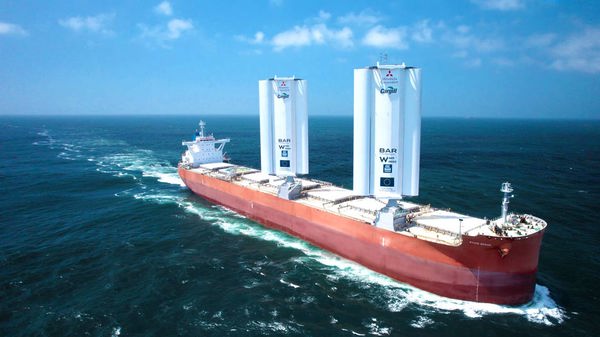
London-headquartered Anemoi Marine has installed four rotor sails on a bulk carrier owned by Singapore-based dry bulk operator Berge Bulk. The project follows a similar installation of four 35-metre rotor sails on the bulk carrier Berge Neblina in June 2024.
By Konica Bhatt
Please get in touch with comments or additional info to news@engine.online