The Week in Alt Fuels: Making claims count
Several shipping companies have launched book-and-claim schemes to offset the cost of bunkering green fuels. But they must prove that the resulting emissions reductions go beyond regulatory requirements.
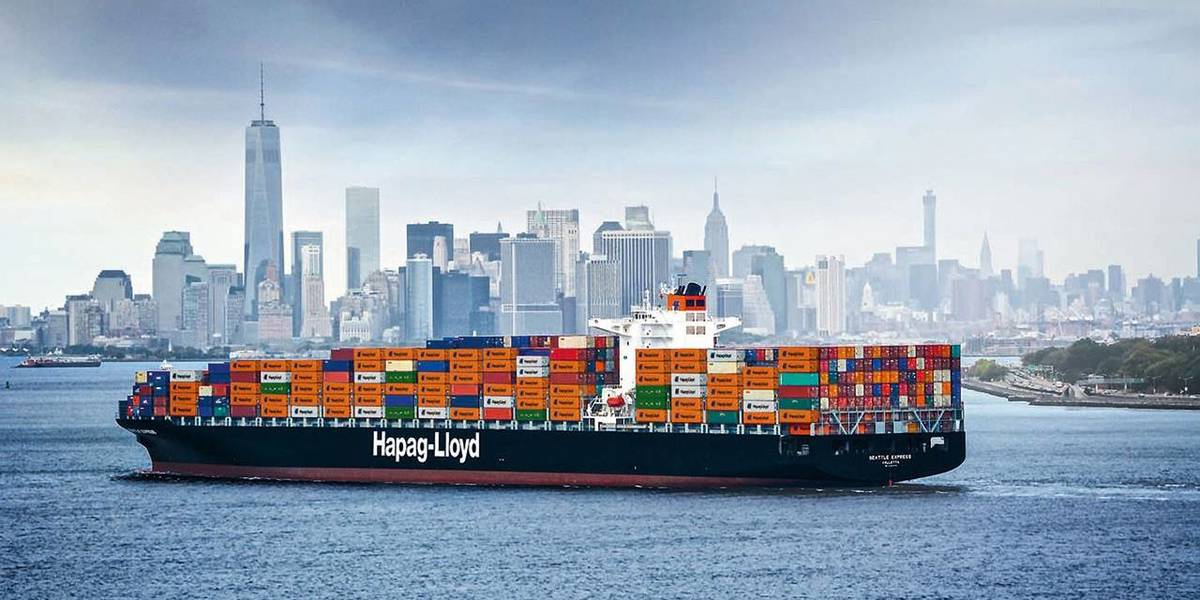 IMAGE: Hapag-Lloyd offers biofuel-based low-emission shipping. Hapag-Lloyd
Norwegian vessel operator G2 Ocean has launched a biofuel-based insetting programme allowing any company reporting Scope 3 supply chain emissions to purchase emissions reduction certificates.
Danish logistics provider Scan Global Logistics (SGL) has extended its use of Hapag-Lloyd's book-and-claim programme, claiming emissions reductions linked to the container liner’s consumption of used cooking oil methyl ester (UCOME) biofuel.
French food producer Bel has joined CMA CGM's programme, purchasing emissions reductions linked to biofuel use across part of the French carrier's fleet.
Other shipping companies such as Norden and Mitsui O.S.K. Lines (MOL) also offer this service.
Book-and-claim "decouples the characteristics from the physical product," industry body Mærsk Mc-Kinney Møller Center for Zero Carbon Shipping explained.
In practice, this allows a cargo owner to claim emissions reductions even if its own shipment is transported on a conventional-fuelled vessel, as long as it purchases an associated emissions reduction certificate.
The model allows shipping companies to offset part of the additional cost of low- and zero-emission fuels by selling verified emissions reductions. At the same time, cargo owners can reduce their reported Scope 3 supply chain emissions.
G2 Ocean has opened its programme beyond its own customers. Any company reporting Scope 3 supply chain emissions can purchase emissions reduction certificates generated by its biofuel voyages, it said.
“The revenue will be reinvested in new biofuel voyages, helping create a cost-sharing model for biofuel and narrowing the gap between biofuel and regular [conventional] fuel,” G2 Ocean added.
Book-and-claim can help accelerate uptake of low- and zero-emission fuels by creating demand signals to support early investment, particularly while fuels such as green ammonia and green methanol remain constrained by limited availability, the International Transport Forum (ITF) said in a February report.
By allowing customers to pay for emissions reductions from low-emission fuels before those fuels are widely available in ports, the system can provide fuel producers and shipowners with stronger commercial signals to invest.
But several challenges remain before book-and-claim can become a mature and widely adopted solution.
One of the biggest unresolved hurdles around this model is the common definition of “additionality” and rules around the criteria required for book-and-claim schemes, the Global Maritime Forum (GMF) and ITF both argue in separate reports.
ITF and GMF explain that additionality means ensuring that book-and-claim supports emissions reductions beyond those already required by regulation.
For example, if a shipowner uses biofuel only to meet its FuelEU Maritime compliance obligation, selling book-and-claim certificates linked to those emissions reductions will not create any additional environmental benefits. To satisfy the principle of additionality, shipowners must use more biofuel than they need to meet their regulatory requirements.
“Because alternative fuel use required by regulations would occur without any voluntary market, the voluntary market should therefore only be used to incentivise the use of alternative fuels that would not occur in its absence. It should, in other words, go beyond regulatory obligations,” GMF argued.
Shipping still lacks a widely accepted definition of additionality, making harmonised rules essential if book-and-claim is to remain credible as the market expands, GMF said.
ITF also warned that multiple book-and-claim registries and certification systems are emerging simultaneously, creating risks of fragmentation, inconsistent standards and potential double-counting of emissions reductions.
It also noted that market confidence can be undermined if market participants are unsure how additionality applies and if book-and-claim will be recognised by regulators and verifiers.
In other news this week, Chinese bunker supplier China Marine Bunker (Chimbusco) has signed a green methanol procurement agreement with state-owned energy company Shenergy Group for use as marine fuel. Under the agreement, Chimbusco will procure 6,000 mt of green methanol, representing the largest single green methanol procurement deal completed in China to date, according to Chimbusco Europe.
Nordic biogas producer St1 Biokraft will supply liquefied biomethane (LBM) to Destination Gotland's ferry services during the summer season and Sweden's Almedalen Week 2026. Physical deliveries will be carried out by bunker supplier Avenir LNG in the Port of Visby.
Dutch bunker supplier Verde Marine Energy (VME) has started physical biofuel bunkering in the ARA region with its first B100 delivery. While it is initially offering only B100, the company is "looking into other collaborations" to supply blends such as B30, which contains a 30% biofuel component, Joe Tierney, head of trading at Verde Marine Energy, told ENGINE.
Bunker supplier Axpo has conducted a ship-to-ship bio-LNG bunkering operation in Barcelona on a vessel operated by Japanese shipping company Mitsui O.S.K. Lines (MOL). MOL’s vehicle carrier, Lapis Ace, received an unspecified amount of bio-LNG from Axpo's bunkering vessel Green Pearl.
By Konica Bhatt
Please get in touch with comments or additional info to news@engine.online