The Week in Alt Fuels: Net-zero battlelines
Competing proposals from Tuvalu, Brazil, Liberia and a four-country group can take the IMO's Net-Zero Framework in very different directions.
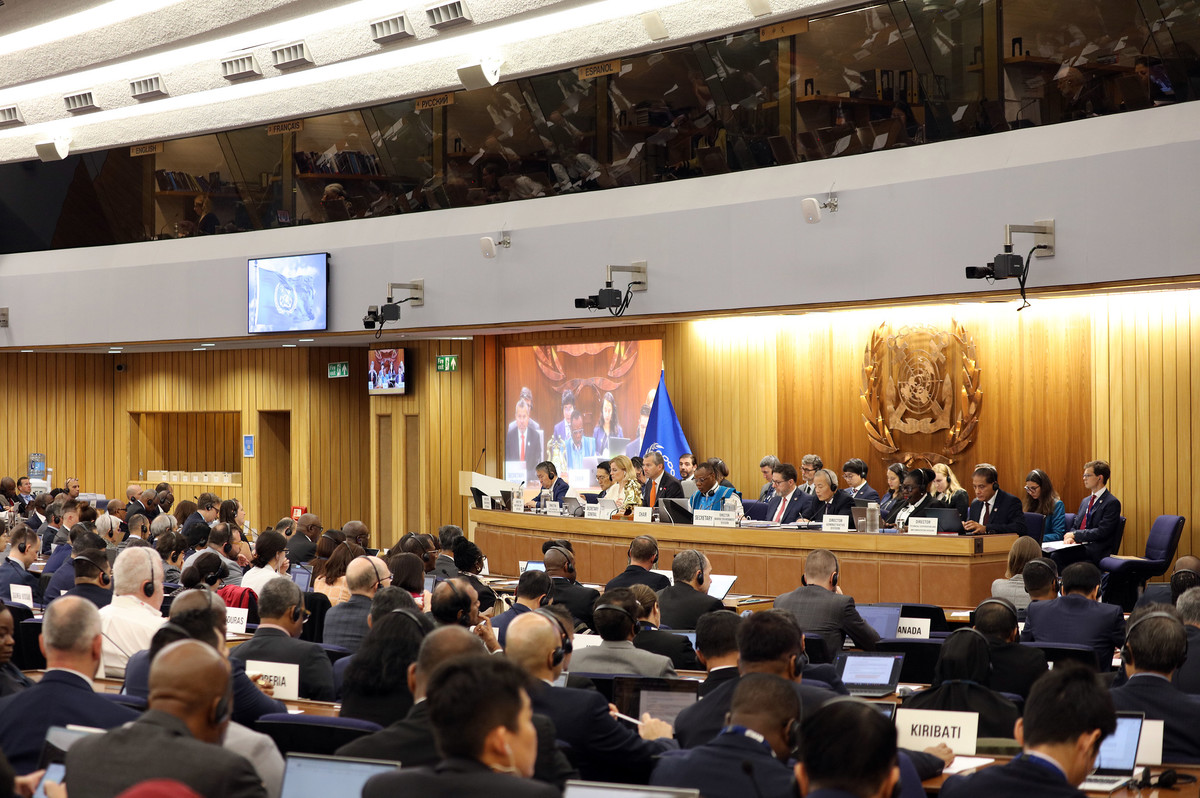 IMAGE: Opening of the IMO Marine Environment Protection Committee 2nd extraordinary session in London. Flickr of IMO
This November, the IMO's Marine Environment Protection Committee (MEPC) will head back to the drawing board with competing visions for shipping's net-zero rulebook.
While the framework approved at MEPC 83 in April last year remains the starting point, the options now on the table range from significantly strengthening its economic measures to removing greenhouse gas (GHG) pricing altogether.
Japan has submitted an alternative proposal, but its eligibility for adoption remains uncertain.
The most ambitious proposal comes from Tuvalu.
The island nation has proposed keeping the Net-Zero Framework's (NZF) base GHG fuel intensity (GFI) reduction targets unchanged but dropping the 2028 step, so the trajectory begins at 6% in 2029. It suggests a direct compliance target of 100% from 2029 to 2035.
Tuvalu has also proposed tripling the initial Tier 1 remedial unit price from $100/mtCO2e to $300/mtCO2e, leaving Tier 2 at $380/mtCO2e. It would scrap surplus units altogether, so both tiers could be balanced only by paying into the IMO Net Zero Fund.
This approach would generate the largest revenue pool to support zero-emission fuels and a just and equitable transition. But it would result in the highest transport cost increases, particularly during the early years, said Tristan Smith, co-lead of the Shipping and Oceans Research Group at University College London.
A joint proposal submitted by Australia, Canada, South Africa and the UK (ACSA-UK) leaves the current NZF largely unchanged, including its emissions intensity targets and compliance payment levels. But it would delay implementation by one year after negotiations were postponed amid severe disagreements at MEPC ES.2 in October 2025.
The NZF puts the polluter pays principle into practice by ensuring those responsible for emissions help finance the transition in the most climate-vulnerable countries, said Sapphire Ross, policy officer at Opportunity Green.
"Governments should protect this hard-fought agreement and resist attempts to weaken the core economic elements that underpin its effectiveness," she added.
Brazil has taken a more gradual approach.
Its proposal eases compliance requirements in the first two years by aligning the base and direct compliance targets in 2029 and 2030, before reverting to the approved NZF trajectory from 2031 onwards. To offset the softer start, it has proposed tightening the long-term base target to 70% in 2041, instead of 65% in 2040, while giving shipowners more time to adjust in the early years.
Liberia's submission, which builds on the proposal jointly submitted by Argentina, Liberia and Panama to MEPC 84, sits at the other end of the spectrum.
It removes GHG pricing entirely and revises the GFI reduction trajectory. Instead of aligning GFI targets with the 2023 IMO GHG Strategy checkpoints, they would be calculated based on the cost, availability and market share of low-emission fuels, with the trajectory recalculated every five years.
It also retains surplus units (SUs) as the sole compliance mechanism, replacing the NZF's pricing system. Ships would be able to transfer, bank and borrow surplus units to meet their GFI targets.
Smith argues this could create greater uncertainty over future fuel standards and compliance credit prices because the framework would no longer be anchored to specific emissions reduction goals. He also notes that, without a dedicated fund, there would be no obvious mechanism to support a just and equitable transition or redistribute revenues to countries most affected by higher transport costs.
Opportunity Green argues that Liberia's proposal would replace mandatory remedial units with "greater reliance" on a market-based surplus unit trading mechanism.
"This would weaken the stable price signal needed to unlock long-term investment in genuinely zero-emission fuels, instead exposing compliance costs to the volatility of carbon markets," the non-profit said.
"At the same time, removing or substantially reducing contributions to the Net Zero Fund would strip away a dedicated source of finance to help developing countries build capacity, strengthen resilience and participate in the maritime transition."
IMO member states including Oman, Kuwait, Jordan, Somalia, Yemen and Tunisia supported the Liberian proposal during the MEPC 84 discussions in April 2026.
Japan has put forward a basis for discussion seeking to soften GFI reduction targets from 2030 onwards while replacing payments into the Net Zero Fund with a "direct contribution" mechanism. Instead of purchasing remedial units, shipowners could either buy surplus units to cover non-compliance or contribute directly to projects proposed by member states and approved by the MEPC.
According to Smith, the proposal addresses concerns raised by the US and other countries over the IMO managing large revenue flows.
However, allowing companies to decide where compliance payments are directed can weaken incentives for zero- and near-zero-emission fuels, complicate governance and introduce additional uncertainty into both compliance credit markets and investment decisions, he argued.
The “direct contribution” mechanism would provide little commercial incentive for shipowners to direct contributions towards projects in small island developing states or least developed countries, said Sinem Onis, vice president of energy at Marsh McLennan.
In addition, opening direct competition between lower-cost options such as LNG and biofuels and more expensive zero- and near-zero-emission fuels could naturally favour the cheaper technologies.
Proposals by Tuvalu, ACSA-UK, Brazil and Liberia will now be debated at the IMO's intersessional GHG working group meetings in September and November, before delegates consider the framework at MEPC 85 from 30 November to 3 December.
If member states agree on a final text, the amendments could then be formally adopted at the second extraordinary session of the MEPC (MEPC ES.2), expected to reconvene on 4 December.
Japan's proposal faces a procedural hurdle as draft MARPOL amendments are normally required to be circulated at least six months before adoption under the IMO procedures. This means a proposal submitted after June would not ordinarily be eligible for adoption in December.
In this case, member states could choose to waive that requirement and proceed with adopting the NZF at MEPC ES.2. Alternatively, they could delay adoption to a later session, such as in 2027, Smith said.
In other alt fuels news this week, green marine fuels are “substantially more expensive” than the fossil alternatives they are expected to replace, partly because fossil fuel prices do not reflect the cost of climate damage, according to the Maersk Mc-Kinney Møller Center for Zero Carbon Shipping (MMMCZCS). It says the gap can be bridged with targeted financial support and subsidies.
Belgian shipping company Exmar is set to convert the 146,000-cbm LNG carrier Simaisa into a floating transshipment unit (FTU). Once converted, the FTU will receive large LNG cargoes from conventional LNG carriers. LNG bunker vessels will then load LNG from the FTU and deliver it to LNG-capable ships.
Global bunker supplier Peninsula has signed an agreement with Evos to develop biofuel storage infrastructure at the Port of Algeciras, aiming to boost its biofuel bunker capacity in the Strait of Gibraltar. The agreement covers Dutch chemical storage firm Evos’ planned 60,000-cbm dedicated biofuel storage facility at its Algeciras terminal.
Navigator Amon Shipping has secured a $122 million loan to finance two ammonia-capable gas carriers under construction in China. The 51,000-cbm gas carriers will be designed to transport liquefied ammonia as cargo and use it as propulsion fuel. They will also be capable of carrying LPG as cargo.
By Konica Bhatt
Please get in touch with comments or additional info to news@engine.online