The Week in Alt Fuels: The retrofit paradox
Some alternative-fuel retrofit projects are moving ahead. But regulatory uncertainty is keeping broader investment subdued.
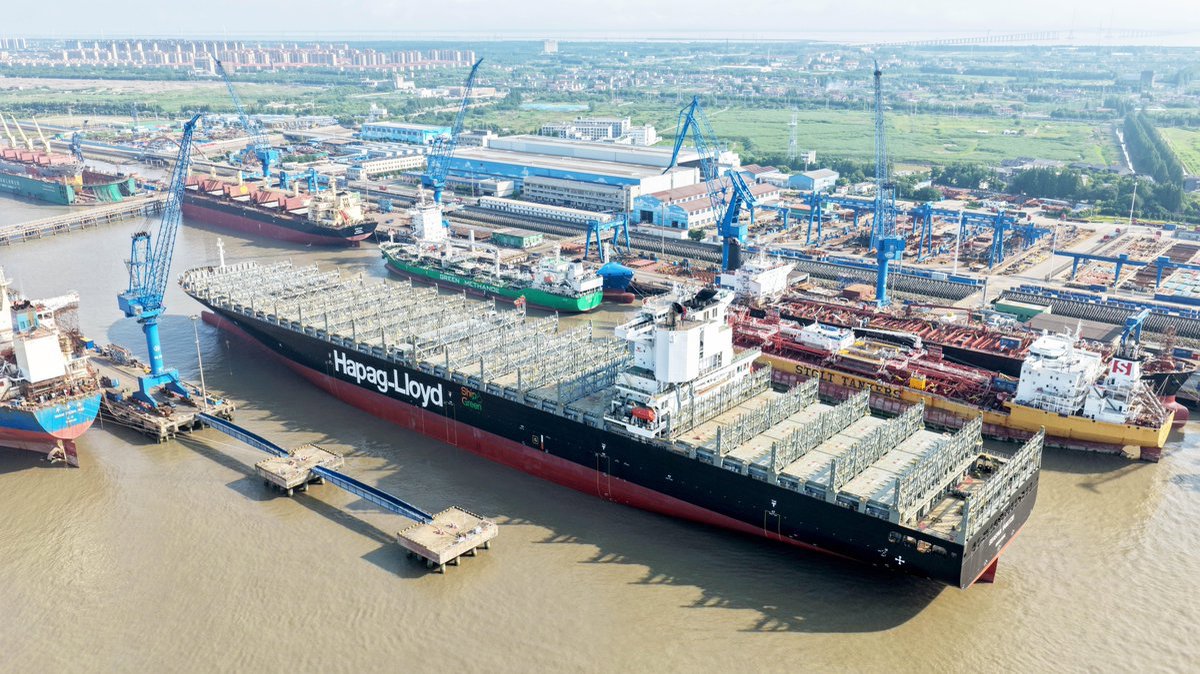 IMAGE: Dual-fuel methanol container ship Seaspan Yangtze. X of @PDChina
German shipping firm Hapag-Lloyd has taken delivery of its first methanol-retrofitted container ship.
The 10,000-TEU Seaspan Yangtze, owned by Seaspan and chartered to Hapag-Lloyd, has been converted from conventional fuel to dual-fuel methanol propulsion. This is the first of five planned retrofits in Hapag-Lloyd’s dual-fuel methanol programme.
A.P. Moller-Maersk converted its 15,000-TEU vessel, Maersk Halifax, to dual-fuel methanol propulsion.
In Norway, offshore vessel Viking Energy has entered dry dock for conversion from LNG to ammonia dual-fuel propulsion and is expected to return to service later this year.
DNV’s alternative fuel database shows that two out of three ammonia-capable vessels currently in operation are retrofitted to run on the fuel.
Despite a handful of high-profile projects, overall investment in vessel conversions remains subdued, engine-maker Everllence said.
"The retrofit market is currently in the doldrums with shipowners backing off investment until clarity arrives regarding IMO rules," said Klaus Rasmussen, project sales director at Everllence.
Even if every vessel delivered after 2030 runs on zero- or near-zero-emission fuels, around 50 GW of existing two-stroke engine capacity will still need to be converted over the next two decades to meet the IMO's net-zero target by 2050. That is equivalent to roughly 2,000 large vessels, Everllence estimated.
Around 5,300 vessels are suitable for dual-fuel conversion. But many owners are choosing energy-efficiency upgrades over alternative-fuel conversions while they wait for greater certainty around future IMO regulation, Rasmussen said.
Hesitation also stems from uncertainty over returns. Shipowners need confidence that retrofit costs can be recovered through operational savings or improved charter rates before making investment decisions, Hyoung-Seog Kim, head of commercial ship engineering and technology at Hanwha Ocean, told DNV.
Technical challenges can also emerge once vessels enter the yard, particularly when actual vessel structures differ from historical drawings, Kim added.
Not every vessel is a suitable candidate.
"Retrofits on younger ships often make good sense, but options become limited on older vessels where significant capital investment won't pay back over the vessel's operational lifespan," said Charles Haskell, then director of maritime decarbonisation at Lloyd's Register, in a 2023 report.
“Meanwhile, some new technologies cannot be installed on existing ships and the cost of a retrofit could actually work out to be more expensive,” Haskell added.
Large vessels in the container, pure car and truck carrier (PCTC) and tanker segments are among the strongest candidates, many of which are less than ten years old and valued at over $50 million.
Everllence estimates average retrofit costs at around $12 million. Conversions are generally considered commercially viable when costs remain below 25% of newbuild cost.
Converting to methanol dual-fuel propulsion typically costs 10-16% of a standard newbuild value. Ammonia conversions cost 19-24%, according to a 2022 study by the Mærsk Mc-Kinney Møller Center for Zero Carbon Shipping.
Methanol conversions are generally less expensive because fuel tanks can be installed during construction and used for conventional fuels before conversion. Ammonia systems require additional specialised equipment and more costly tank arrangements, the same study found.
It also found that converting LNG-fuelled vessels to ammonia may be less complex than converting conventional fuel oil-powered ships, as many gas-handling systems are already in place.
That finding is now being tested through the Viking Energy project.
For proponents, retrofits offer a way to preserve existing assets while preparing for future fuel pathways.
"While newbuilds will always attract the headlines, the reality is that the path to net zero runs through the ships already in service," said René Baart, head of retrofit solutions at WinGD. "Retrofits give shipowners the flexibility to reduce emissions, improve efficiency and extend the value of their assets today, not years from now."
Some shipowners may find that modifying existing vessels is less risky than ordering newbuilds while regulations and fuel choices are still unclear.
However, Everllence's Rasmussen warned that a wait-and-see approach could lead to "costly capacity bottlenecks", with the industry potentially facing a scramble for shipyard slots, engineering capacity and equipment supplies if IMO’s regulatory certainty eventually emerges.
In other news this week, the number of large commercial vessels equipped with wind-assisted propulsion systems has surpassed 100 as of June, the International Windship Association (IWSA) reported. The technology has been installed on 37 tankers, 24 bulk carriers, 24 RoRo passenger vessels and 19 cargo ships.
Singapore-based LPG shipping firm BW LPG has placed an order for eight LPG dual-fuel very large gas carriers (VLGCs) at South Korean shipbuilder Hyundai Heavy Industries. Each 90,000-cbm vessel will be capable of operating on both LPG and conventional marine fuels. The ships will be able to transport LPG cargoes and are designed with the option to be upgraded for ammonia carriage, according to BW LPG’s first-quarter 2026 financial results.
Singapore-based Global Centre for Maritime Decarbonisation (GCMD) tested 100% biofuel (B100) derived from two different feedstocks on a BHP-chartered bulk carrier. The BHP-chartered bulk carrier Berge Lyngor was bunkered in Singapore with a B100 biofuel comprising 50% tallow-derived biofuel blended with 50% used cooking oil methyl ester (UCOME)-based biofuel. The tallow-derived component was supplied by HAMR Energy and UCOME component was supplied by Mitsui & Co Energy Trading Singapore.
By Konica Bhatt
Please get in touch with comments or additional info to news@engine.online