The Week in Alt Fuels: Will the IMO follow the COP-out in Türkiye?
The IMO's emissions talks have resumed in London in the shadow of COP31's collapse, and informal efforts at a compromise have yet to win broad support.
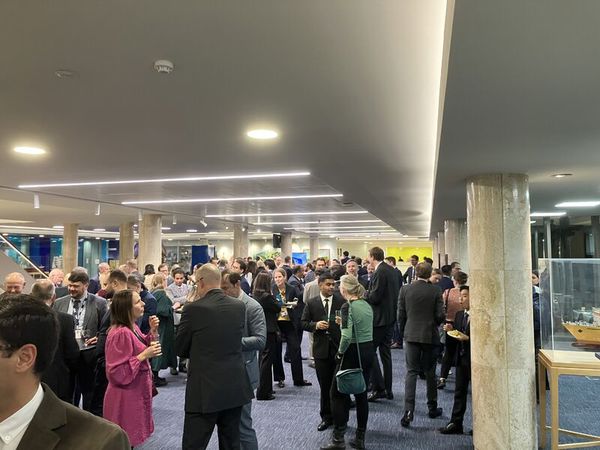 IMAGE: IBIA and ICS reception for delegates at the IMO ISWG-GHG 23 meeting on Monday. Linkedin of Edmund Hughes
The world's climate negotiators left the UN's COP31 summit in Antalya without a final political agreement after negotiations ran deep into overtime. Countries could not agree on language addressing fossil fuels or climate finance. Oil- and gas-producing nations opposed explicit references to transitioning away from fossil fuels, while the EU, Pacific island nations and others refused to accept a weaker text.
“It was the first time since 2009 that COP had failed like this. It was also the right outcome when petrostates once again stood in the way of progress for everyone,” the Climate Reality Project said.
Transport & Environment said the breakdown showed that fossil fuel interests remain a major obstacle to climate action. COP28's final text in 2023 called for transitioning away from fossil fuels in energy systems, but fossil-producing countries have blocked similar language at later COPs despite the growing economic and social costs of climate change, it said.
For the IMO’s Net-Zero Framework, this feels like a bad omen.
The IMO's GHG Working Group (ISWG-GHG) is meeting in London this week, ahead of the Marine Environment Protection Committee's 85th session (MEPC 85) next week. A possible resumption of the extraordinary MEPC session on 4 December could put the fate of the NZF back on the table.
Davina Hurt, climate policy director at Pacific Environment, sees an uncomfortable parallel between the COP31 and the IMO negotiations.
“The demand for perfection has become a recipe for stagnation. That doesn't mean lowering our ambition. It means exactly the opposite and acting on it now,” she said. “COP31 showed us what happens when delay wins. The IMO doesn’t have to repeat it.”
Compromise remains elusive
The IMO's negotiations are hardly starting from a blank page. The NZF's draft language was approved in 2025, but opposition from the US and several other countries has complicated efforts to move it forward.
An informal group of countries, dubbed the “Risotto Group”, had been exploring a possible compromise ahead of MEPC 85, as first reported by Lloyd's List.
The group included Saudi Arabia, the US, Brazil, Japan, Singapore, Denmark, Norway, Germany, Greece, the Marshall Islands and Solomon Islands. Other European countries were also understood to have participated.
But the discussions have yet to produce a compromise with broad support, two sources told ENGINE.
“The formal negotiations within the IMO have been complemented by ongoing informal discussions between member states. Various delegations have come together on equal terms without anyone taking the lead,” one source told ENGINE.
“These discussions have allowed member state concerns to be considered, but as far as we have seen, none of the alternative proposals proved more effective or gathered broader support than the NZF does,” the source added. “If anything, discussions have served to highlight the virtues of the NZF.”
A second source told ENGINE that the group had produced a compromise document, but it failed to attract significant support.
China's position could now prove particularly important.
“China plays a critical role in the negotiations, especially after the absence of the US in international climate policy,” the first source said.
The second source was more direct: “China could be instrumental in securing the framework. It is more important that they don't block or undermine [the existing version of the text].”
Meanwhile, informal diplomacy continues alongside the official proceedings.
The International Bunker Industry Association (IBIA) and International Chamber of Shipping (ICS) hosted a reception for delegates on Monday following the first day of ISWG-GHG 23 deliberations, according to former IMO official and IBIA representative to the IMO Edmund Hughes.
“[It is] important to allow delegates to meet ‘informally’ in the margins of these meetings to exchange views and seek to identify where, if any, compromises can be identified and taken forward,” Hughes added.
Pacific Island nations and delegates from the Micronesian Center for Sustainable Transport (MCST) have also been attending informal sessions on the sidelines of the ISWG-GHG discussions, according to MCST researcher John Taukave, who described their participation as “encouraging” for the negotiations.
Some member states are willing to compromise on certain elements of the technical global fuel standard, but significant disagreements remain over the economic measures, Rhona Macdonald, IMO liaison officer at the International Association of Ports and Harbors (IAPH), said at the end of the fourth day of negotiations.
The disagreements centre on future compliance mechanisms and whether to establish an IMO net-zero fund to manage revenues generated by the measures, she added.
Another test of multilateralism
Four environmental groups have urged Panama's President José Raúl Mulino to carry the country's position at COP31 into the IMO negotiations.
In a letter dated 25 November, the Clean Shipping Coalition, Environmental Defense Fund, Pacific Environment and WWF International praised Panama's support for transitioning away from fossil fuels at COP31 and called on its government to back stronger global shipping emissions regulations at the IMO.
“The outcomes of COP31 highlight the persistent gap between global climate commitments and the ambition required to address the climate crisis,” Malawi's alternate permanent representative to the IMO, Elias Tsokalida, said, calling for “constructive dialogue and international cooperation” to bridge differences.
“This may be a marathon, but hopefully not a sprint! The Polish delegation is well prepared, and our EU coordination is strong and united under the Irish Presidency,” Poland's permanent representative to the IMO, Marcin Białek, said.
In other alt fuels news this week, ships able to run on LNG, methanol or ammonia would account for 21% of the annual energy demand of liner shipping, meaning container ships and vehicle carriers, by around 2030, up from 9.8% today, the World Shipping Council (WSC) said in a report.
The Clean Port Coalition, an alliance of industry and environmental groups, has asked the European Commission to set shore power targets for ports beyond 2030 when it reviews the Alternative Fuels Infrastructure Regulation (AFIR). The coalition made the request in a letter to officials in the Commission's transport and energy departments.
The UK and EU have agreed to link their emissions trading systems, targeting 1 January 2028 for the arrangement to take effect alongside the UK's planned expansion of carbon pricing to international shipping.
By Konica Bhatt
Please get in touch with comments or additional info to news@engine.online