UK shipping body calls for stronger ammonia, hydrogen safeguards
Ammonia's toxicity and the technical challenges associated with storing and handling hydrogen remain among the biggest safety barriers to scaling their adoption in shipping, the UK Chamber of Shipping has warned.
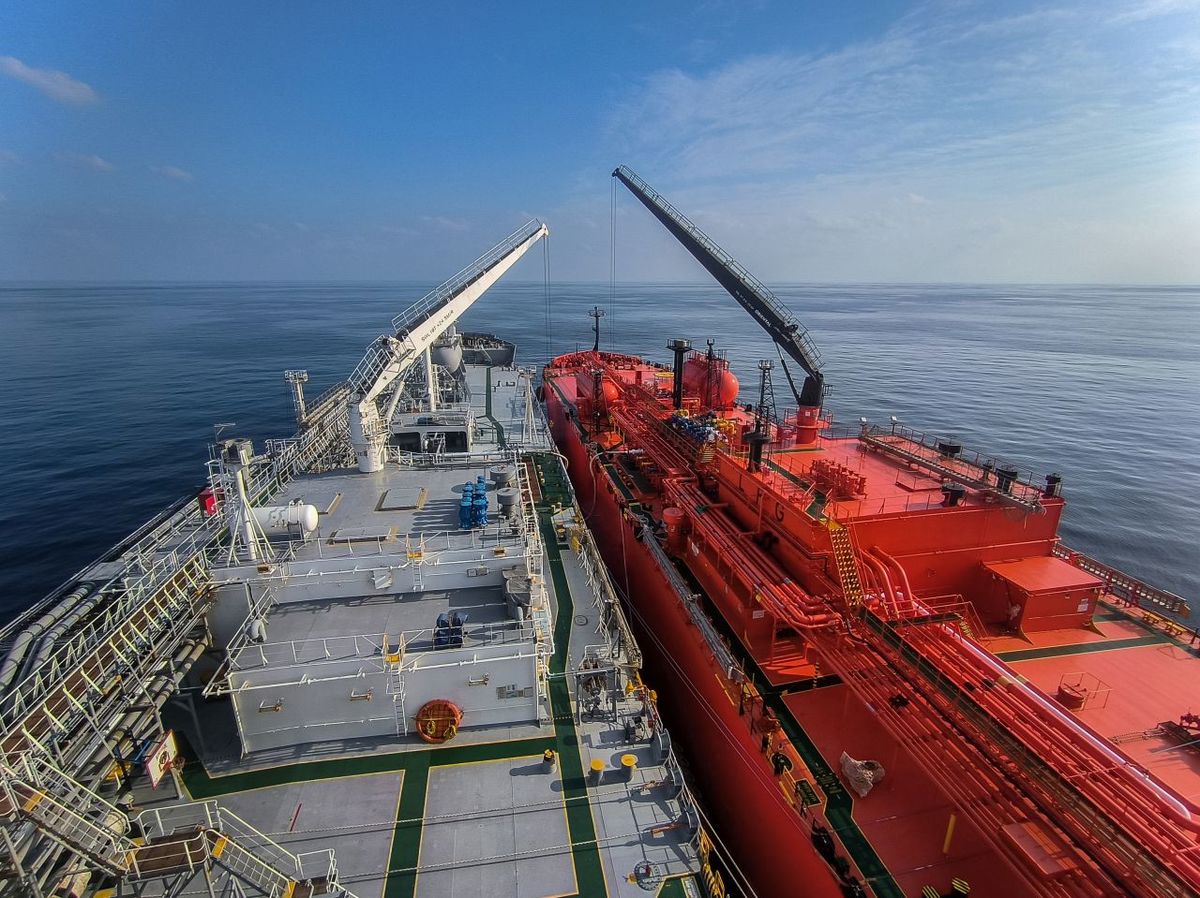 IMAGE: Ship-to-Ship ammonia transfer in Sohar port, Oman. Exmar Ship Management
The findings are outlined in a new report by the Chamber's Safety of Alternative Fuels Working Group (SAFWG), which examines the safety implications of emerging marine fuels.
The report presents preliminary, high-level risk assessments for battery-electric, biofuels, methanol, ammonia and hydrogen pathways, aiming to create a common evidence base for their safe deployment.
The working group comprises 52 organisations, including shipowners, classification societies, port authorities, government agencies, insurers, equipment manufacturers and academic institutions.
Ammonia as a bunker fuel
Toxic releases during ammonia operations are identified as the primary safety concern throughout bunkering and onboard operations.
Hose failures during fuel transfer, incorrect valve alignment during bunkering, physical damage to fuel tanks or piping and vessel collisions severe enough to rupture onboard storage tanks could cause hazardous ammonia releases.
Incidents can be exacerbated if ports and nearby vessels are unfamiliar with ammonia-specific emergency response procedures.
The report recommends dedicated port emergency response playbooks, ammonia-specific personal protective equipment (PPE) and specialised crew training to strengthen operational safety.
Material selection standards, pilot port acceptance frameworks and wider adoption of risk-based design principles should also support the safe use of ammonia as a marine fuel.
Hydrogen as a bunker fuel
The lack of established design standards for hydrogen-fuelled vessels and fuel systems remains a key challenge that could increase operational risks as the fuel enters wider commercial use.
It also points to hydrogen embrittlement, where prolonged exposure can weaken unsuitable materials and increase the risk of fuel leaks.
It also flags the potential for hydrogen releases during construction and maintenance activities, inadequate ventilation that could allow gas to build up in enclosed spaces and a shortage of personnel with the specialist skills needed to operate and maintain hydrogen-fuelled vessels.
Liquid hydrogen presents additional challenges because of the cryogenic temperatures required for storage.
To address these risks, the report recommends clearer engineering guidance for hydrogen storage and venting systems, improved leak detection and gas dispersion assessments, expanded operator training and risk-based design methodologies.
Beyond individual fuels, the report highlights broader priorities such as integrating safety into vessel design, ensuring material compatibility, strengthening emergency response capability, improving crew competence and providing clearer regulatory direction for commercial deployment of low- and zero-emission potential fuels.
The Chamber said the work is intended to improve understanding of both established and emerging risks, identify knowledge gaps, and support future research, regulation and operational learning as alternative marine fuels move towards wider deployment.
By Konica Bhatt
Please get in touch with comments or additional info to news@engine.online