Vard study backs use of nuclear power in shipping
A study led by Fincantieri Group’s Norwegian subsidiary Vard has concluded that nuclear-powered offshore vessels are technically achievable.
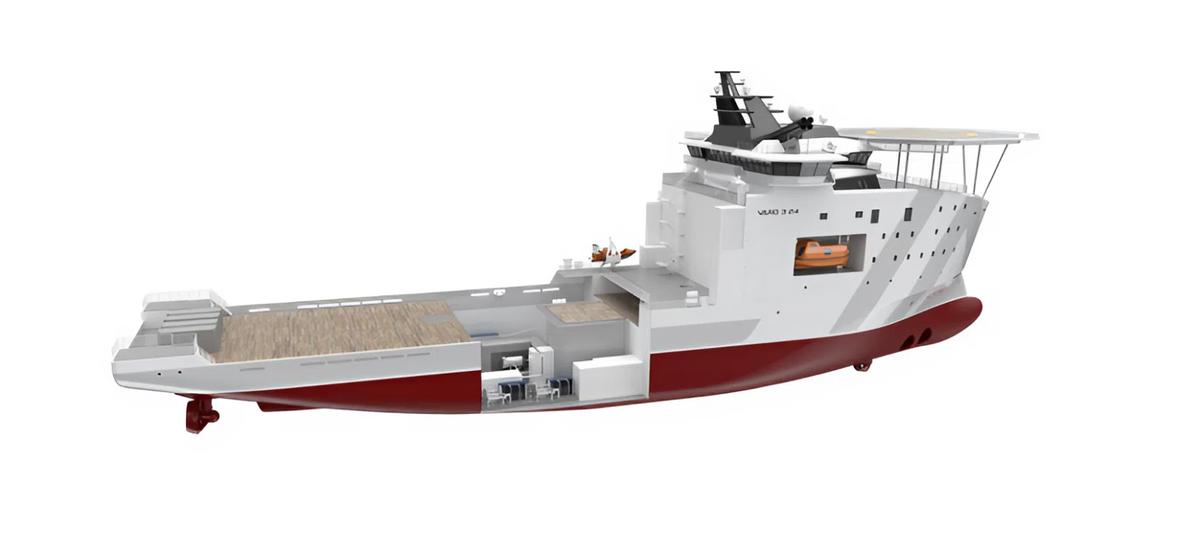 IMAGE: Vard’s nuclear-powered offshore vessel concept. Vard
The findings confirm that small, fourth-generation nuclear reactors can be integrated into dynamically positioned (DP) vessels.
A DP vessel can automatically hold its position using thrusters controlled by sensors and computer systems, without the need for anchors. These vessels are used for offshore operations such as drilling, cable laying and research. A small fourth-generation reactor, meanwhile, is a compact nuclear unit designed with enhanced safety features, higher efficiency, and reduced waste compared with conventional reactors.
The study brings together DNV, modular reactor developer Emerald Nuclear, Vard Electro, offshore vessel owner Island Offshore, and the Norwegian University of Science and Technology (NTNU)
Concept and technical findings
Conducted under the Nuclear Propulsion for Merchant Ships II (NuProShip II) programme, the project demonstrates the feasibility of nuclear-powered DP vessels. As part of the work, Vard developed a concept design for a nuclear-powered construction vessel.
The study examines how a helium gas-cooled nuclear reactor could function as the vessel’s main power source, assessing impacts on ship layout, safety systems and overall performance.
The design supports the high redundancy standards required for DP2 vessels and can be adapted to DP3 configurations, further improving safety and operational reliability. In simple terms, DP2 vessels can maintain position after a major system failure, while DP3 vessels can do so even if part of the ship is affected by fire or flooding.
Challenges and wider context
By using nuclear propulsion, the NuProShip II concept points to the potential elimination of greenhouse gas emissions and the ability to operate for extended periods without refuelling.
Although nuclear propulsion has been discussed in merchant shipping for decades, progress has been slowed by safety concerns. Small modular reactors (SMRs) are now viewed as a potential turning point, offering compact designs suitable for large vessels and multi-year operation without refuelling.
The project also highlights the need for an updated regulatory framework, greater industrial experience with civilian nuclear marine propulsion, and strong public acceptance.
Notably, in September last year, US President Donald Trump and UK Prime Minister Sir Keir Starmer signed an agreement to explore the feasibility of using nuclear energy in the civil maritime sector, including the development of international regulatory standards.
What comes next
NuProShip II is a two-year project funded by the Research Council of Norway and will conclude in 2026. It will be followed by the SFI SAINT Research Centre, led by NTNU, which will focus on applied and industrialised nuclear technology for maritime use.
“NuProShip II shows that nuclear-powered vessels are not merely a future concept, but a technically viable solution,” said Henrik Burvang, research and innovation manager at Vard Design.
By Tuhin Roy
Please get in touch with comments or additional info to news@engine.online