Vitol and Olam Agri complete CNSL co-processed VLSFO bunkering in Singapore
Global bunker supplier Vitol Bunkers and agricultural firm Olam Agri have completed a bio-bunkering operation in Singapore using VLSFO co-processed with cashew nutshell liquid (CNSL), demonstrating the fuel’s performance during a full commercial voyage.
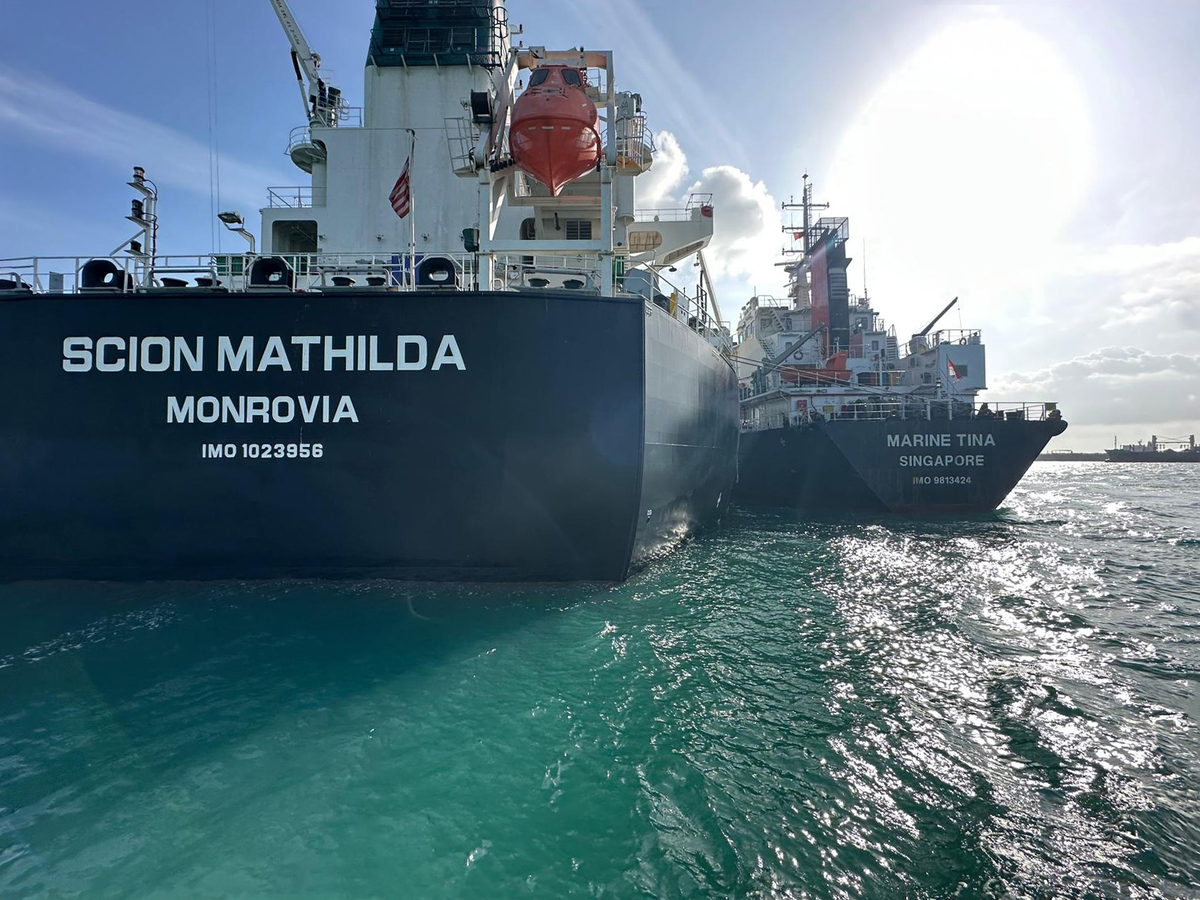 IMAGE: MV Scion Mathilda receiving CNSL co-processed VLSFO in Singapore. Vitol Bunkers
The operation involved MV Scion Mathilda, which was supplied with around 247 mt of co-processed VLSFO at the Port of Singapore. The stem comprised 212 mt of conventional VLSFO and approximately 35 mt of VLSFO co-processed with CNSL.
The operation marked the world’s first bio-bunkering operation using co-processed VLSFO, Vitol Bunkers said.
Vitol Bunkers supplied the fuel, which was procured by Olam Agri’s ocean freight business. The vessel subsequently consumed the fuel on a voyage carrying cargo from Caofeidian in China to Rotterdam in the Netherlands, followed by a ballast leg from Rotterdam to Barcarena in Brazil.
The vessel completed the voyage without any operational issues, demonstrating the fuel’s performance under real-world conditions.
“This operation proves that co-processed VLSFO can be delivered and consumed at sea without any compromise to vessel performance or operational routine,” Vitol Bunkers’ trading manager Sherman Yeo said.
The co-processed VLSFO has a GHG intensity of 2.02 gCO2eq/MJ and delivered emission savings of at least 120 mt CO2eq compared with conventional VLSFO on an equivalent basis, Vitol Bunkers said. The fuel required no additional onboard handling or fuel treatment.
A different approach to biofuel production
Vitol launched its CNSL co-processed VLSFO in June last year at its 100,000 b/d refinery in Fujairah.
The process differs from conventional biofuel blending, in which bio components are added to marine fuel after the refining stage. Instead, CNSL is introduced directly into the refinery stream and processed alongside conventional crude oil.
CNSL has historically presented challenges when directly blended into marine fuels, including material compatibility and handling issues. Vitol’s co-processing approach is designed to overcome these limitations by passing a small quantity of CNSL through the refinery’s distillation and cracking units alongside a much larger volume of crude oil.
The resulting fuel is chemically identical to conventional VLSFO, according to Vitol. This means it retains the full energy content and does not require engine modifications, additional approvals or special charterparty clauses, the company previously told ENGINE.
Direct CNSL blending has traditionally been viewed by the marine fuel industry as impractical because of these compatibility and handling concerns. Co-processing the bio component within the refinery stream could instead provide a commercially viable route for CNSL to contribute to shipping’s GHG reductions.
By Tuhin Roy
Please get in touch with comments or additional info to news@engine.online