Does timing matter when selling FuelEU surplus?
Selling FuelEU compliance surplus early offers lower risk. Waiting until the end of the pooling year could deliver higher payoffs, but the window to act is narrow and the outcome is uncertain.
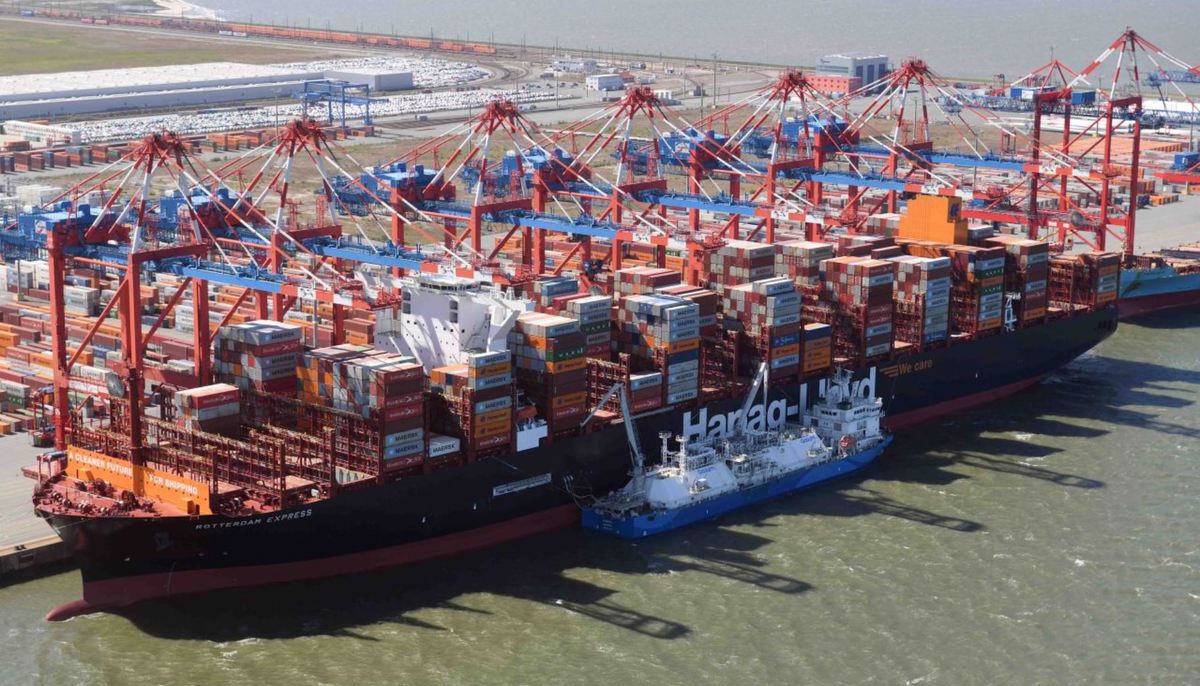 IMAGE: Gasum supplying LBM to a Hapag-Lloyd containership in Wilhelmshaven. Linkedin of Hapag-Lloyd
All the prices in this article are adjusted for calorific content to become VLSFO-equivalent.
Potential FuelEU Maritime pooling values are large enough to materially reduce the cost of bunkering B100 and liquefied biomethane (LBM) in Europe.
Shipowners using low-emission fuels such as B100 and LBM can generate surplus compliance balances under FuelEU Maritime and sell them to undercompliant vessels within a pool.
Pooling values fluctuate depending on factors including market supply and demand. A softer market can lower offer prices. A tighter market can sharply increase them.
Timing FuelEU surplus sales can carry more risk, but potentially greater value, and in rare cases even more than the fuel price itself.
Sell surplus today
The most straightforward option is to bunker B100 or LBM today and sell the generated surplus at current 2026 market offers.
Rotterdam B100 is currently priced at $1,486/mt on a VLSFO-equivalent basis. Pooling platform OceanScore's current pooling index price is €225/mtCO2e ($265/mtCO2e). Selling surpluses at that level can generate a pooling value of around $716/mt for B100. This cuts its bunker cost to $771/mt for EU-EU voyages.
After adding $4/mt in EU ETS compliance costs, the net bunker cost stands at about $775/mt.
Rotterdam LBM is currently priced at $1,455/mt. If the compliance surplus generated by LBM is sold at the same surplus price, it can generate pooling values of $991–1,161/mt, depending on engine type and methane slip.
For vessels with high-methane slip Otto medium speed (Otto MS) engines, EU ETS costs add $79/mt.
This brings the bunker cost to $543/mt.
Vessels with low-methane slip diesel slow speed (diesel SS) engines face much lower EU ETS costs of around $6/mt, reducing LBM's final bunker cost to $299/mt.
Pooling platform provider Kickstarter’s best early 2026 compliance offer currently stands at €190/mtCO2e ($223/mtCO2e). At that level, B100’s pooling value falls to around $603/mt, while LBM’s drops to $837-981/mt.
Net bunker costs rise accordingly, to $888/mt for B100 and $482-697/mt for LBM.
The caveat is that early 2026 offers suggest the compliance market is oversupplied.
OceanScore notes that the majority of the early offers sit in the range of €170-210/mtCO2e ($199-246/mtCO2e), and the wide spread "reflects the continuing, and increasing oversupply of surplus in the market."
Volumes remain well below last year's traded levels, Kickstarter says.
Hold until year-end
If OceanScore's pool price index (OPX) is used as a proxy for FuelEU compliance offers, 2025 data seems to suggest that selling surplus at the end of the calendar year could generate more value than selling earlier.
The OPX moved from an average of €214/mtCO2e ($248/mtCO2e) in June 2025 to €225/mtCO2e ($265/mtCO2e) in December 2025, a relatively modest €11/mtCO2e ($13/mtCO2e) rise over six months.
Three pooling platform indexes ultimately closed the 2025 compliance year at broadly similar levels in April 2026.
Kickstarter recorded an average of €220/mtCO2e ($259/mtCO2e) for April 2026.
OceanScore's monthly average in April came in at €227/mtCO2e ($267/mtCO2e) and BetterSea's stood at €213/mtCO2e ($251/mtCO2e).
The data suggests that prices remained relatively stable through the calendar year, indicating limited upside for surplus holders who waited.
Holding surpluses is not guaranteed to achieve a higher price.
2026 is only the second FuelEU compliance year, after what many in the market treated as a test run in 2025. There is no guarantee that prices will follow the same pattern - that the market will tighten to the same degree or that surplus holders will find buyers.
Hold until pooling deadline
The riskiest but potentially most lucrative strategy is to bunker low-emission fuel today and hold the generated compliance surplus until after the calendar year has ended.
At that stage, undercompliant vessels can no longer improve their position by purchasing physical fuel and must instead source compliance balances from surplus holders. If not, they will have to borrow compliance or pay penalties.
Tightening surplus supply near the deadline can increase pooling offers sharply.
During the closing days of the 2025 compliance cycle, OceanScore’s index peaked at €296/mtCO2e ($346/mtCO2e) on 17 April 2026. B100 was priced at $1,434/mt and LBM was priced at $1,394/mt on the day.
At those levels, B100’s pooling potential rises to around $941/mt, while LBM’s increases to $1,305-1,530/mt, depending on engine type and methane slip.
Adding EU ETS costs takes the cost of bunkering B100 in Rotterdam to around $498/mt, around a third of the VLSFO-equivalent cost of the fuel.
For dual-fuel vessels with Otto MS engines, the cost of bunkering LBM in Rotterdam drops to around $168/mt even with the EU ETS costs added to the price.
For diesel SS engine vessels with the lowest methane slip, compliance revenues can theoretically exceed the cost of the fuel itself, resulting in a net bunker balance of around -$128/mt on paper.
That would mean the LBM is more than paying for itself.
The trade-off is execution risk.
OceanScore’s 2025 pooling price peak was recorded only 13 calendar days before the compliance deadline. That left limited time to finalise commercial terms, register pool compositions in the FuelEU database, complete verifier checks and secure approval of compliance balances.
The compressed timeline could make it difficult for some surplus holders to monetise balances before the deadline, potentially forcing them to bank surplus into the following compliance year instead.
By Konica Bhatt
Please get in touch with comments or additional info to news@engine.online