GCMD study backs safety case for Singapore’s ammonia bunkering pilot
GCMD has mapped out recommendations for operational safety during ship-to-ship ammonia transfers in Singapore, which could serve as practical guidelines for future ammonia bunkering operations in the port.
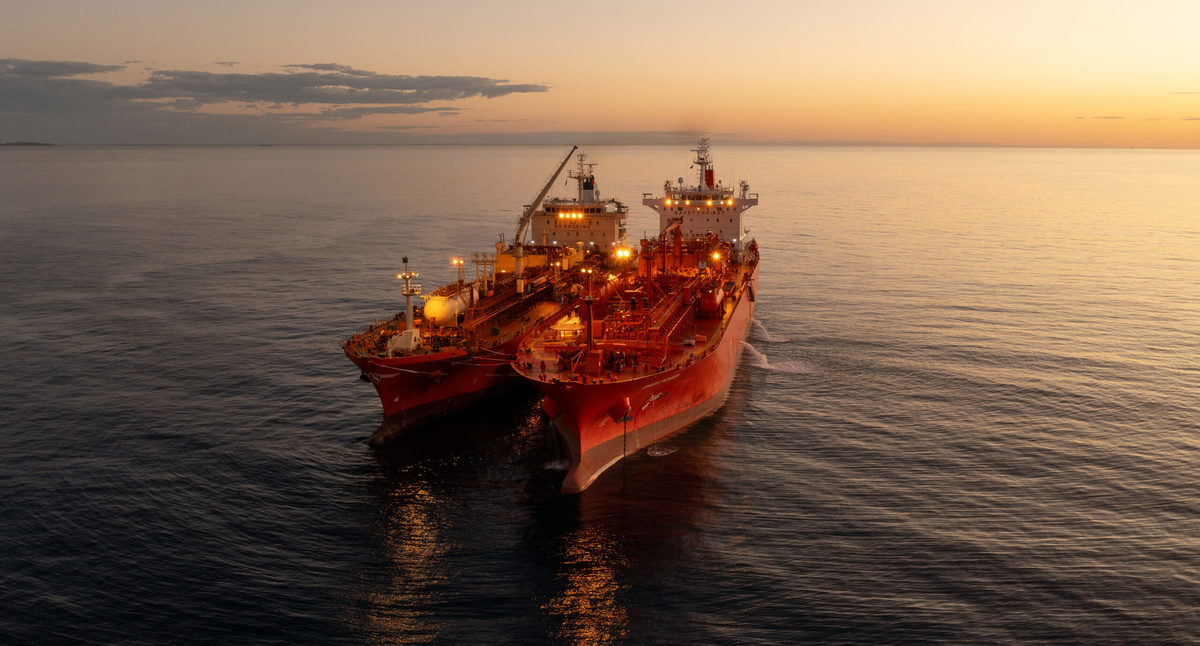 IMAGE: STS ammonia transfer between Navigator Global and the Green Pioneer at the outer anchorage of Port Dampier. GCMD
Ammonia’s hazardous and toxic nature requires strict safety protocols for its use as a marine fuel, particularly during bunkering and storage.
Ship-to-ship (STS) transfers replicate many of the key steps involved in ammonia bunkering, as both operations rely on specialised equipment, strong containment measures and careful handling to minimise the risk of leaks and exposure during fuel transfer between vessels.
To examine these risks in detail, the Global Centre for Maritime Decarbonisation (GCMD) and classification society DNV carried out a technical study focused on potential safety and operational gaps for STS ammonia transfers in Singapore.
The work builds on GCMD’s earlier ammonia transfer trial at the Australian port of Dampier in Pilbara and follows the first phase of assessment completed in April 2023, which concluded that risks associated with STS ammonia transfers in Singapore are “low or mitigable”.
The latest findings reiterate that “ammonia transfer operations are technically and operationally feasible within Singapore’s port waters, provided robust safeguards are in place,” GCMD noted.
Among its recommendations, GCMD called for the establishment of clear safety buffer zones during transfer operations and the creation of practical safety guidelines tailored specifically for ammonia.
It also stressed the need for improved leak detection and monitoring at ports and onboard vessels, and urged operators to strengthen emergency readiness through routine drills, checklists and specialised response equipment.
The organisation further emphasised the need for “continuous collaboration” between the shipping industry, regulators and emergency responders to help scale ship-to-ship ammonia bunkering globally.
“While the navigational and process risks were found to be low or mitigable, the analyses underscored the need to continue refining ammonia-specific risk management practices,” the study noted.
Ammonia transfers “serving as a precursor to commercial-scale bunkering can be safely executed within Singapore’s anchorage environment,” the report said. The study is expected to serve as a foundation for the Singapore port authority’s planned ammonia bunkering pilot this year.
By Konica Bhatt
Please get in touch with comments or additional info to news@engine.online