Oil leaps as instability in the Middle East worsens overnight
Brent crude’s price has jumped above $105/bbl after Yemen’s Houthis intensified attacks aimed at disrupting Saudi energy exports, while more vessels came under attack off Oman’s coast.
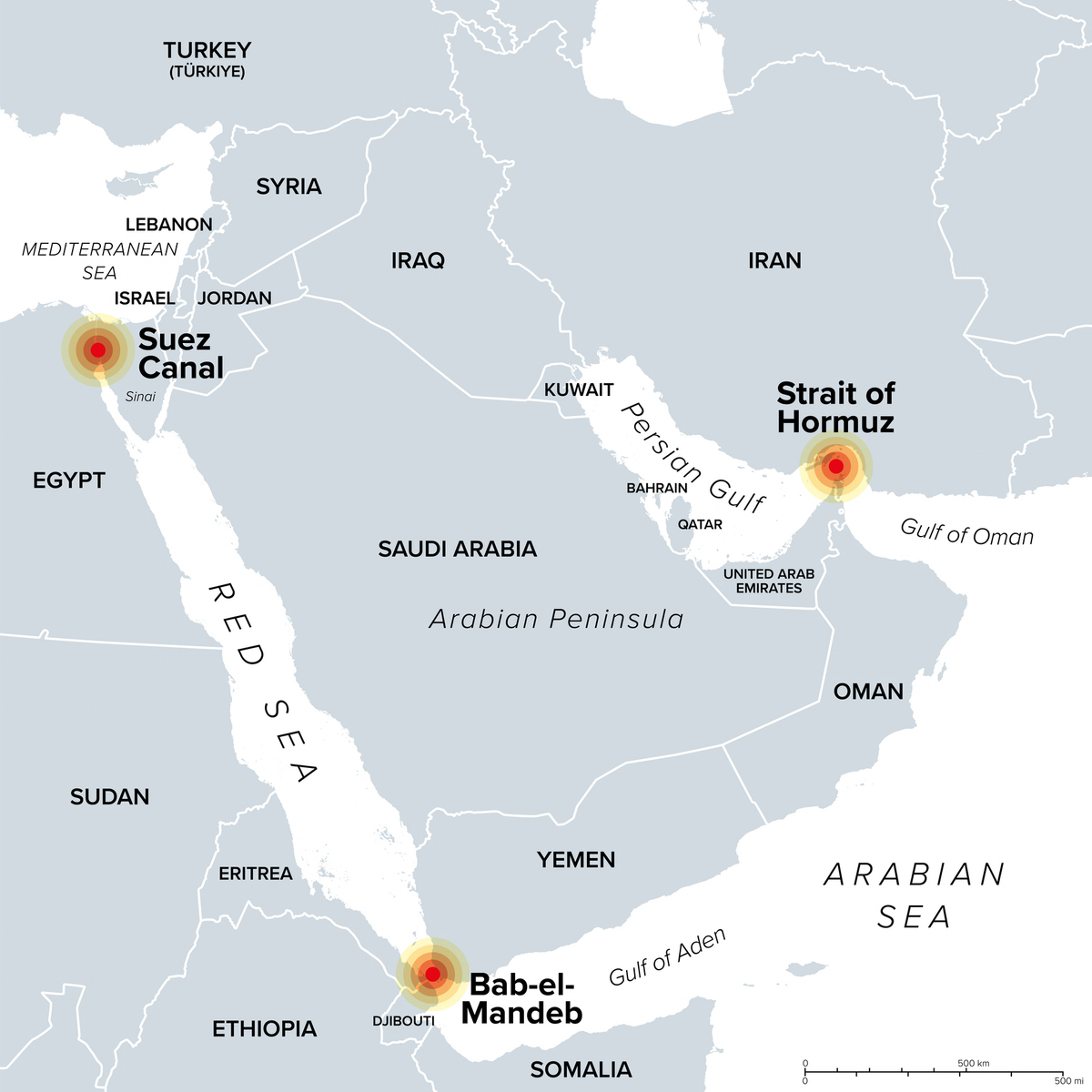 IMAGE: Getty Images
Two more commercial vessels came under direct air attack off the coast of Oman yesterday, the United Kingdom Maritime Trade Operations (UKMTO) agency reported.
The vessels were about 4 nautical miles west of Khasab, Oman, when they were hit by four unknown projectiles, causing a fire on one vessel, the UKMTO said.
The agency is “unsure of the status of the second vessel, 6NM [nautical miles] north of his position,” it said.
Additionally, Yemen’s Iran-backed Houthi militants have gained control of Yemeni port city of Mokha, advancing down the Red Sea coast, Reuters reported citing sources.
The Houthis have seized the islands of Hanish, further leveraging over the Bab al-Mandeb Strait – one of the world’s busiest shipping routes in the southern outlet of the Red Sea, the report added.
Threats to the Bab el-Mandeb Strait, which has become increasingly important as an alternative route to the Strait of Hormuz, have further exacerbated supply-related concerns, analysts said.
“As the Houthis have taken control of the Red Sea port of Mokha in Yemen, recent events increase the threat to shipping around the Bab al-Mandeb Strait,” two analysts from ING Bank noted.
This bold move by the Houthis came with direct guidance from Iran’s military, Reuters reported citing officials from the UN-recognised Yemeni government.
A Houthi takeover of the vital corridor right opposite to the Arabian Peninsula could give Tehran a strategic wartime advantage over Washington, threatening disruptions in two critical chokepoints and inevitably rocketing crude oil prices skyward.
Saudi Arabia in the crossfire
Since the Iran conflict effectively closed the Strait of Hormuz – a crucial trade artery through which one-fifth of global oil previously moved – OPEC+ producer Saudi Arabia has shifted its exports channels, relying on the Red Sea route.
The situation worsened in recent months, after the Houthi militants announced a naval blockade on Saudi Arabia, dragging the US-Iran conflict directly to the Red Sea gateway.
Overnight, satellite imagery and fire-detection data raised concerns if the Houthis have struck Saudi Arabia’s strategically important East-West oil pipeline in multiple sites, local media reported.
Riyadh is highly dependent on its 1,200 km East-West Pipeline, funnelling about 70% of its crude exports through the Red Sea terminal at Yanbu, to circumvent the Strait of Hormuz.
“Saudi energy infrastructure and crude oil exports from the Red Sea are increasingly at risk, with the Houthis in Yemen targeting Saudi Arabia,” ING Bank’s analysts said.
Meanwhile, advancing Houthi forces along the Red Sea coast has compounded escalating tanker attacks between US warships and Iranian vessels in the Persian Gulf, further stoking oil prices.
Iran’s Islamic Revolutionary Guard Corps (IRGC) said its navy struck a US “Saildrone-type” unmanned vessel in the Strait of Hormuz, “thwarting its aggressive mission,” Al Jazeera reported.
The US has yet to formally address the latest claims. Earlier this week, Washington dismissed claims by IRGC that it struck two US Navy destroyers operating in the Middle East – dismissing it as “completely false.”
By Aparupa Mazumder
Please get in touch with comments or additional info to news@engine.online