The Week in Alt Fuels: The grid is the limit
A 41 MWh battery ferry entered service and a 151 MWh container ship design won approval this week, but the harder part is getting enough power to the quay.
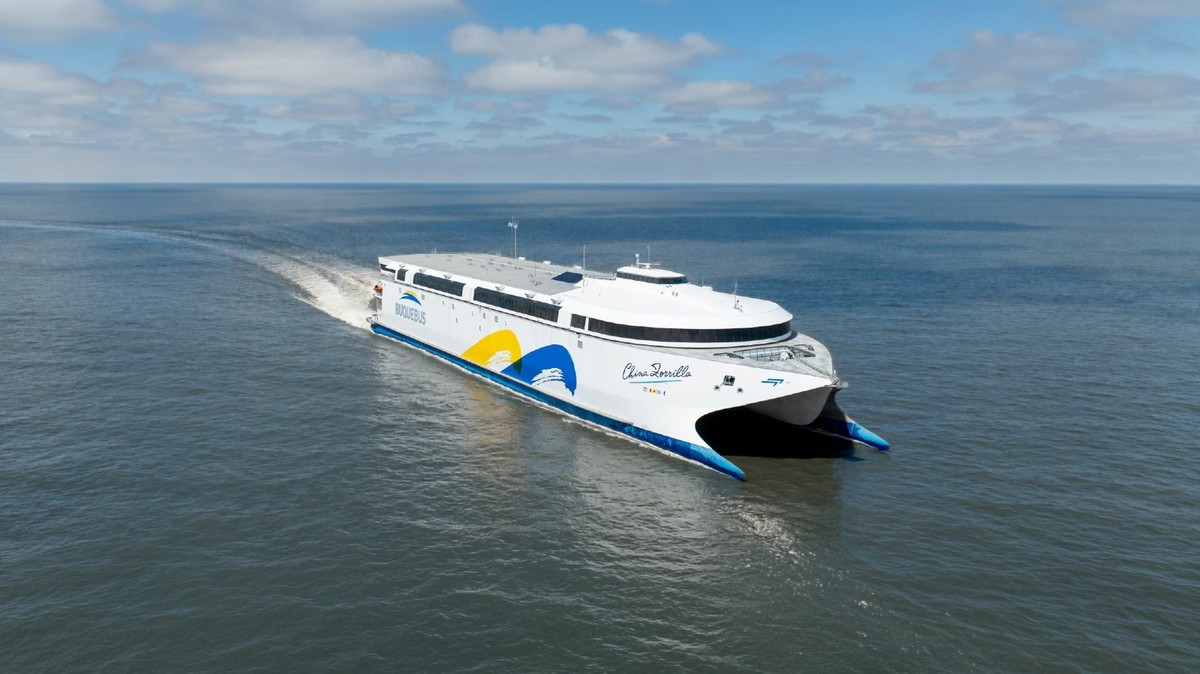
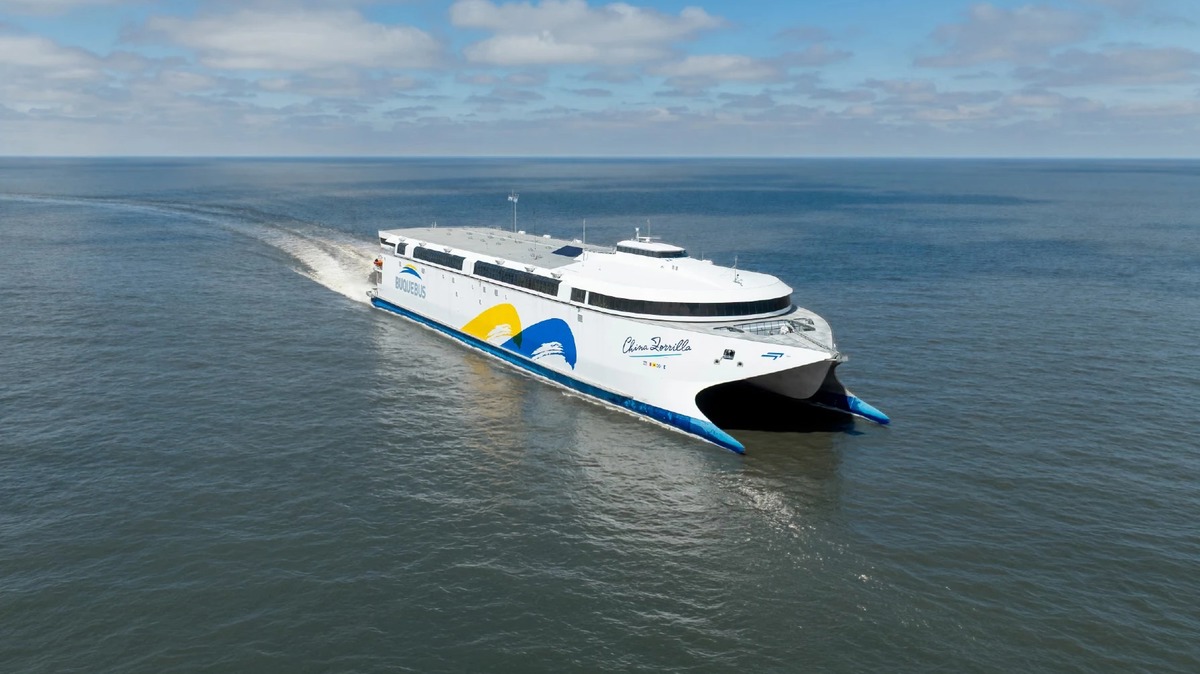 IMAGE: Fully electric ferry China Zorrilla under way. Buquebus
Battery-electric ships are moving beyond short-hop ferries. This week a 41 MWh ferry began crossing the River Plate, a fast ferry for the Strait of Gibraltar was launched, an electric barge was ordered for Vietnam and a 1,700 TEU battery container ship design was approved. Each depends on power ashore.
Ferries first
Ferry operator Buquebus’s China Zorrilla has begun sailing between Argentina and Uruguay with a 41 megawatt-hour (MWh) battery system. It can sail for up to 1.5 hours on battery power.
Norwegian battery maker Corvus Energy, which supplied the system, said it is the largest marine battery installation currently in operation on a ship. Corvus said the installation has around four times the capacity of any battery previously fitted to a commercial vessel, and that the ferry is South America’s first fully electric ship of its kind.
Australian shipbuilder Incat Tasmania built the vessel. Finnish technology company Wärtsilä picked Corvus in 2023 to supply the ferry’s battery system.
“This project proves that battery-electric propulsion is no longer limited to smaller ferries or short routes,” said Ole Jacob Irgens, executive vice president and head of sales at Corvus.
Spanish ferry operator Baleària has launched its first fully electric fast ferry at Armon Shipyards in Gijón, Spain. The 87-metre vessel has a 14 MWh battery system and is scheduled to start sailing between Tarifa in Spain and Tangier in Morocco in summer 2027.
A second ferry, now under construction, is expected to join it later that year. The two will operate along the first green corridor between Spain and Morocco. Baleària has not disclosed the launched vessel’s name.
From ferries to boxes
The largest battery in the week’s news is still on paper. The American Bureau of Shipping (ABS) has approved the concept design of a 1,700 TEU fully electric container ship developed by Hanwha Power, part of South Korean conglomerate Hanwha Group.
The design runs entirely on a 151 MWh battery energy storage system, more than three times the capacity of China Zorrilla’s. The batteries sit in containerised units that can be handled and stowed like cargo containers, so they can be replaced, Hanwha Power said.
The company sees the design as a potential pathway to decarbonising short-sea and regional container shipping. Even with batteries that can be lifted off like containers, the design relies on port charging to run without direct carbon emissions, Hanwha Power said.
Hanwha Power has also completed the basic design of a 1,000 TEU battery-powered container ship.
Batteries are heading for inland waterways too. Global sportswear company Nike has contracted French container shipping firm CMA CGM for a fully electric barge in Vietnam, which CMA CGM will operate with logistics and port operator Gemadept.
The barge will link Nike’s inland drop-off location in Ho Chi Minh City with the Gemalink deep-sea terminal at Cai Mep.
The plug behind the battery
“Electrification shifts the energy-system burden from vessel to port,” Anthony Wiskich wrote in a working paper published this month by the Australian National University’s Centre for Applied Macroeconomic Analysis.
“Charging a large vessel during a short turnaround requires megawatt to tens-of-megawatts power, which can exceed local distribution capacity and attract severe demand-charge costs.”
Baleària’s project costs more than €200 million ($223 million) and covers electrifying the ports of Tarifa and Tangier City as well as building both ferries. Nike’s barge will charge from a solar-powered station on the Gemalink terminal, CMA CGM has said.
Valencia is adding grid capacity for its cargo terminals and for shore power for ships at berth. The Port Authority of Valencia (APV) has launched a tender for a new electrical substation that will double the port’s electricity supply capacity and take an estimated 20 months to build.
The substation, ST2, will share between 40 megawatts (MW) and 90 MW of capacity with the existing ST1 substation, depending on which incoming power lines are used.
At the lower figure, charging a 151 MWh battery like Hanwha’s from empty would take nearly four hours, before losses.
Shore power lets ships switch off the auxiliary engines that burn bunker fuel while they are in port. What ships pay for that electricity is another matter, as ENGINE found when we compared shore power tariffs earlier this month.
Valencia’s project carries an estimated investment of €18.7 million ($21 million), supported by the European Commission through the Connecting Europe Facility. APV tendered its first shore power project in 2023 and said then that it planned a second substation to support it.
Under FuelEU Maritime, container and passenger ships above 5,000 gross tonnage must use shore power or an equivalent zero-emission technology at berth from January 2030 in the EU ports that must offer shore power by the end of 2029.
Non-profit Transport & Environment (T&E) wants the EU law behind that shore power requirement to cover charging for battery ships too.
“Given the recent technological advances and the continuous decrease in battery prices, the limited availability of charging infrastructure on the shore is becoming the main barrier to the scale-up of battery-electric vessels,” it said in a briefing in April.
Battery ships have grown fast. Whether they move beyond ferry routes and inland barges now depends less on how big the next battery is than on whether ports can get tens of megawatts to the quay while a ship is at berth.
In other alt fuels news this week, the fleet of dual-fuel container ships and vehicle carriers reached 503 in September, up from 358 a year earlier, according to the World Shipping Council (WSC). Another 849 are on order, but the WSC said orders for conventional-fuel ships have also risen amid uncertainty over IMO greenhouse gas rules.
Singapore-based shipowner Eastern Pacific Shipping (EPS) has taken delivery of an ammonia-capable very large ammonia carrier, the 93,000-cbm Terra Clove, from South Korea’s HD Hyundai Heavy Industries. EPS plans to bunker it with green ammonia supplied by Lotte Fine Chemical in Ulsan to test the practicalities of ammonia as a marine fuel.
The Port of Santos in Brazil has moved from a trial to regular ethanol bunkering, the port authority said. The first operation under the new model refuelled the 13,000 TEU container ship CMA CGM Iron on 19 October.
By Erik Hoffmann
Please get in touch with comments or additional info to news@engine.online