The Week in Alt Fuels: Don’t weaken the NZF
The IMO’s Net-Zero Framework (NZF) is already a fragile compromise and further concessions risk undermining its effectiveness, several organisations warn ahead of next week’s IMO committee meeting.
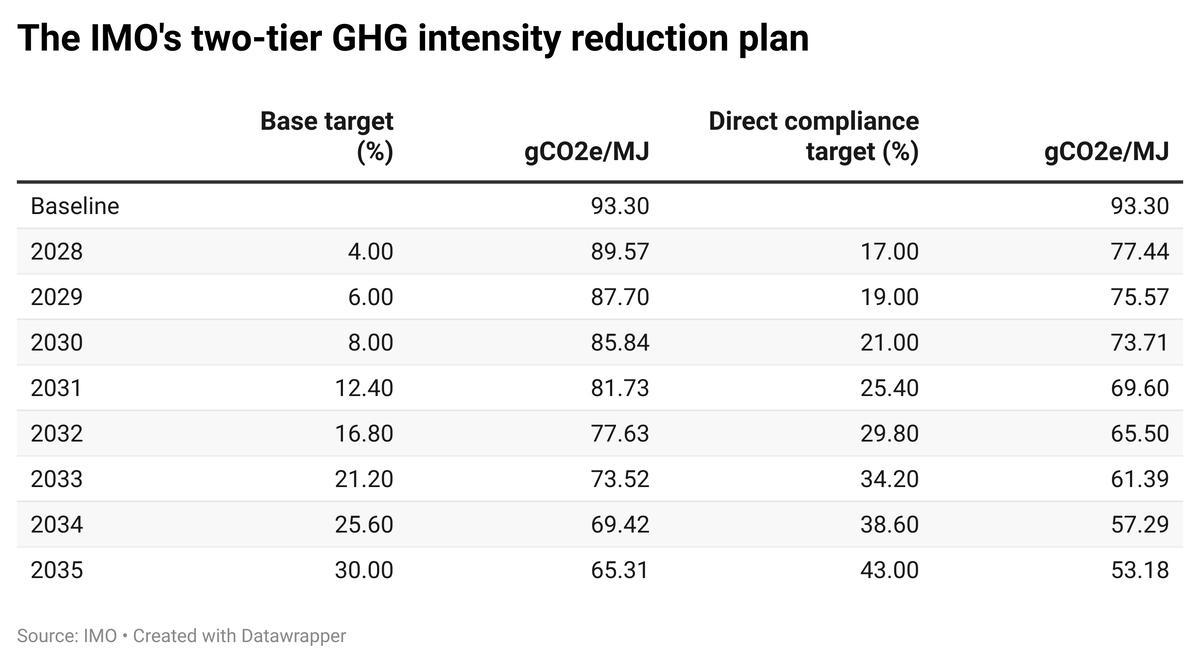 IMAGE: Annual GHG fuel intensity reduction targets for base and direct compliance, relative to the GFI reference value. IMO, ENGINE
The IMO's Intersessional Working Group on Reduction of GHG Emissions from Ships (ISWG-GHG 21) will meet in London next week to discuss submissions from member states and organisations.
The working group will then report to the Marine Environment Protection Committee’s 84th session (MEPC 84) in two weeks.
Submissions from IMO member states to the GHG committee and the MEPC 84 show a widening political split, with the framework’s central fund and technical and economic elements emerging as key battlegrounds.
Framework under fire
“A framework that imposes sudden or unclear financial burdens will not command sustained support from Member States or industry, and risks undermining confidence in the process,” an Algeria-led submission to the IMO said. It was co-signed by the petroleum-producing states Bahrain, Iraq, Kuwait, Russia, Saudi Arabia, Somalia and the UAE.
The US has called for the approved draft framework to be scrapped entirely and has opposed resuming the second MEPC Extraordinary Session in October this year.
Against this backdrop, several shipping-focused non-profits have urged IMO member states to keep the framework intact.
“The Net-Zero Framework is already a fragile compromise and any substantial changes will lead to an unacceptable reduction in effectiveness,” Lukas Leppert, senior lawyer at Naturschutzbund Deutschland (NABU) told ENGINE.
“The current framework is the result of the Comprehensive Impact Assessment and multiple rounds of negotiations, building on the IMO GHG Strategy 2023. The technical and economic instrument are both essential for the decarbonisation of shipping and neither should be changed in its ambition,” he added.
Clean Shipping Coalition president Delaine McCullough shares the view. The NZF “may not be as ambitious as is needed” but the technical and economic elements in the approved draft remain the backbone of shipping’s path to net-zero, she told ENGINE.
Contentious remedial units
Proposals to remove mandatory remedial unit (RU) payments into the IMO's Net-Zero Fund while retaining only the surplus units (SU) have drawn strong criticism.
RUs are units a ship must acquire and remit to cover emissions that exceed the stricter Direct Compliance Target, but still fall within the looser Base Target, purchased at a fixed price into the IMO Net-Zero Fund.
SUs are units issued to ships whose GHG fuel intensity falls below the Direct Compliance Target in the IMO framework, which can be banked for future use or transferred to other ships needing to close a compliance gap.
These payments underpin both enforcement and funding, NABU's Leppert said. Without them, the framework would lose its main revenue stream and its ability to penalise non-compliance.
UCL researchers have also flagged risks around market design.
“A single-tier GFI can provide a capped SU market but introduces risks of SU price instability if the regulatory unit (RU) price must balance both compliance incentives and revenue generation simultaneously,” a joint study by shipping experts from the UCL Shipping and Oceans Research Group and RMI notes.
Without penalties, there is little reason for operators to change behaviour, Clean Shipping Coalition's McCullough said, pointing to the IMO’s Carbon Intensity Indicator as an example of a toothless regulation with limited impact.
No economic element?
A separate set of proposals seeks to remove GHG pricing altogether, leaving a technical-only framework.
"...there must be no financial penalty, carbon tax, levy, or multilateral fund, or equivalent thereof. The United States will vigorously oppose any of the aforementioned levied by the Organization on the shipping industry," the US said in a submission to the IMO.
But removing the economic element from the framework will undermine investment signals for low- and zero-emission fuels, Clean Shipping Coalition's McCullough said. She argues it will also “destabilize fuel market signals, lock in false solutions like LNG and unsustainable biofuels and eliminate certainty for industry investors.”
UCL and NABU argue that technical standards alone cannot shift the market at scale. Without a carbon price, fossil fuels retain a structural cost advantage over cleaner alternatives.
“A technical-only measure… leaves the SU market uncapped, provides no revenue for rewards or just transition, and… carries the highest transition risk and cost of any architecture considered,” authors of the UCL Institute report note.
Global fund key to redistribution
The debate extends to the IMO’s proposed Net-Zero Fund, which has emerged as another key point of contention.
The fund is designed to collect revenues from ships that exceed emissions targets and redistribute them to support uptake of low- and zero-emission fuels, particularly in developing economies. It is also intended to narrow the cost gap between fossil fuels and cleaner alternatives.
Without a reliable source of funding and redistribution, the transition risks becoming uneven and fragmented.
Weakening or removing the net-zero fund would be detrimental, particularly to the Global South, least developed countries and small island developing states, NABU's Leppert said.
“The pricing mechanism allows for generation of revenue through remedial units and relinquishing a central fund still keeps the possibility of financing sustainable technologies and fuels in a decentralized way. But the distribution and availability of capital will lean towards the Global North where capital and major shipping companies exist,” he added.
The Global Maritime Forum (GMF) estimates the framework could generate $11–12 billion/year and argues that how this revenue is deployed will shape both political support and market confidence.
GMF supports a hybrid model combining grants, loans and guarantees to fund fuel production, infrastructure and fleet upgrades. It also stresses a need for direct funding towards vulnerable states to ensure balanced distribution.
Environmental and research groups oppose revisions to the framework's core design, despite calls for revisions.
“The NZF ‘as is’ contains the key structural features needed for an investable transition: a capped SU market and a reward mechanism. Careful design of reward rates, multipliers and review mechanisms will be needed to manage SU price volatility,” the UCL Institute report notes.
UCL and others caution that the current proposal is the result of years of negotiations, and the outcome at MEPC 84 will determine whether the IMO delivers a functioning global framework or faces a more fragmented transition driven by regional measures and uneven investment signals.
A watered-down framework would be a “climate failure and a political dead end,” the Clean Shipping Coalition's McCullough said.
In other news this week, the US has urged the IMO to rethink how it assesses deforestation risk in crop-based marine biofuels. It has instead proposed a region-based approach to the IMO's indirect land-use change (ILUC) risk assessment.
German shipping company Elbdeich Reederei has taken delivery of its first methanol dual-fuel container ships being built at China’s Guangzhou Wenchong Shipyard. Three more sister vessels are scheduled for delivery in the coming months.
Finnish shipping company Wasaline will extend its use of liquefied biomethane (LBM) on one of its vessels through 2027, with fuel supplied by Gasum. Wasaline’s ferry Aurora Botnia makes daily crossings between the ports of Vaasa in Finland and Umeå in Sweden. Last August, the company agreed to run the vessel on LBM to support FuelEU Maritime compliance on Baltic Sea voyages.
By Konica Bhatt
Please get in touch with comments or additional info to news@engine.online