The Week in Alt Fuels: From multi-fuel to flexibility
As fuel regulations, infrastructure and bunker economics remain uncertain, shipowners appear to be seeking fuel flexibility without long-term commitments.
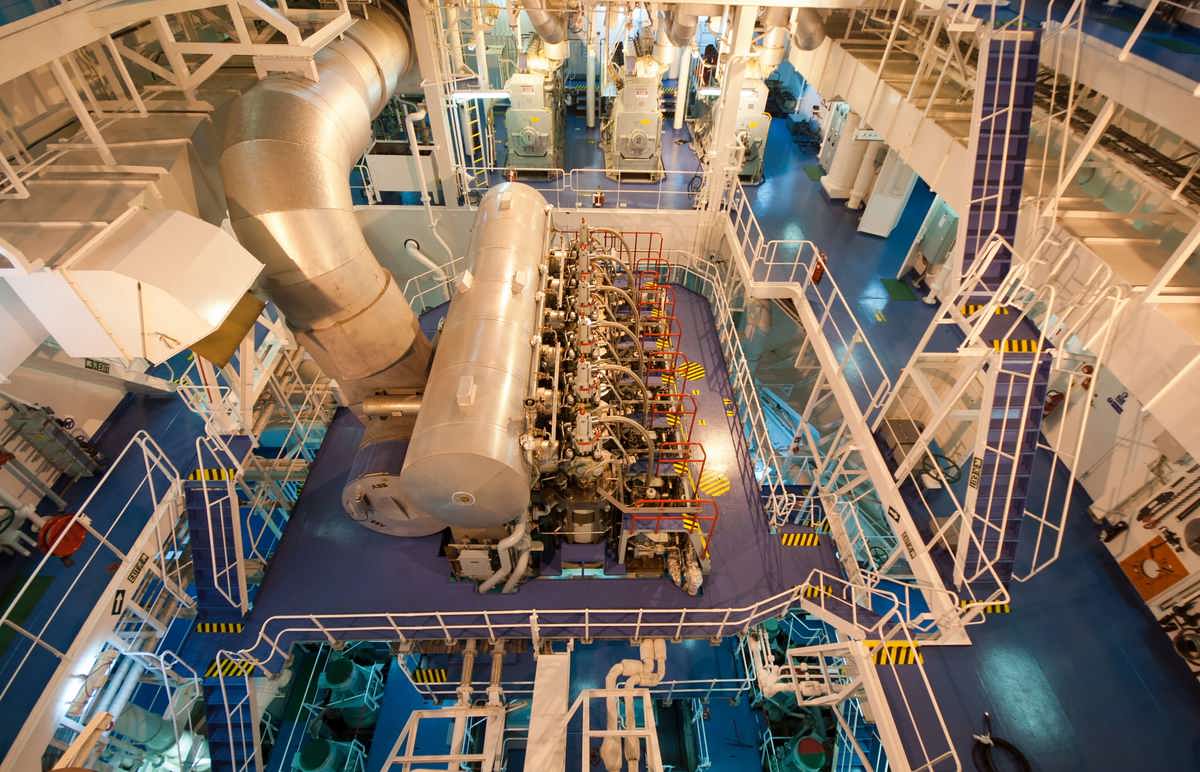 IMAGE: Inside a ship's engine room. Getty Images
Engine maker Everllence has developed a modular engine platform that can operate on conventional fuels while also allowing shipowners to retrofit to either methane or methanol dual-fuel propulsion when they think the time is right.
Everllence said the system architecture enables conversion between fuel types without requiring an entirely new engine design.
“Today’s shipowners are navigating a dual challenge: advancing the energy transition while safeguarding energy security and commercial resilience,” said Bjarne Foldager, head of two-stroke business at Everllence.
“What we are seeing… is not a shift towards a single fuel but a clear preference for flexibility,” he said.
Regulatory uncertainty, volatile global energy markets, uneven low- and zero-emission fuel supply and higher green premiums over conventional fuels continue to shape investment decisions. Fuel flexibility is becoming increasingly important for shipowners looking to invest in alternative fuel-capable vessels without committing to a single fuel option.
While the IMO has approved a draft Net-Zero Framework, uncertainty remains around the final shape of global greenhouse gas price mechanism, fuel standards and implementation timelines. At the same time, regional regulations such as the EU ETS and FuelEU Maritime are already reshaping bunker economics for some trading routes, vessel segments and fuel types.
For many shipowners, the challenge is no longer simply choosing the “right” future fuel, but ensuring vessels remain commercially viable regardless of how fuel supply chains or regulations evolve over time.
Danish shipping firm A.P. Moller–Maersk tested 100% ethanol (E100) on one of its methanol dual-fuel containerships in the first quarter.
“…successful trial using 100% ethanol underscores the potential to create greater optionality for Maersk’s dual-fuel methanol fleet,” the company added. Its current fuel mix includes biofuels and bio- and e-methanol, and Maersk expects to include liquefied biomethane (LBM) and LNG from next year.
Hapag-Lloyd started bunkering LBM when it won ZEMBA’s inaugural tender. The company eventually plans to expand its alternative fuel mix to include methanol and ammonia, Hapag-Lloyd's director of decarbonisation Arne Maibohm told ENGINE.
Other shipowners, including CMA CGM and COSCO Shipping, have also invested in LNG- and methanol-capable vessels.
Instead of forcing owners into immediate and irreversible fuel choices, engine makers are increasingly adapting designs to allow easier conversion between fuels later in a vessel’s life with fewer technical complications.
Cummins offers a methanol conversion kit that can retrofit existing engine installations to use methanol as fuel. The company said the system “dismisses the need for a major vessel overhaul”, which in practice can help lower the cost burden of shifting towards alternative fuels.
Wärtsilä recently increased the power of its four-stroke ammonia dual-fuel engine to match the output of its LNG dual-fuel engine. The company said the power increase enhanced the engine’s “retrofitability” for conversion between LNG and ammonia propulsion and would give shipowners “greater flexibility in fuel choice.”
Everllence has run its methanol dual-fuel four-stroke engine on ethanol, while WinGD has developed an ethanol engine based on its methanol engine design.
Industry observers have repeatedly argued that shipping is unlikely to converge around one dominant bunker fuel. Organisations including DNV and the Mærsk Mc-Kinney Møller Center for Zero Carbon Shipping have pointed towards a mixed-fuel future shaped by vessel type, fuel availability, regional regulations and trade routes.
Methanol, LNG, LBM, ammonia and conventional fuels are all expected to coexist in varying degrees over the coming decades, the companies have said.
A mixed-fuel future appears to be turning into a commercial reality for shipowners, who increasingly seem to be prioritising adaptability as a form of risk management during one of shipping’s most uncertain transition periods ever.
In other news this week, Indian project developer CIST Technology is planning to build a plant in India’s Maharashtra state that can produce 200,000 mt/year of bio-methanol and 100,000 mt/year of green ammonia. It aims to have the plant up and running by 2029 and supply these fuels for bunkering to ports in India and Singapore, the company told ENGINE.
South African project developer Green eFuels Producers (GeFP) plans to build a 14,300 mt/year e-methanol plant in the Vaal Special Economic Zone in the South Africa’s Gauteng Province. GeFP said it will supply the fuel to the shipping, road transport and chemical sectors.
A consortium led by Stillstrom has secured a €5 million ($5.8 million) funding to develop offshore charging infrastructure for anchored vessels operating with engines running. The project will allow vessels to plug into a power supply point with electricity provided via the Port of Skagen.
By Konica Bhatt
Please get in touch with comments or additional info to news@engine.online