The Week in Alt Fuels: The year of ammonia's dress rehearsal
Ports and regulators gear up to trial ammonia bunkering this year
Supply of low- and zero-emission ammonia molecules could trail bunker demand
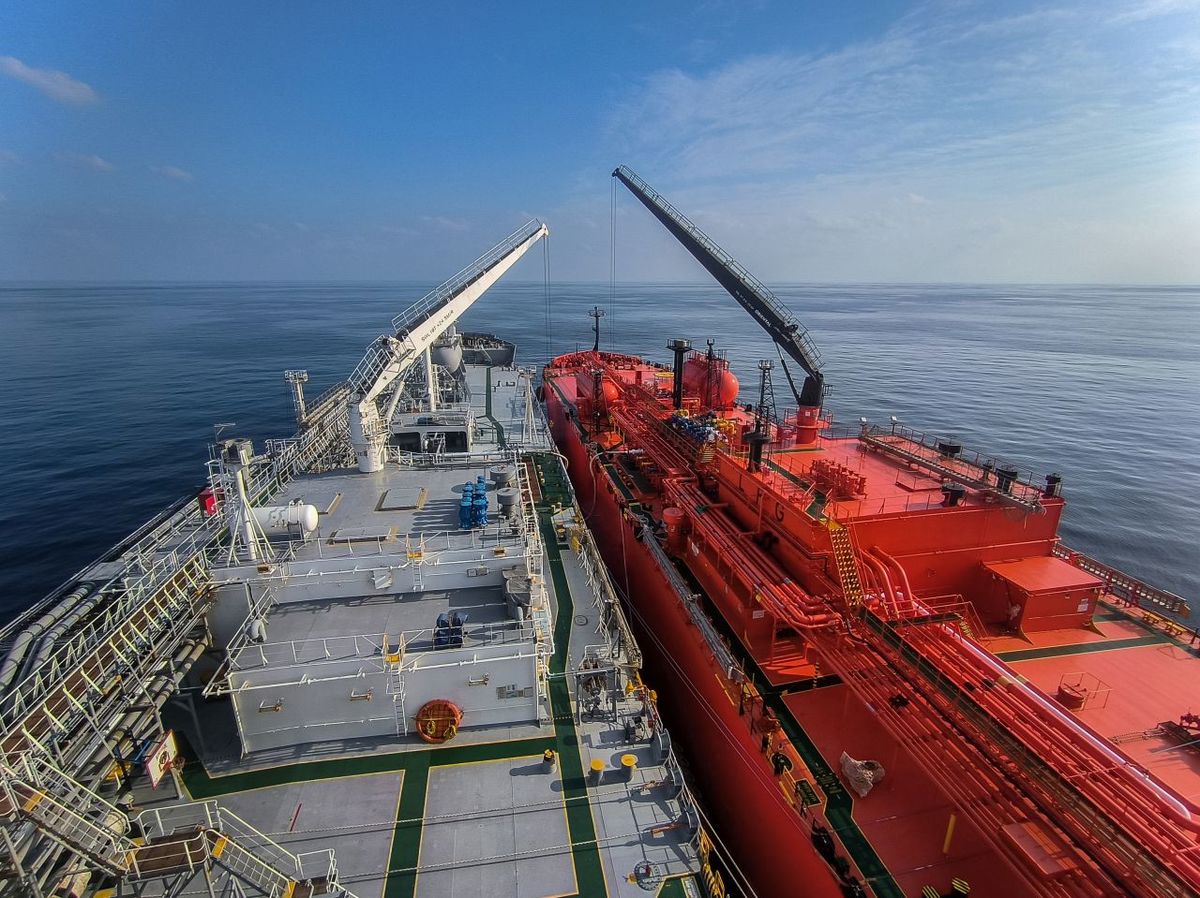 IMAGE: Ship-to-ship ammonia transfer in Sohar port, Oman. Exmar Ship Management
One of the main reasons the shipping industry is gearing up to include ammonia in its future fuel mix is its zero-emission capability when produced using green hydrogen and used onboard vessels with a biofuel pilot.
Preparations are certainly becoming more widespread.
Vessels are being ordered. Engine designs are being finalised. Safety frameworks and operational guidelines are falling into place. The IMO has issued interim guidance for using ammonia as a marine fuel.
Last year saw a few scattered instances of ammonia bunkering around the world. A truck-to-ship bunkering was carried out in the Port of Yokohama in Japan. A tank-to-ship bunkering was carried out at Singapore’s Jurong Island and a ship-to-ship (STS) ammonia bunkering operation in China’s Dalian port.
STS bunkering allows greater flexibility away from shore, which is particularly important for a toxic fuel like ammonia. It also allows for larger transfer volumes than with trucks, making it a delivery method of particular interest for the shipping industry.
STS transfer trials are quietly laying the groundwork for future STS bunker operations across multiple ports and jurisdictions. These trials provide valuable operational data, as they mirror the containment, transfer, monitoring and emergency response requirements that ammonia bunkering will demand.
Exmar has completed a large STS ammonia transfer in the Port of Sohar in Oman. NYK Line has received a 23,000 mt STS transfer off Ceuta in Spain. Trafigura and Purus undertook a smaller STS transfer in the same region. Navigator Gas carried out a similar transfer in the Port of Ngqura in South Africa.
The Global Centre for Maritime Decarbonisation (GCMD) was involved in a STS ammonia transfer trial in Australia's Port of Dampier. It later mapped out operational safety recommendations for similar transfers in Singapore and found that risks associated with these operations are “low or mitigable” if robust safeguards are in place.
Some ports have started translating this operational data into formal guidance.
Zhoushan's port authority introduced operational management guidelines in 2025 that expand permitted fuels for waterborne refuelling to include ammonia. Singapore's port authority is expected to draw on GCMD’s findings for its own ammonia bunkering pilot this year.
Rotterdam's port authority is also gearing up for ammonia bunkering this year.
Taken together, these ports, classification societies and operators appear to be building a safety and operational playbook for ammonia bunkering well before the fuel becomes widely available for ships.
But project data suggests that large volumes of green ammonia could only become available for bunkering towards the end of the decade.
According to the Ammonia Energy Association, more than 600 low- and zero-emission ammonia projects have been announced globally. Yet only around 6.3 million mt/year of capacity was online as of late 2025.
And it remains unclear how much of this is earmarked specifically for bunkering.
ENGINE’s analysis of planned green ammonia projects with dedicated bunkering capacity includes only one 5,000 mt/year green ammonia pilot project in Denmark, which started operations late last year. Most plants are scheduled to come online between 2027 and 2030.
This year, the industry may have clearer rules, improved handling procedures and ports preparing for pilot operations. But with 22 ammonia-capable vessels likely to enter service this year, theoretical demand could outpace available green volumes if shipowners want these vessels to run exclusively on green ammonia.
Instead, this year could serve as a dress rehearsal for ammonia bunkering, with limited volumes and controlled pilots paving the way for wider adoption once supply and demand align.
In other news this week, LNG bunkering is now available in 222 ports across the world, with 62 more ports planning to host it, a report from industry body Sea-LNG has said. The number of LNG bunker vessels in operation increased to 62 in 2025, compared to just one in 2016. There are around 38 more bunker vessels on order, Sea-LNG said.
South Korean shipping firm HMM has deployed an oil and chemical tanker equipped with a wind-assisted propulsion system (WAPS) for sea trials. It will evaluate the performance of the wind technology over the next two years, before deciding whether to roll it out across its entire bulk carrier fleet, HMM added.
Commodity trader Trafigura, ammonia producer CF Industries and bunker supplier TFG Marine have partnered to advance ammonia bunkering in the US Gulf Coast and Northwest Europe. Under the agreement, CF Industries will supply low-carbon ammonia and TFG Marine will manage the physical deliveries of the fuel.
By Konica Bhatt
Please get in touch with comments or additional info to news@engine.online


