The Week in Alt Fuels: Widening fuel gap
The gap between LNG and other alternative fuel-capable vessel orders has widened in the first quarter of 2026, as the IMO's Net-Zero Framework remains at an impasse.
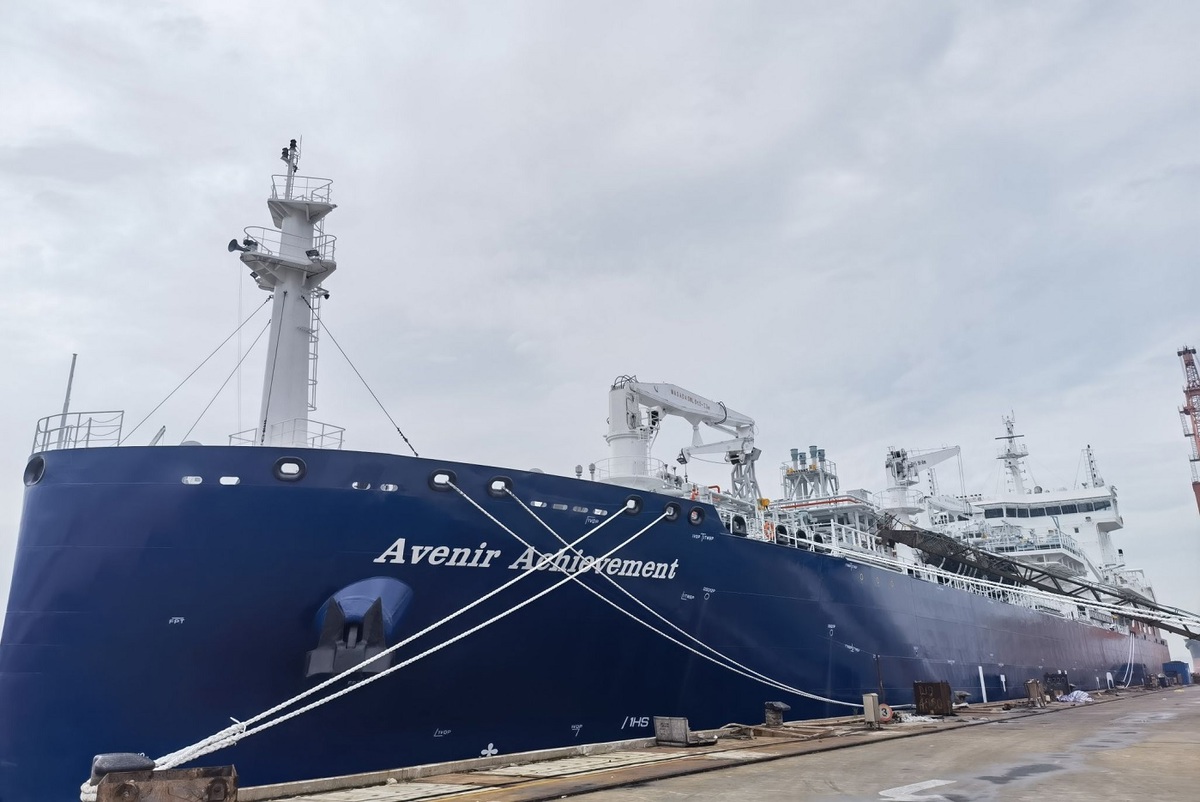 IMAGE: Avenir LNG's bunker vessel, Avenir Achievement. Avenir LNG
LNG-capable vessel orders increased sharply in the first quarter of 2026, while activity in methanol and ammonia remained subdued.
DNV data shows that 32 LNG-capable vessels were ordered in the first three months of 2026, far ahead of eight orders for LPG-capable vessels and two for methanol. No new ammonia-capable vessels were ordered in the first quarter.
Fuel supply activity around methane also picked up.
A.P. Moller-Maersk has agreed to source liquefied biomethane (LBM) from bunker supplier Avenir LNG's subsidiary Avenir Marine from 2027. Maersk has ordered at least 33 LNG-capable vessels for delivery by 2030, with the first four scheduled to be delivered this year.
Japan's Kawasaki Kisen Kaisha (K Line) has signed an agreement with an unspecified producer for long-term LBM supply.
Bunker supplier Titan Clean Fuels recently announced it will supply e-methane produced by Germany-based TURN2X for bunkering from 2028.
The stalled momentum in ammonia- and methanol-capable vessel orders should not be surprising.
Last year, industry bodies including Transport & Environment, Ammonia Europe, and the Sustainable Shipping Initiative warned that, without regulatory clarity, investment in fuels with genuine low- and zero-emission potential could slow.
And deep divisions over the Net-Zero Framework's structure, including greenhouse gas (GHG) intensity targets and economic measures, in proposals submitted to the IMO’s Marine Environment Protection Committee meeting in April show that regulatory clarity remains elusive.
This uncertainty carries particular weight for ammonia and methanol, whose demand and cost competitiveness are closely tied to regulatory signals.
Both fuels are currently caught in a chicken-and-egg loop where producers cannot justify scaling up without clear demand signals, and bunker buyers hesitate to commit without clear incentives. And the first quarter vessel order data suggests that hesitation is already beginning to show.
In other news this week, Norwegian shipping company Grieg Maritime has partnered with UK-based engineering firm GT Wings to install wind-assisted propulsion systems (WAPS) on its cargo vessel, Star Kirkenes. Under the agreement, the vessel will be equipped with two jet sails, with installation planned during a scheduled drydock in late 2026 or early 2027.
Anew Climate has completed its first LBM loading on an Avenir LNG vessel at the Port of Klaipėda in Lithuania. The company’s waste-based LBM was loaded onto Avenir LNG’s 7,500-cbm vessel, Avenir Ascension, at the LNG terminal in Klaipėda. It was then transported to Sweden for bunkering the dual-fuel vessels of Destination Gotland.
A consortium of Japanese firms has successfully completed hydrogen co-firing trials across all cylinders of a two-stroke hydrogen marine engine. The engine achieved a co-firing ratio exceeding 95% at full load, demonstrating both stable performance and significant greenhouse gas reduction. Co-firing refers to the simultaneous use of two fuels within the same system.
By Konica Bhatt
Please get in touch with comments or additional info to news@engine.online