Vale to charter two ethanol-capable ships from 2029
Brazilian miner Vale will charter two ethanol-capable vessels from China's Shandong Shipping from 2029 under a 25-year agreement that includes an option for additional ships.
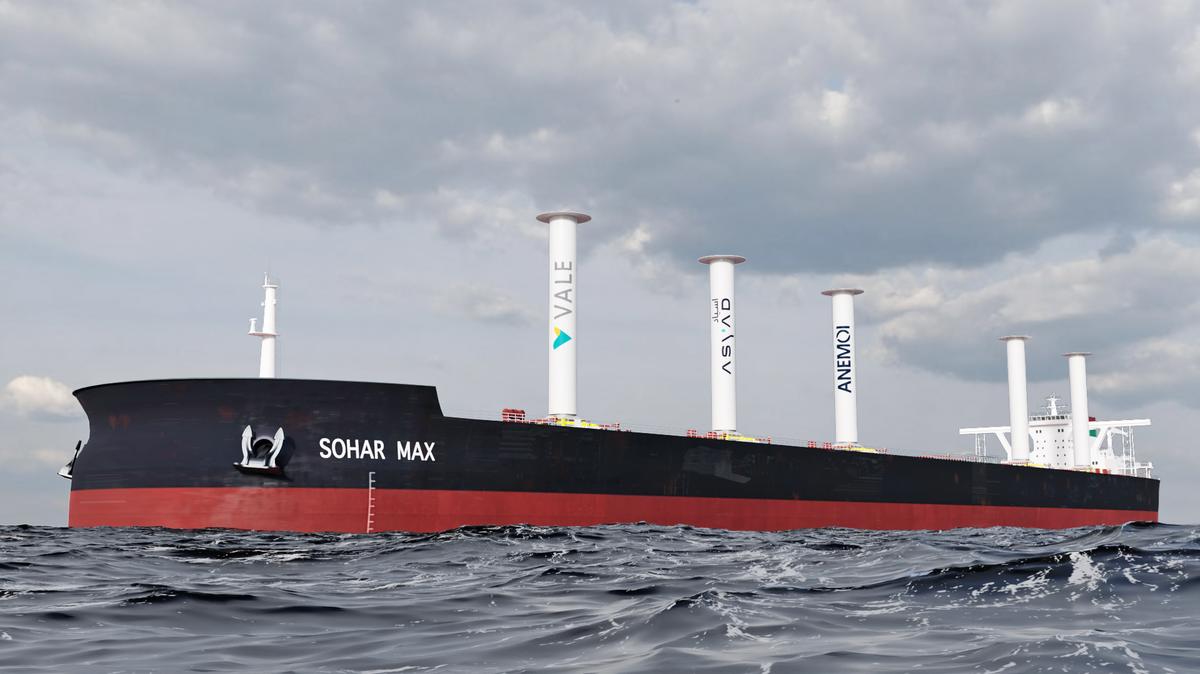 IMAGE: Vale-chartered ore carrier, Sohar Max, equipped with wind-assisted propulsion. Vale
The two 350,000-DWT ore carriers will be capable of running on ethanol, methanol and conventional fuels. They will also carry rotor sails for wind-assisted propulsion alongside other energy efficiency measures, Vale said on social media.
The design will also include an option for future ammonia retrofit, it added.
Each vessel is expected to use about 10,000 mt of ethanol per voyage to Asia, Vale's main export market for ore.
Vale estimates that combining ethanol, wind propulsion and energy efficiency measures could cut CO2 emissions by up to 90% against conventional fuels on a well-to-wake basis. That reduction, however, depends on how the ethanol is produced.
Several studies estimate that ethanol produced from sugarcane cane have a well-to-wake (WtW) greenhouse gas (GHG) intensity of 30–60 grams of CO2-equivalent per mega joule (gCO2e/MJ). If the ethanol is produced from corn it can have 43–62 gCO2e/MJ and 45–68 gCO2e/MJ if it comes from wheat.
Synthetic ethanol, produced from green hydrogen and captured CO2, can reach 22-25 gCO2e/MJ, and below 10 gCO2e/MJ when combined with carbon capture, according to IEA Bioenergy.
Complementing methanol
Vale's move comes as engine-makers such as Everllence, and shipowners, including A.P. Moller-Maersk, are testing ethanol use in existing methanol-capable engines. The appeal lies in cutting well-to-wake emissions without major modifications.
The two fuels share technical overlap that makes the idea theoretically plausible.
Methanol (11-12°C flash point) and ethanol (13°C flash point) are both alcohols with low flash points and they are liquid at ambient temperatures.Their low cetane numbers mean combustion requires a small amount of pilot fuel, typically diesel, to ignite.
But the two fuels do not behave identically in operation. Ethanol has about 30% higher energy content per kilogram than methanol, ignites more readily, burns at a slightly slower rate and generates a higher flame temperature.
And in practice, this means engines must be specifically calibrated for ethanol use, with adjustments to fuel injection systems, ignition timing and operating temperatures. A methanol-capable engine cannot automatically switch to ethanol unless its fuel-handling and safety systems are compatible.
Ethanol also presents storage challenges. It is corrosive and hygroscopic, meaning it absorbs moisture from the air.
Fuel left in tanks for extended periods can accelerate corrosion and form residues that interfere with fuel supply systems, raising maintenance needs and affecting vessel performance.
By Konica Bhatt
Please get in touch with comments or additional info to news@engine.online