Zhoushan's Hi5 spread collapses to seven-month low as HSFO supply tightens
Zhoushan's Hi5 spread has fallen by $176/mt since 2 September to $41/mt
HSFO price is up $126/mt since 21 September, while VLSFO is down $16/mt
HSFO arrivals into Zhoushan fell by 40% in September
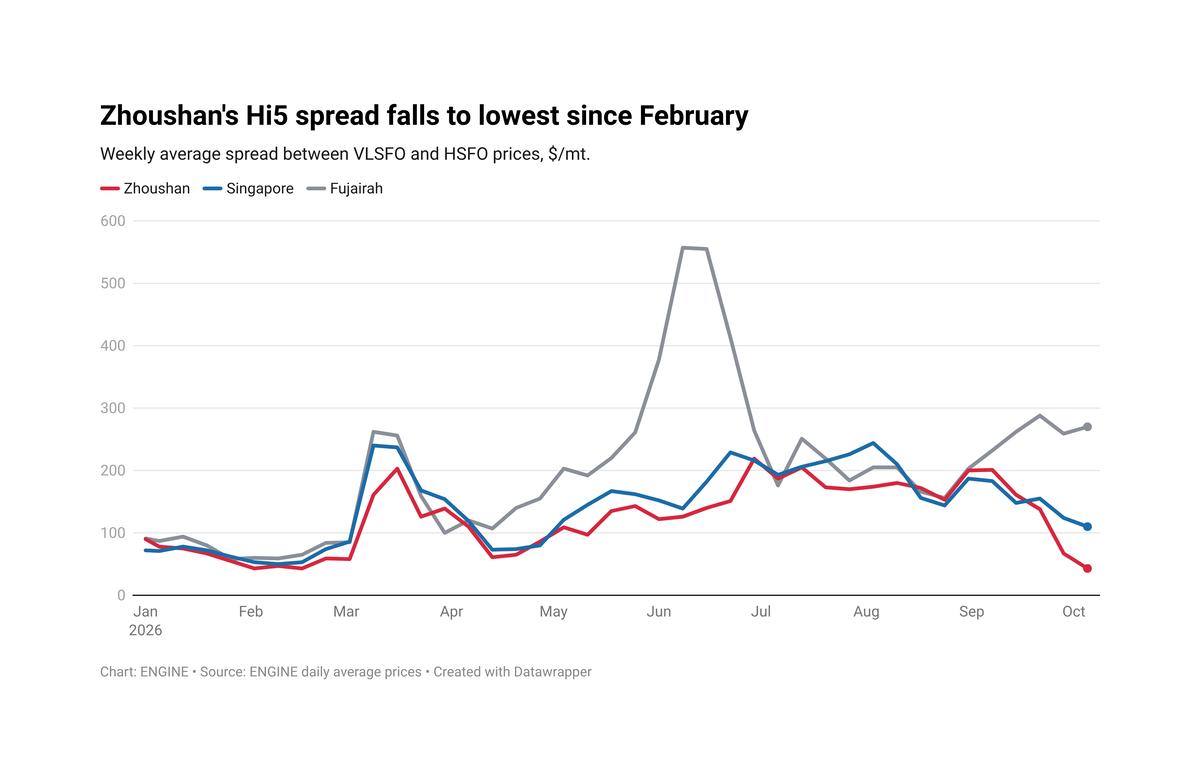
Zhoushan's Hi5 spread has narrowed to its lowest level since February, as the HSFO price at the Chinese hub has surged while the VLSFO price has eased.
The spread between VLSFO and HSFO averaged $41/mt on Tuesday, the lowest since 22 February. It was $217/mt on 2 September and peaked this year at $226/mt on 3 July.
Zhoushan's HSFO price has risen by $126/mt since 21 September to $863/mt, while VLSFO has fallen by $16/mt to $904/mt. The HSFO average price so far this month stands at $865/mt, the highest monthly average since November 2021. It is $95/mt above Singapore's HSFO price and $175/mt above Fujairah's. The rally accelerated on 23-24 September, when HSFO gained $63/mt in two days as Brent rebounded above $105/bbl.
Imports slump, availability tight
HSFO imports into Zhoushan fell by 40% in September to 63,000 b/d from 105,000 b/d in August, according to cargo tracker Vortexa data. Six cargoes arrived, down from 15 in August. Russian-origin volumes fell to 23,000 b/d from 53,000 b/d, while no Saudi cargoes were recorded, compared with 31,000 b/d in August. Arrivals have remained low in October, with two cargoes from Mexico totalling 451,000 bbl discharged since 1 October, Vortexa data shows.
Bunker fuel availability remains tight in Zhoushan despite muted demand, with several suppliers reporting low stock levels. HSFO lead times have edged up to about 15 days from 14 days last week. VLSFO lead times have shortened to around 12 days from 14 days, while LSMGO lead times have lengthened to 12 days from 10 days. Bunkering at the port's outer anchorages fully resumed on 16 September after a 22-day suspension due to typhoon-related bad weather.
A volatile year for the spread
Zhoushan's spread began the year at about $90/mt and narrowed to as little as $36/mt on 3 February.
The Iran war then lifted VLSFO prices faster than HSFO as flows through the Strait of Hormuz were disrupted. The weekly average spread rose to $161/mt in the week to 15 March from $59/mt in the week to 1 March. On a daily basis, it peaked at $221/mt on 20 March.
As prices retreated, the spread narrowed to $51/mt on 18 April. It rebuilt through May and June, then hit its 2026 high on 3 July after HSFO slid to $448/mt on 2 July while VLSFO held near $670/mt.
Singapore and Fujairah
Zhoushan's spread has mostly sat below Singapore's this year, but it was the wider of the two for five straight weeks from 17 August to 20 September.
Singapore's weekly average spread began 2026 at $72/mt, bottomed at $50/mt in the week to 15 February and peaked at $244/mt in the week to 9 August. It averaged $124/mt last week, the lowest weekly figure since the week to 10 May, and was $106/mt on Tuesday, $65/mt above Zhoushan's. Strengthening of HSFO crack had reduced some of the previously extreme gap between high- and low-sulphur fuel oil prices, a Singapore-based trader said.
Fujairah has been the outlier. Its spread started the year at about $91/mt, rose to $262/mt in the week to 15 March and peaked at $609/mt on 17 June, when VLSFO traded above $1,200/mt against HSFO at $621/mt. It was $270/mt on Tuesday, $229/mt wider than Zhoushan's.
Vortexa data shows HSFO accounted for 80% of Fujairah’s fuel oil imports through late September, with VLSFO cargoes arriving for the first time since February.
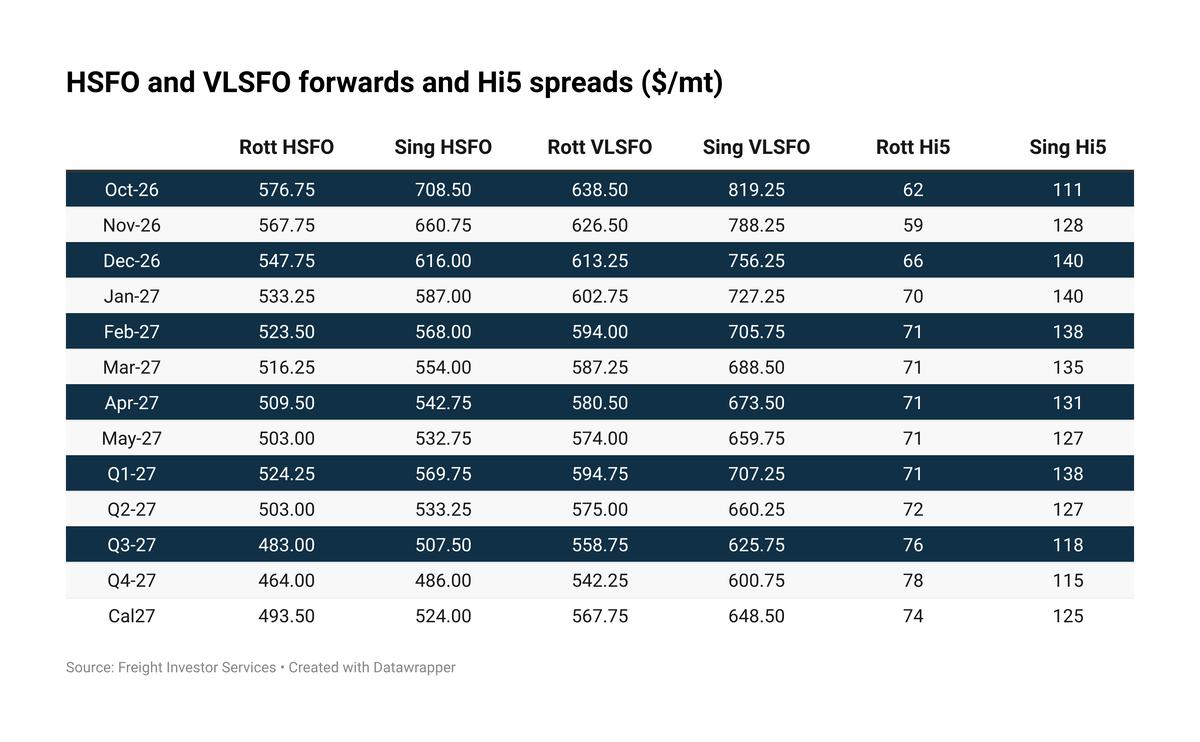
A wider Hi5 spread increases fuel cost savings for scrubber-fitted ships burning HSFO instead of VLSFO. Currently, the spread stands at $40/mt in Zhoushan, $115/mt in Singapore and $288/mt in Fujairah.
By Tuhin Roy
Please get in touch with comments or additional info to news@engine.online