UK ETS to cover emissions from international voyages
The UK government plans to expand its Emissions Trading Scheme (UK ETS) to cover emissions from international shipping, according to finance ministry budget documents.
 IMAGE: Smoke coming out of a cruise ship moored at a cruise terminal in Southampton, UK. Getty Images
The UK government proposes to include 50% of greenhouse gas (GHG) from international voyages to and from British ports in its UK ETS from 2028. The proposal will now go to a public consultation for feedback.
Shipping companies will have to hold and surrender emissions allowances to cover the GHG gases produced on their UK-linked voyages. They can buy these allowances at auctions or in secondary markets.
Companies whose total emissions are lower than their allowance holdings can sell surplus allowances, while those whose emissions exceed their holdings must buy more. The scheme is meant to create financial incentives for shipping companies to reduce their fuel consumption and shift toward cleaner fuels.
This will apply to vessels above 5,000 gross tonnes (GT) in size. A proposal to extend the scope to ships between 400 GT and 5,000 GT is also being considered.
The UK ETS has already been expanded to include 100% of emissions from domestic voyages between British ports and will be effective from July next year.
The British government suggests expanding the scheme’s reach to cover emissions from ships while they are in port, and from voyages to and from Crown Dependencies and Overseas Territories.
The proposal also considers covering 50% of emissions from offshore vessels, which are significant GHG emitters.
Northern Irish phase-in
Different emissions scopes for international and domestic voyages would mean that a vessel sailing from a port in the Republic of Ireland to the UK after July 2026 will have 50% of its GHG emissions covered under the UK ETS, while a ship sailing domestically between the UK and Northern Ireland will have 100% of its GHG emissions covered.
The UK ETS authority said this disparity in ETS obligations for vessels sailing across the Irish Sea could lead to potential rerouting via the Republic of Ireland or other gaming behaviour to avoid higher GHG emission pricing obligations.
Consequently, the authority said it will provide a 50% reduction in allowance surrenders for ships sailing between the UK and Northern Ireland.
But this exemption will only be in place until 2028, after which 100% of GHG emissions from ships sailing between the UK and Northern Ireland will be covered under the UK ETS, the government proposal said.
Exemptions are also being considered for ferries serving Scotland’s island and peninsula communities, as well as for fish-catching and fish-processing vessels.
Across the channel
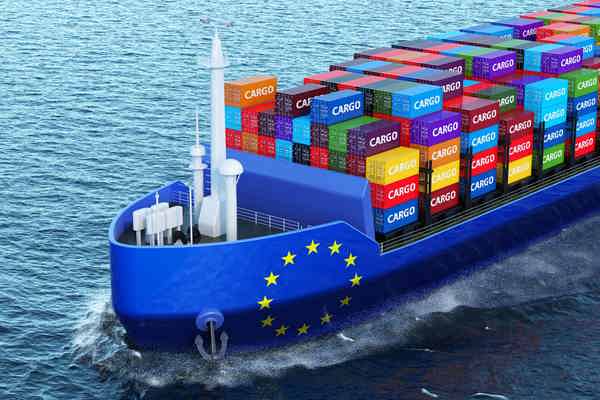
While the UK ETS is set to have a full GHG emissions scope, the EU's Emissions Trading System (EU ETS) has so far only covered carbon dioxide (CO2) emissions.
The EU ETS has covered 50% of CO2 emissions from voyages to or from EU ports since January 2024, and 100% of CO2 emissions between EU ports. Methane and nitrous oxide emissions emissions were not included from the start.
The EU ETS was only 40% phased in in 2024 and 70% phased in this year. So for example, 70% of 50% of CO2 emissions between EU and non-EU ports have counted this year.
From next year, the EU ETS will be 100% phased in and also include the other two major GHG emission types: methane and nitrous oxide.
The EU and the UK are also edging closer to linking their emissions trading schemes. In November, the European Council authorised the European Commission to open formal negotiations with London, a move that could streamline ETS compliance for shipping companies operating across both jurisdictions.
A step, but not enough
According to the budget document, the Treasury could raise around £285 million ($377 million) by 2030–2031 from bringing international maritime transport into the scheme.
"This makes the UK one of only a handful of countries globally taking meaningful action on international shipping emissions," Renewable Transport Fuel Association's maritime policy manager Jonathan Hood said.
But Hood said that emissions pricing alone will not be enough to accelerate the shift to cleaner marine fuels and technologies.
“We need the ETS working with further measures to do that. Measures like a fuel emissions intensity standard and/or low-emission fuel mandate,” he said.
By Nachiket Tekawade
Please get in touch with comments or additional info to news@engine.online